










Manorama targets FY29 contribution after FY28 commissioning
Key highlights
- Manorama targets Q3-Q4 FY28 commissioning for its expansion projects.
- New capacity is expected to start at roughly 40%-50% utilisation and contribute gradually from FY29.
- Manorama said new facilities may take 2-3 years to reach 85%-90% utilisation.
- Management said Rs 70 crore to Rs 75 crore had been invested in the projects.
powered by IRIS
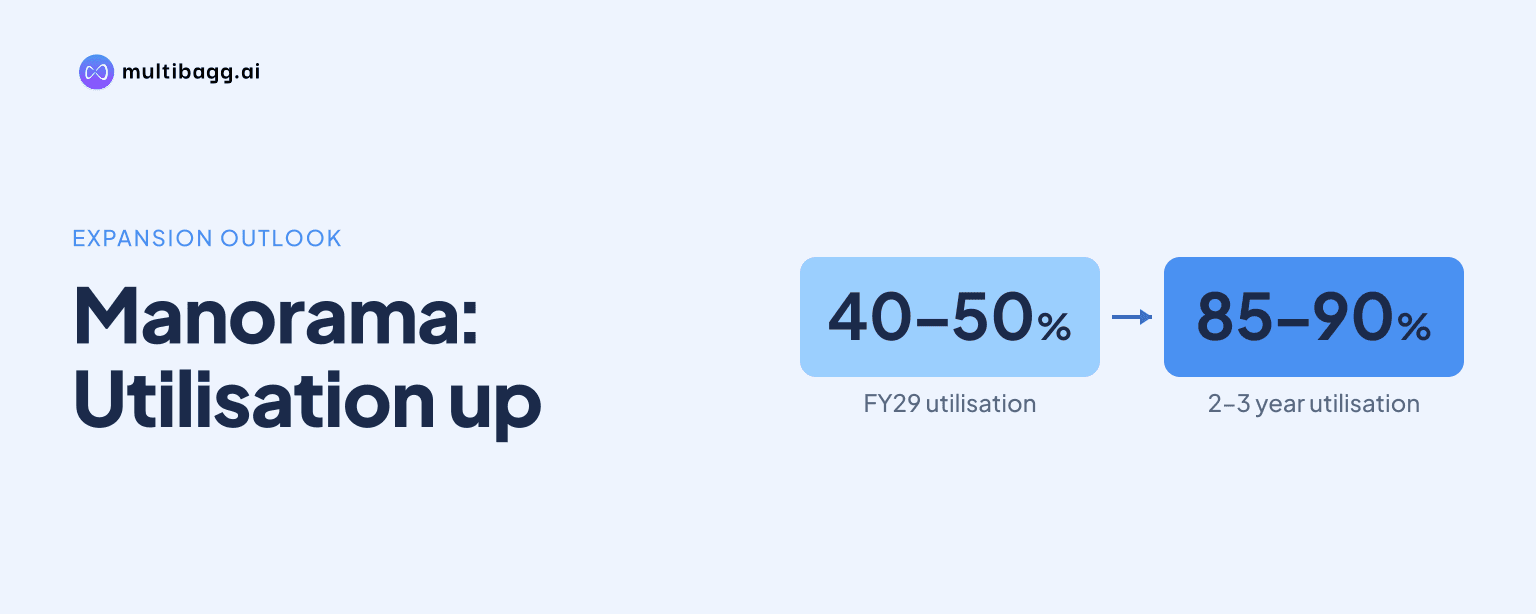
Manorama Industries Limited is targeting Q3-Q4 FY28 commissioning for its expansion projects, but management expects the new capacity to start at about 40%-50% utilisation and contribute gradually from FY29. Manorama said facilities typically need two to three years after commissioning to reach 85%-90% utilisation, based on its existing fractionation plants.
Know Manorama Industries inside out
Results, valuation, peers and who's buying, in one view.
When will Manorama commission its expansion projects?
Manorama is targeting Q3 or Q4 of FY28 for commissioning its projects, although management described this as the timeline “as of today” rather than a fixed delivery date. It said about Rs 70 crore to Rs 75 crore had been invested in the projects and that a substantial part of investment was expected during the second half of the current financial year.
Management did not specify the first production line to be commissioned, a month for start-up, or the share of the programme for which orders had been placed. An analyst referred to an overall Rs 460 crore capital-expenditure programme, but Manorama did not independently confirm or revise that amount in its reply. The Q3-Q4 FY28 timing is therefore a management target, subject to updates on the complex projects.
What stage is Manorama’s solvent fractionation project at?
Manorama said its solvent fractionation plant remains at the planning and engineering stage. Management called the projects complex because the company processes different wild-crop raw materials, each with different requirements, and said it would provide an update when developments had substantially materialised.
The current programme follows Manorama’s earlier 15,000-tonne greenfield project and a subsequent 25,000-tonne second plant. Management said it incorporated experience from the first facility into the second and now has two fractionation plants running at good utilisation. It also said it had recruited domestic and international specialists for the design and engineering work required by the current projects.
An analyst described the new programme as a geographically distributed 75,000-tonne expansion with backward and forward integration, compared with an earlier 25,000-tonne greenfield plan. Manorama did not restate those capacity figures in its answer, but said it remained focused on meeting timelines communicated to shareholders and would disclose modifications or updates if they arose.
How quickly will Manorama’s new capacity contribute to revenue?
Manorama expects new capacity to begin at roughly 40%-50% utilisation after commissioning and to contribute gradually from FY29. Management said its experience with both existing fractionation plants indicates that a new facility needs about two to three years to reach 85%-90% utilisation.
Manorama did not issue numeric revenue or earnings before interest, tax, depreciation and amortisation, or EBITDA, guidance for FY28 or FY29. Instead, management differentiated between commissioning and a mature production run-rate: existing facilities can operate at about 85%-90% utilisation, while new plants must build output over time.
Manorama said its existing capacity was operating at around 85%, including debottlenecking completed in the last or second-last quarter. Management also expects further debottlenecking to be completed by the end of the current financial year, providing an interim capacity lever before the targeted Q3-Q4 FY28 commissioning.
Got a follow-up? Ask IRIS
What will support Manorama before new plants ramp up?
Manorama said available headroom in current facilities, further debottlenecking and a possible 5%-10% price benefit could support sales before the new projects start contributing. Management said its objective for the current and following fiscal year was to utilise existing capacity optimally, but it declined to quantify a revenue-growth percentage.
Product mix is another factor cited by management. Cocoa butter equivalent, or CBE, and stearin accounted for about 75% of value contribution, compared with an earlier 65%-70% range. Manorama said the contribution from these value-added products could remain within a 70%-80% band at existing capacity, with olein, refined butters and by-products making up the balance.
Management also said its capacity was substantially booked for the next year and that it had not seen order deferrals or a demand slowdown in its product portfolio. It described its products as being in short supply, but did not provide a product-wise, customer-wise or geography-wise volume forecast that would quantify FY29 sales from the new facilities.
How could expansion affect Manorama’s EBITDA margin?
Manorama said its EBITDA margin had been in a 25%-27% range over the preceding four to six quarters, and management described that band as reasonable at present. It cautioned that margins can move modestly quarter to quarter because of macroeconomic factors and business conditions, and it gave no formal margin target for the expanded facilities.
For the longer term, management said margins should improve gradually through changes in product mix, operating leverage and economies of scale. This was a management expectation rather than numeric guidance, and its timing depends on utilisation rising from the initial 40%-50% level toward 85%-90% over the stated two-to-three-year ramp-up period.
Manorama also gave a directional asset-turnover reference rather than a revenue forecast. Management said forward-integration investments had generally delivered around 6 times asset turn, with a range of about 5-7 times depending on product mix and other factors. That reference does not establish future sales because Manorama did not disclose final project cost, line sequencing or a facility-level utilisation schedule.
Conclusion
Manorama’s expansion remains in planning and engineering, with Q3-Q4 FY28 targeted for commissioning and gradual contribution expected from FY29. The stated 40%-50% initial utilisation and two-to-three-year path to 85%-90% utilisation mean that existing facilities, debottlenecking, pricing and the 70%-80% value-added product mix remain the nearer-term operating levers.
The next points to watch are investment during the second half of the current financial year, any change to the Q3-Q4 FY28 commissioning target, and updates on project engineering and applications. After commissioning, the central operating measure will be whether new capacity progresses from 40%-50% utilisation toward the 85%-90% range management has indicated from its existing plants.