










Max Healthcare targets 10,607 beds by FY30, Rs 7,362 crore outflow
Key highlights
- Max Healthcare targets 10,607 beds by FY30, up from 6,024 beds in Aug ’26.
- Projects underway carry estimated outflow of Rs 7,362 crore through FY30.
- FY30 includes 2,631 scheduled bed additions, the largest annual increase in the plan.
- Max Healthcare identifies 4,350-plus potential beds from FY31 onward, with no formalised plans.
powered by IRIS
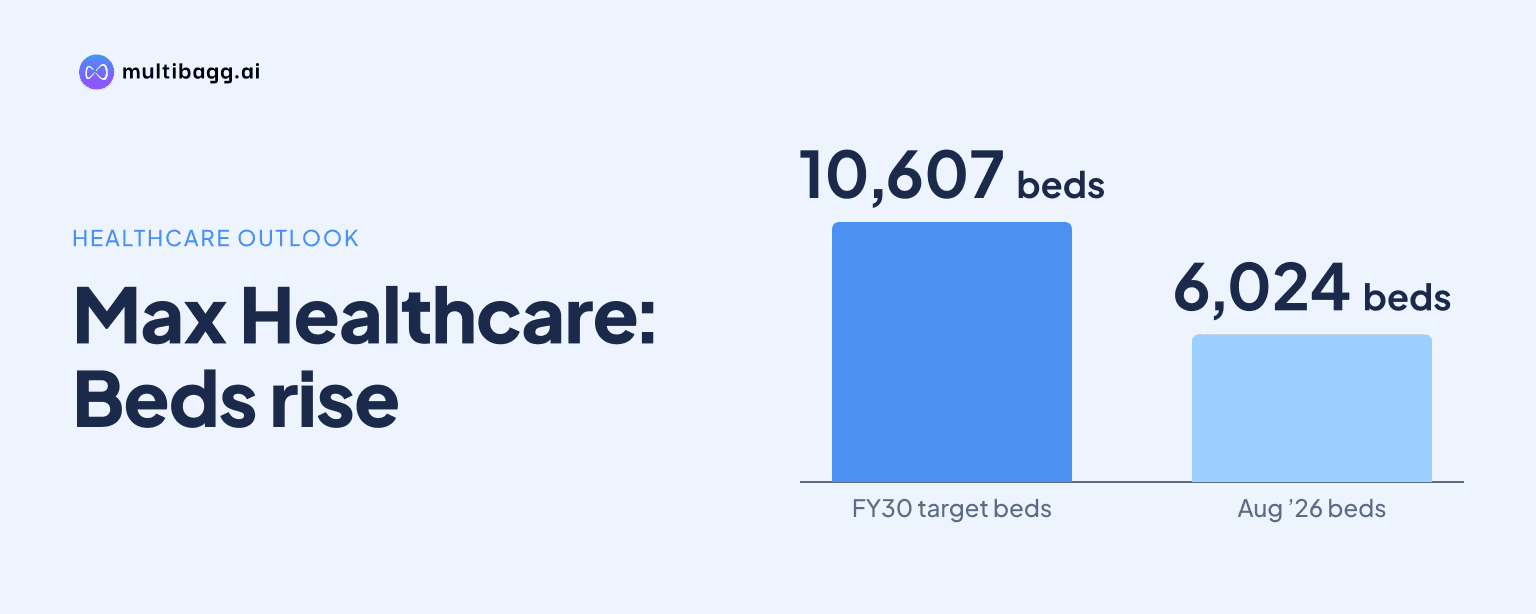
MAX Healthcare targets 10,607 beds by FY30, up from 6,024 beds in Aug ’26, and estimates Rs 7,362 crore of outflow for projects underway. The schedule places 2,631 bed additions in FY30, while a further 4,350-plus beds are only potential from FY31 onward, with no formalised expansion plans.
Know Max Healthcare Institute inside out
Results, valuation, peers and who's buying, in one view.
What is Max Healthcare’s bed-capacity target by FY30?
Max Healthcare’s detailed schedule sets out 10,607 beds by FY30, compared with 6,024 beds in Aug ’26. The difference is 4,583 beds, based on the stated opening capacity and FY30 total. The presentation’s capacity chart describes the FY30 position as 10,600-plus beds, while the detailed table gives the more precise 10,607 figure.
The company identifies brownfield expansion, greenfield hospitals and asset-light projects as routes to build capacity. Its broader growth framework describes about 4,500 beds through brownfields, about 2,000 through operations and maintenance arrangements or long leases of built-to-suit properties, and about 3,000 through greenfield hospitals over the next five years. The presentation does not reconcile those broad estimates with the FY30 project schedule.
The planned expansion follows 1,019 beds added in the preceding 12 months. Max Healthcare also reported Rs 897 crore of operating cash generation in H1 FY27 and net debt of Rs 2,369 crore as of September 30, 2026, which it cites as support for future growth and borrowing capacity.
How are Max Healthcare’s bed additions scheduled through FY30?
Max Healthcare’s detailed table schedules 601 bed additions in FY27, 500 in FY28, 851 in FY29 and 2,631 in FY30. FY30 is therefore the largest delivery year, accounting for about 57% of the 4,583-bed increase from the Aug ’26 base to the FY30 target.
The presentation contains two FY27 figures: its chart shows 501 bed additions, while the detailed bed-additions table shows 601. The 601 figure mathematically reaches the stated 10,607-bed FY30 total when added to 6,024 beds in Aug ’26 alongside the FY28, FY29 and FY30 additions. Max Healthcare does not explain the 100-bed difference.
Listed brownfield projects include Nanavati-Max, Saket Complex Smart, Gomti Nagar in Lucknow, Sector 56 Gurugram, Nagpur, Vaishali, Zirakpur in Mohali, Dwarka, Patparganj, Dehradun and Saket Complex Vikrant. Greenfield projects include Shaheed Path in Lucknow, Thane, Pitampura, Pune, and other projects identified as BLK and Vaishali.
How much outflow does Max Healthcare estimate for the projects underway?
Max Healthcare estimates Rs 7,362 crore of outflow through FY30 for projects underway. This estimate excludes land cost, routine capital expenditure at existing hospitals and capital expenditure for potential future bed additions, so it is not a full estimate of all network investment through FY30.
FY28 has the highest estimated outflow at Rs 2,764 crore, equal to about 38% of the Rs 7,362 crore total, despite carrying 500 scheduled additions. FY30 has the largest planned capacity delivery of 2,631 beds but the lowest annual outflow disclosed, at Rs 656 crore. The presentation does not provide a project-level cost schedule explaining the different timing of spending and bed additions.
For acquisitions, management states a return on capital employed, or ROCE, threshold of about 20% within four years after acquisition. It also says brownfield projects are expected to deliver more than 25% improvement in earnings before interest, tax, depreciation and amortisation, or EBITDA, through operating leverage, without giving project-specific EBITDA forecasts.
Got a follow-up? Ask IRIS
Which projects use asset-light and partner-led structures?
Max Healthcare identifies Zirakpur in Mohali, Dehradun, Thane and Pitampura as asset-light built-to-suit properties being developed by partners. The company says this structure is de-risked for time and cost overruns, while its growth strategy also includes operations and maintenance arrangements and long leases.
Patparganj and Saket Complex Vikrant are identified as partner healthcare facilities in the capacity schedule. The company notes that actual bed numbers may vary with ward configuration, making the 10,607-bed figure a disclosed target rather than an immutable final count. At Nanavati, 160 beds in an old wing were demolished and a 271-bed new tower is planned, for a net addition of 111 beds.
Max Healthcare’s May 18, 2026 acquisition of Kalinga Hospital also expanded the network. The 250-bed Chandrasekharpur facility was rebranded as Max Super Specialty Hospital, Bhubaneswar, and Max Healthcare holds about 66% of its equity share capital. The presentation includes a further 250-bed brownfield opportunity at Bhubaneswar within post-FY30 potential.
At Bhubaneswar, the upgrade programme targets operating theatres, seven intensive care unit beds and 37 ward beds by December 2026. The hospital reported FY26 revenue of Rs 154 crore, EBITDA of Rs 7 crore, 60% average occupancy and average revenue per occupied bed of Rs 29,000. These are operating figures for FY26 rather than projected returns from future expansion.
What does Max Healthcare’s 4,350-plus-bed potential after FY30 represent?
Max Healthcare identifies 4,350-plus beds as potential capacity from FY31 onward, which would take the network to about 15,000 beds when combined with the 10,607-bed FY30 target. The company explicitly says no plans have been formalised for this later expansion, and estimated outflow is yet to be firmed up.
The potential includes 250 beds at Bhubaneswar, 300 beds at Sector 56 Gurugram and 300 beds at Shaheed Path in Lucknow. Those three brownfield opportunities total 850 beds. The remaining disclosed potential comes from six land parcels with a combined 3,500-bed capacity.
Gomti Nagar in Lucknow has the largest disclosed land-bank potential at 900 beds, followed by Sector 128 Noida at 700 beds. Max Smart in Delhi, Sector 53 Gurugram and Greater Mohali each have 500-bed potential, while Greater Noida has 400 beds. No timing, capital estimate or formal project plan is provided for those six land-bank opportunities.
Conclusion
Max Healthcare’s disclosed programme would increase capacity from 6,024 beds in Aug ’26 to 10,607 beds by FY30, a 4,583-bed rise. The Rs 7,362 crore estimated outflow covers projects underway but excludes land, routine capital expenditure and potential additions after FY30. The strategy combines brownfield work, greenfield hospitals, partner-built properties and acquired capacity.
The main delivery point is FY30, when 2,631 beds are scheduled to be added despite only Rs 656 crore of disclosed annual outflow. Readers should also watch for clarification of the 501-bed and 601-bed FY27 discrepancy, and whether Max Healthcare formalises any of the 4,350-plus potential beds identified for FY31 onward.