










Max MyHealth reaches 163,200 MAUs and 33% of H1 revenue
Key highlights
- Max MyHealth monthly active users increased from 15,000 in Sep-22 to 163,200 in Sep-26.
- Max MyHealth had more than 21.0 lakh cumulative patient registrations by September 2026.
- Online marketing activities and web-based appointments accounted for about 33% of overall revenue in H1 FY27.
- More than 18,000 patients completed pre-operative assessments through Max MyHealth by September 2026.
powered by IRIS
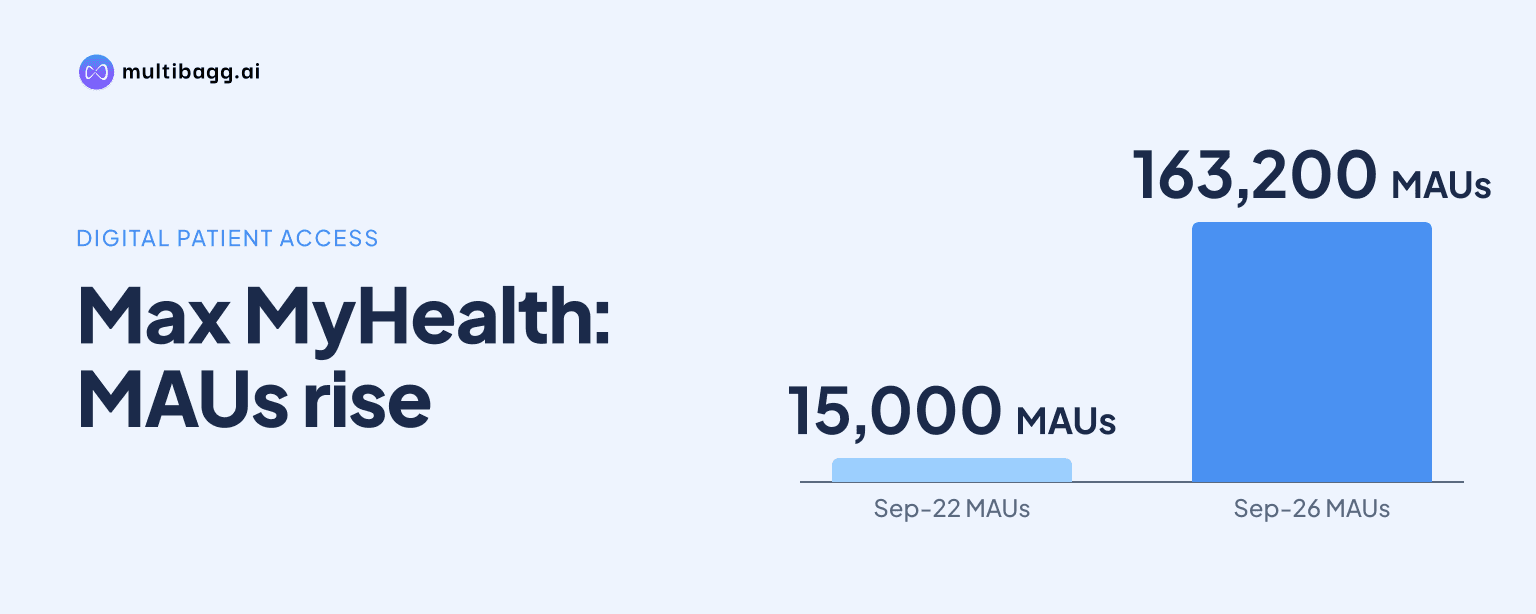
Max MyHealth reached 163,200 monthly active users in September 2026, up from 15,000 in September 2022, while digital revenue from online marketing activities and web-based appointments accounted for about 33% of overall revenue in the first half (H1) of financial year (FY) 2027.
Know Max Healthcare Institute inside out
Results, valuation, peers and who's buying, in one view.
How quickly has Max MyHealth’s user base grown?
Max MyHealth’s monthly active users (MAUs) rose almost 11-fold from 15,000 in September 2022 to 163,200 in September 2026. The presentation labels this increase as 11x growth, based on the four-year progression shown on its MAU chart. The September 2026 figure is also presented as more than 163,000, indicating a larger active audience than in September 2022.
Max MyHealth had recorded more than 21.0 lakh patient registrations by September 2026. Registrations are cumulative, whereas the 163,200 MAU figure measures monthly usage, so the two measures are not interchangeable. The presentation does not provide quarterly MAU figures between September 2022 and September 2026, but identifies the end-to-end increase as 11x.
How much revenue comes through Max MyHealth’s digital channels?
About 33% of overall revenue in H1 FY27 came from digital revenue through online marketing activities and web-based appointments, according to the presentation. This shows that the specified digital acquisition and booking routes were linked to revenue during the six-month period, rather than serving only appointment administration or patient support.
The disclosure does not state that one-third of revenue came solely through the Max MyHealth app. It combines online marketing activities with web-based appointments, and provides no rupee value, H1 FY26 comparison or split between marketing-led demand and web bookings. The reported measure therefore establishes channel contribution in H1 FY27, but does not quantify Max MyHealth’s standalone revenue contribution.
Max MyHealth lists appointment booking, lab-test booking, instant consults, health check-ups and home healthcare booking among its options. Its service menu also includes physiotherapy, electrocardiogram (ECG), X-ray, procedure booking, nursing care and clinically defined packages, providing multiple digital entry points for hospital, diagnostic and homecare services.
What can patients do on Max MyHealth?
Max MyHealth offers booking and care-navigation functions across hospital, diagnostics and home-service needs. Its app interface lists doctor or specialty search, appointment booking, lab-test booking and instant consults. It also includes immigration-related bookings, supported by a separate digital passport-submission initiative.
Max MyHealth has launched a Health Record Analyzer to provide patients with personalized insights from their health records. The presentation identifies the product launch but does not disclose user numbers, repeat usage, clinical outcomes or revenue associated with the analyzer as of September 2026. The tool extends the platform beyond booking transactions into the use of stored patient health information.
The listed service menu links Max MyHealth with care outside a hospital visit, including home healthcare, nursing care, physiotherapy, ECG and X-ray. This aligns with the omnichannel model described in the presentation, which uses the company’s brand, clinical expertise, doctor network and data to connect existing and new customers. The 21.0 lakh-plus registrations are the stated customer base able to access these services.
Got a follow-up? Ask IRIS
Which workflow changes has Max MyHealth introduced?
Max MyHealth has introduced digital passport submission for immigration bookings to reduce manual paperwork. The presentation does not quantify the reduction in processing time or paperwork volume, but identifies the mechanism: documentation for immigration bookings can be submitted digitally rather than through a manual process.
More than 18,000 patients had completed pre-operative, or pre-OP, assessments through Max MyHealth by September 2026. The presentation says these assessments helped streamline consultations. This is an operational use case beyond demand generation because it moves a preparatory clinical workflow onto the platform before a procedure-related consultation.
Max MyHealth also provides in-app outpatient department (OPD) wait-time forecasts, which the presentation describes as industry-first and accurate within plus or minus seven minutes. The source does not state the number of OPD users receiving these forecasts or whether the seven-minute measure applies across all hospitals. It shows that the platform is used to provide a time-based service expectation during a hospital visit.
What does the H1 FY27 disclosure show about the omnichannel model?
The H1 FY27 disclosure shows that Max MyHealth’s associated digital channels had become a route linked with about 33% of overall revenue. The revenue statement specifically covers online marketing activities and web-based appointments, while the platform’s functions cover doctor access, diagnostics, instant consults, immigration processes and homecare-related services. Together, these elements support the stated omnichannel approach.
The scale indicators measure different parts of that approach: more than 21.0 lakh cumulative registrations, 163,200 MAUs in September 2026 and more than 18,000 completed pre-OP assessments. The presentation does not disclose conversion rates from registrations to MAUs, from MAUs to appointments, or from bookings to revenue. It also provides no prior-period digital-revenue share, so the change in channel monetisation cannot be calculated from this presentation.
Conclusion
Max MyHealth’s disclosed data show a sharp expansion in patient engagement, with MAUs rising from 15,000 in September 2022 to 163,200 in September 2026, alongside an approximately 33% H1 FY27 revenue contribution from online marketing activities and web-based appointments. The platform combines transaction services, including appointments and lab tests, with workflow tools such as pre-OP assessments and OPD wait-time forecasts.
The next disclosed development to watch is the Health Record Analyzer, which Max MyHealth has launched to provide personalized insights from health records. The presentation provides no usage target, revenue target or rollout timetable for the tool, and it does not provide a year-on-year comparison for the 33% digital-revenue share.