










Max Healthcare H1 EBITDA rises 17% as margin holds 25.9%
Key highlights
- Max Healthcare’s H1 FY27 network operating EBITDA rose 17% to Rs 1,524 crore.
- Max Healthcare’s H1 FY27 operating EBITDA margin remained 25.9% as net revenue increased 17% to Rs 5,890 crore.
- Max Healthcare’s H1 FY27 reported EBITDA was Rs 1,480 crore, equal to a 25.1% margin.
- Max Healthcare’s H1 FY27 reported profit after tax was Rs 805 crore versus Rs 899 crore in H1 FY26.
powered by IRIS
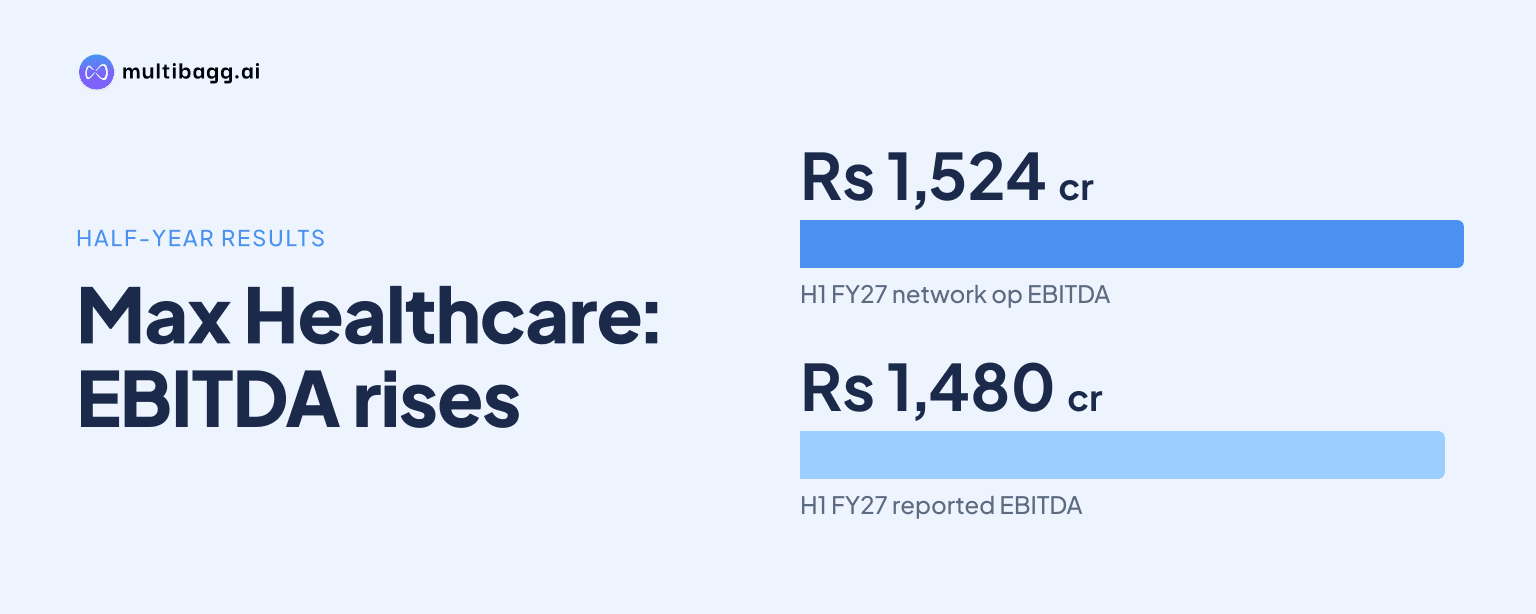
Max Healthcare Institute Limited’s network operating earnings before interest, tax, depreciation and amortisation (EBITDA) rose 17% year on year to Rs 1,524 crore in H1 FY27, while its operating EBITDA margin remained 25.9%, as net revenue grew 17% to Rs 5,890 crore.
Know Max Healthcare Institute inside out
Results, valuation, peers and who's buying, in one view.
How did Max Healthcare’s H1 FY27 revenue and operating EBITDA change?
Max Healthcare increased net revenue by 17% to Rs 5,890 crore in H1 FY27 and operating EBITDA by the same 17% to Rs 1,524 crore. Gross revenue rose 18% to Rs 6,200 crore from Rs 5,266 crore in H1 FY26, while net revenue increased from Rs 5,039 crore. Operating EBITDA represented 25.9% of net revenue in both half-year periods.
Max Healthcare’s contribution, defined in the presentation as net revenue after direct costs, rose Rs 506 crore to Rs 3,470 crore. Contribution margin edged up to 58.9% from 58.8%, because direct costs rose 17% to Rs 2,420 crore but declined slightly as a share of net revenue, to 41.1% from 41.2%.
The presentation attributes the contribution improvement primarily to lower material costs, supported by a lower institutional-bed share and a favourable case-mix shift. Those factors offset the expansion in the absolute direct-cost base, preserving the contribution margin while H1 FY27 net revenue added Rs 851 crore over the corresponding prior-year period.
Why did Max Healthcare’s operating margin remain 25.9%?
Max Healthcare held its operating EBITDA margin at 25.9% because indirect overheads grew 17%, in line with net revenue, even as their share of revenue increased only 0.1 percentage point to 33.0%. Indirect overheads rose Rs 289 crore to Rs 1,946 crore in H1 FY27, compared with Rs 1,657 crore in H1 FY26.
The company said the overhead increase included Rs 27 crore relating to Max Bhubaneswar. It also cited higher healthcare-facility fees associated with international-patient revenue growth, increased provisions for doubtful debts arising from aged receivables, and additional employee costs linked to brownfield beds commissioned at Max Mohali, Max Smart, Max Lucknow and Nanavati-Max.
The second quarter showed a similar revenue-to-profit conversion. In Q2 FY27, net revenue rose 18% year on year to Rs 3,055 crore and operating EBITDA increased 18% to Rs 820 crore, producing a 26.8% margin versus 26.9% in Q2 FY26. That was higher than the 24.8% margin recorded in Q1 FY27, when operating EBITDA was Rs 704 crore.
Q2 FY27 contribution margin reached 59.4%, compared with 58.9% a year earlier, while direct costs were 40.6% of net revenue versus 41.1%. Indirect overheads were Rs 995 crore, or 32.6% of net revenue, compared with Rs 826 crore, or 32.0%, in Q2 FY26. The quarterly data therefore show a higher contribution margin alongside a higher overhead ratio.
Got a follow-up? Ask IRIS
What happened to Max Healthcare’s reported EBITDA and profit after tax?
Max Healthcare’s reported EBITDA rose 17% to Rs 1,480 crore in H1 FY27, but its margin was 25.1%, marginally below 25.2% in H1 FY26. The difference from operating EBITDA reflected Rs 29 crore of expense under its equity-settled employee stock option plan (ESOP) and Rs 16 crore for movement in fair value of contingent consideration payable and amortisation of contract assets.
In H1 FY26, the corresponding deductions were Rs 27 crore for ESOP expense and Rs 13 crore for the contingent-consideration and contract-asset item. As a result, reported EBITDA increased from Rs 1,268 crore to Rs 1,480 crore, while the gap between operating and reported EBITDA widened from Rs 40 crore to Rs 44 crore.
Profit before tax increased 10% to Rs 1,051 crore, a slower rate than operating EBITDA growth. Net finance cost rose to Rs 117 crore from Rs 75 crore, while depreciation and amortisation increased to Rs 312 crore from Rs 239 crore. Max Healthcare attributed the higher depreciation and amortisation to capitalisation of brownfield projects at Max Mohali, Max Smart, Nanavati-Max and Max Lucknow.
Reported profit after tax was Rs 805 crore in H1 FY27, compared with Rs 899 crore in H1 FY26. The presentation labels profit-after-tax growth as 7% after normalising for a one-time tax gain of Rs 149 crore, while also reporting an effective tax rate of 23.5% in H1 FY27 against 21.4% in H1 FY26. Tax expense was Rs 247 crore, compared with Rs 55 crore in the prior-year half.
What does Max Healthcare’s network financial result include?
Max Healthcare’s network result combines Max Healthcare Institute Limited, its subsidiaries, deemed separate entities or silos for managed healthcare facilities, and partner healthcare facilities (PHFs). Management presents this memorandum consolidation because the group has financial exposure to the PHFs and considers the combined network presentation appropriate for showing operating performance indicators.
The company states that PHFs are not owned or controlled by Max Healthcare under Indian Accounting Standard 110, or Ind AS 110. Their financial statements are prepared under Indian generally accepted accounting principles and then combined with the company’s reviewed financials, with intra-network eliminations and Ind AS adjustments. An independent chartered-accountancy firm certifies the consolidated network information.
For H1 FY27, Max Healthcare Institute Limited and its subsidiaries and silos generated operating EBITDA of Rs 1,368 crore in the memorandum consolidation. The presentation listed operating EBITDA of Rs 6 crore for Balaji Society, Rs 62 crore for GM Modi Society and Rs 58 crore for Devki Devi Society, alongside Rs 25 crore of eliminations and adjustments, producing network operating EBITDA of Rs 1,524 crore.
The network approach also affects the interpretation of revenue and costs. In the H1 FY27 memorandum consolidation, total operating income was Rs 5,890 crore after Rs 363 crore of eliminations and adjustments, while total expenses were Rs 4,366 crore after Rs 388 crore of such adjustments. The eliminations include PHF revenue and intra-network sales and purchases, as well as related effects on amortisation.
Conclusion
Max Healthcare’s H1 FY27 result combined Rs 216 crore of operating EBITDA growth with an unchanged 25.9% operating margin, but reported EBITDA deductions widened to Rs 44 crore from Rs 40 crore. Higher finance cost, depreciation and tax meant profit before tax increased 10% to Rs 1,051 crore while reported profit after tax was Rs 805 crore.
The next results will show whether staffing costs at the brownfield beds commissioned at Max Mohali, Max Smart, Max Lucknow and Nanavati-Max continue to affect overheads. Receivables are also a disclosed matter to watch: days sales outstanding were 93 days at the end of September 2026, compared with 87 days at the end of March 2026, while management cited aged debts in its doubtful-debt provisions.