










Max Lab’s non-COVID net revenue rose to ₹201 crore in FY26
Key highlights
- Max Lab’s non-COVID net revenue increased from ₹41 crore in FY20 to ₹201 crore in FY26.
- Max Lab reported ₹124 crore of net revenue and served more than 13 lakh patients in H1 FY27.
- Max Lab had more than 690 collection centres, more than 990 pick-up points and 55 processing laboratories as of September 30, 2026.
- Max Lab reported Q2 FY27 EBITDA of ₹10 crore and an EBITDA margin of 15%.
powered by IRIS
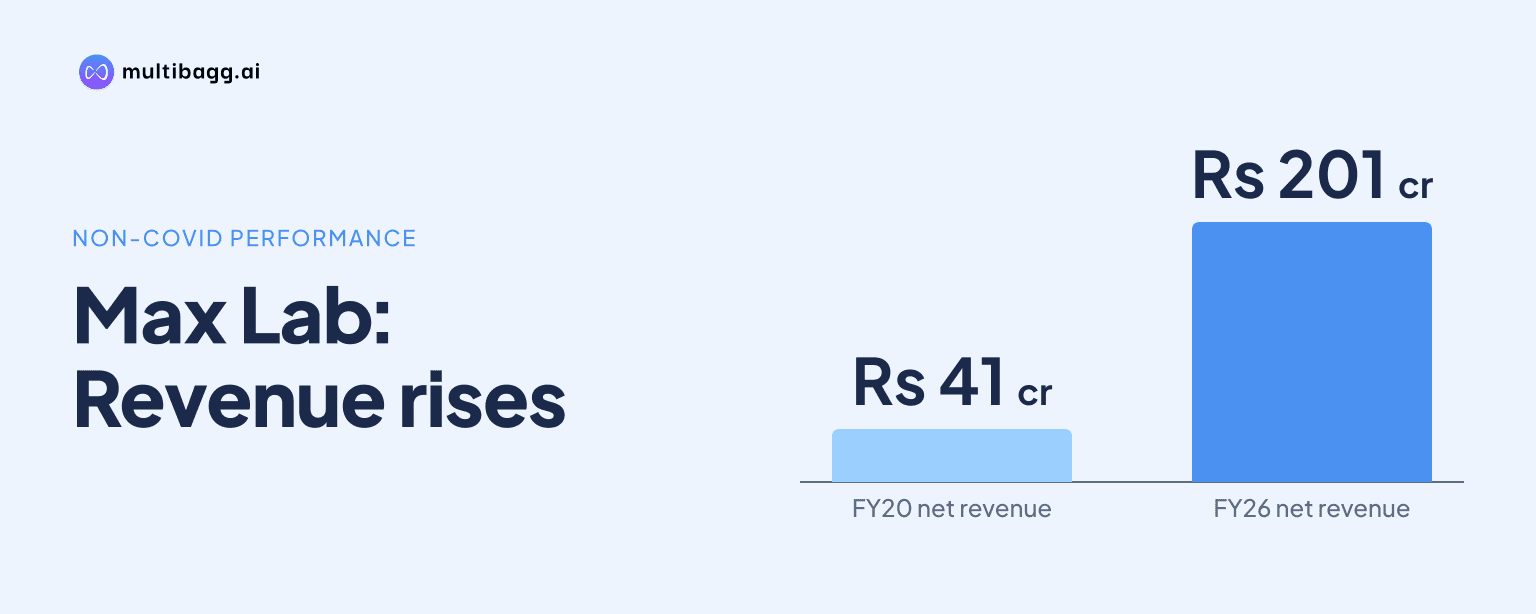
Max Lab – non-captive pathology SBU reported ₹201 crore of non-COVID net revenue in FY26, up from ₹41 crore in FY20, and described the six-year trajectory as a 30%+ compound annual growth rate. In H1 FY27, Max Lab reported ₹124 crore of net revenue and served more than 13 lakh patients.
Know Max Healthcare Institute inside out
Results, valuation, peers and who's buying, in one view.
How fast did Max Lab’s non-COVID revenue grow?
Max Lab’s non-COVID net revenue increased by ₹160 crore between FY20 and FY26, rising from ₹41 crore to ₹201 crore. The presentation describes this FY20-to-FY26 progression as a 30%+ six-year compound annual growth rate, with revenue increasing to ₹72 crore in FY22, ₹109 crore in FY23, ₹143 crore in FY24 and ₹175 crore in FY25.
The composition of revenue changed after FY21, when COVID-19 and related testing contributed ₹66 crore while non-COVID revenue was ₹39 crore. By FY23, non-COVID revenue had risen to ₹109 crore and COVID-19 revenue had fallen to ₹4 crore. The presentation shows no COVID-19 revenue figure for FY25, FY26 or H1 FY27, leaving the reported total revenue aligned with the non-COVID business in those periods.
H1 FY27 revenue of ₹124 crore was more than half of FY26’s ₹201 crore, although the periods cover six months and 12 months respectively. The source does not provide a full-year FY27 revenue target or guidance. It does, however, show that H1 FY27 revenue exceeded the ₹113 crore total recorded for all of FY23.
How large was Max Lab’s network at September 30, 2026?
Max Lab operated more than 690 collection centres, more than 990 pick-up points and 55 test processing laboratories across 63 cities as of September 30, 2026. The pathology network also had more than 1,750 active partners, supporting the non-captive diagnostics business that generated ₹124 crore of net revenue in H1 FY27.
Max Lab served more than 13 lakh patients in H1 FY27, a six-month volume measure rather than a full-year count. The presentation does not provide the number of tests per patient, revenue per patient, or a split of patients between collection centres, pick-up points and hospital laboratories. Those omissions prevent a direct calculation of network productivity from the disclosed ₹124 crore of H1 FY27 revenue.
Digital revenue grew 28% year on year in H1 FY27, according to the presentation. Max Lab does not disclose the rupee value of this digital revenue or its share of H1 FY27 net revenue. The growth rate therefore identifies expansion in the channel without quantifying its contribution to the pathology unit’s ₹124 crore half-year revenue.
Got a follow-up? Ask IRIS
What did Max Lab report for EBITDA and margin?
Max Lab reported earnings before interest, tax, depreciation and amortisation, or EBITDA, of ₹10 crore and an EBITDA margin of 15% in Q2 FY27. This was the highest quarterly EBITDA amount in the five-quarter series shown, exceeding ₹7.6 crore in Q2 FY26, ₹6.3 crore in Q3 FY26, ₹8.6 crore in Q4 FY26 and ₹8.4 crore in Q1 FY27.
The EBITDA margin ranged from 13% to 17% across the five disclosed quarters. It rose from 13% in Q3 FY26 to 17% in Q4 FY26, before settling at 15% in both Q1 and Q2 FY27. Q2 FY27 EBITDA was ₹2.4 crore higher than in Q2 FY26, while the margin was 1 percentage point lower than the 14% reported a year earlier.
The presentation calculates EBITDA margin on net revenue. For samples tested in hospital laboratories, Max Lab and hospitals have used a 60:40 arm’s-length revenue share from FY23 onwards. That accounting mechanism means the disclosed margin is based on the pathology unit’s net revenue under the sharing arrangement rather than an undisclosed gross billing figure.
What diagnostic market backdrop does Max Lab face?
Max Lab operates in an Indian diagnostics industry valued at ₹48,000 crore to ₹49,000 crore in FY24, according to the presentation’s market data. Pathology accounts for 56% of the industry, while the overall diagnostics market increased from ₹27,500 crore in FY17 to ₹44,100 crore in FY23, a period for which the presentation cites 8% to 9% compound annual growth.
The presentation estimates the diagnostics market could reach ₹70,000 crore to ₹75,500 crore by FY28E, where E denotes estimate, implying a cited 9% to 11% compound annual growth rate from FY24. It says organised diagnostics players are expected to grow faster than the overall industry, attributing the shift to preference for higher quality and brands. The source does not disclose Max Lab’s market share, a FY28E revenue target or a projected market-share outcome.
Hospital laboratories account for 36% to 40% of the provider mix, standalone centres for 35% to 39%, and diagnostics chains for 20% to 24%, according to the presentation. Within diagnostics chains, multi-regional chains account for 34% to 38% and regional chains for 62% to 66%. Max Lab’s 63-city presence provides a network measure, but the source does not place it within either chain category.
Conclusion
Max Lab’s FY26 result shows a pathology business that has shifted away from the COVID-19 testing revenue seen in FY21, when such tests generated ₹66 crore. Non-COVID net revenue reached ₹201 crore in FY26, supported by a network of more than 690 collection centres, 55 processing laboratories and more than 13 lakh patients served in H1 FY27. Q2 FY27 EBITDA was ₹10 crore at a 15% margin.
The next disclosed markers are the quarterly EBITDA margin range of 13% to 17%, H1 FY27 digital-revenue growth of 28%, and the market estimate of ₹70,000 crore to ₹75,500 crore by FY28E. Management has not disclosed a specific FY27 or FY28E revenue, margin, patient-volume or market-share target for Max Lab, leaving subsequent periodic disclosures as the measure of progress.