










Maximus H1 revenue rises 39% while EBITDA margin falls to 7.74%
Key highlights
- Maximus H1 FY27 revenue reached Rs 118.64 crore, nearly 39% above approximately Rs 85 crore in H1 FY26.
- H1 FY27 EBITDA margin fell to 7.74% from 10.18%, a decline of 244 basis points.
- H1 FY27 net profit declined to Rs 4.10 crore from Rs 5.12 crore a year earlier.
- The Middle East supplied approximately 58% of Maximus geographical revenue, while East Africa contributed 34%.
powered by IRIS
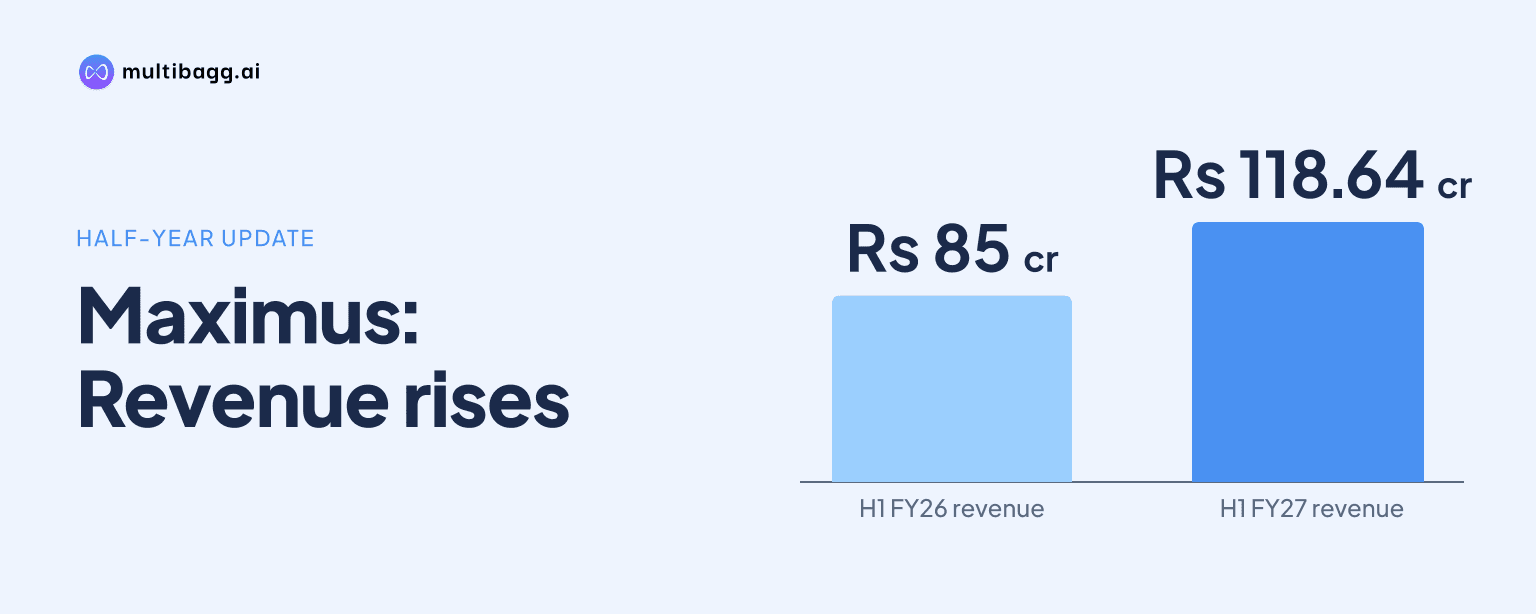
Maximus International Limited reported H1 FY27 revenue of Rs 118.64 crore, nearly 39% higher year on year, but EBITDA margin fell to 7.74% from 10.18% as Middle East geopolitical tensions caused base-oil price volatility and increased logistics and distribution costs.
Know Maximus International inside out
Results, valuation, peers and who's buying, in one view.
How did Maximus perform in H1 FY27?
Maximus increased consolidated revenue from operations to Rs 118.64 crore in H1 FY27 from approximately Rs 85 crore in the corresponding period of FY26. Management described the increase as nearly 39%, despite disruption in a region that accounted for approximately 58% of the geographical revenue it disclosed.
Earnings before interest, tax, depreciation and amortisation, or EBITDA, rose more slowly than revenue. H1 FY27 EBITDA was Rs 9.18 crore, up 5.65% from Rs 8.69 crore a year earlier, while net profit declined to Rs 4.10 crore from Rs 5.12 crore. The difference between sales growth and earnings growth reflects the higher input, logistics and distribution costs identified by management.
The H1 comparison shows EBITDA increased by Rs 0.49 crore while revenue rose by roughly Rs 33.64 crore. Maximus did not provide a volume split, pricing trend or segment-level profit disclosure for lubricant manufacturing, petrochemical trading and toll blending, so the call does not identify the precise source of the revenue increase.
Why did Maximus EBITDA margin fall to 7.74%?
Maximus said its H1 FY27 EBITDA margin fell because Middle East geopolitical tensions created volatility in base-oil prices and raised logistics and distribution expenses. Base oil is a key raw material for the company, affecting the cost of both lubricant manufacturing and petrochemical trading.
The EBITDA margin declined by 244 basis points, or 2.44 percentage points, from 10.18% in H1 FY26 to 7.74% in H1 FY27. Management attributed the reduction to raw-material and freight-related pressures rather than to a stated demand decline, and said the same factors affected operating margins during Q2 FY27.
The quarterly figures indicate that the cost pressure continued into Q2 FY27. Revenue from operations increased 28% year on year to Rs 58.74 crore, while EBITDA was Rs 4.60 crore and net profit was Rs 2.05 crore. Maximus did not disclose Q2 FY26 EBITDA, net profit or margin figures during the call, preventing a direct quarterly profitability comparison.
Management said it was pursuing operating efficiency while continuing its expansion programme in FY27. It did not issue a formal FY27 margin forecast, but said it was aiming for a 50-basis-point to 100-basis-point margin improvement through better use of available financing, new trading opportunities and changes to customer credit methodology and terms.
Got a follow-up? Ask IRIS
Where is Maximus exposed to Middle East disruption?
Maximus derives approximately 58% of its disclosed geographical revenue from the Middle East, while East Africa contributes 34%. Those regions together represented approximately 92% of the geographical revenue mix disclosed by management, making base-oil supply, freight and distribution conditions in those markets relevant to the H1 FY27 cost base.
The company manufactures, trades and distributes automotive, industrial and specialised base-oil and petrochemical products. Its combined manufacturing capacity in the United Arab Emirates and Kenya is approximately 50,000 kilolitres, and management said the two locations provide access to international markets in the Middle East and East Africa.
Maximus serves more than 400 customers across more than 25 countries and over 50 industries, with more than 200 products. Its three verticals are lubricant manufacturing, petrochemical trading, and toll blending, which provides contract manufacturing and private-label lubricant blending services for multinational brands.
The revenue mix helps explain management's focus on both commodity and freight costs. Middle East tensions were said to affect the price of base oils as well as logistics and distribution expenses, while the UAE and Kenya facilities support the regions producing the bulk of the disclosed geographical revenue.
What expansion plans has Maximus disclosed for FY27?
Maximus has disclosed a proposed export-oriented manufacturing facility and product-development centre near Vadodara in India. The board has approved the proposal, and management said it was exploring acquisition of industrial land to manufacture advanced and high-performance lubricants.
The proposed India site forms part of Maximus's Vision 2030 strategy to expand manufacturing capabilities, international-market penetration and premium specialty lubricants. Management also cited automated blending systems, additional storage infrastructure and high-speed packaging lines as measures intended to improve operational efficiency and support higher volumes.
In Kenya, Maximus plans to commission a grease manufacturing facility during the third quarter of FY27. The company is also exploring Tanzania, starting with warehousing and distribution operations and adding manufacturing only when it reaches an appropriate stage above break-even, according to management.
Management said these initiatives are intended to expand the product portfolio and regional presence while maintaining financial discipline. The call did not disclose capital expenditure, funding requirements, a commissioning date for the proposed Vadodara facility, or expected revenue from the Kenya grease project.
Conclusion
Maximus combined nearly 39% H1 FY27 revenue growth with a decline in EBITDA margin and net profit, showing that increased sales did not fully offset higher base-oil, logistics and distribution costs. The 244-basis-point margin decline is particularly relevant because the Middle East, where management cited geopolitical disruption, supplied approximately 58% of disclosed geographical revenue.
The next disclosed milestones are the planned Kenya grease-facility commissioning in Q3 FY27, progress on industrial-land acquisition for the proposed Vadodara facility and planned Tanzania warehousing and distribution operations. Management also said it aims for a 50-basis-point to 100-basis-point margin improvement and indicated a consolidated revenue objective above Rs 225 crore, subject to Middle East tensions not worsening or extending further.