










Maximus International plans Tanzania entry and Kenya grease unit
Key highlights
- Maximus plans to commission a grease manufacturing facility at its Kenya plant in Q3 FY27.
- Maximus reports 50,000 KL of owned blending capacity across the United Arab Emirates and Kenya.
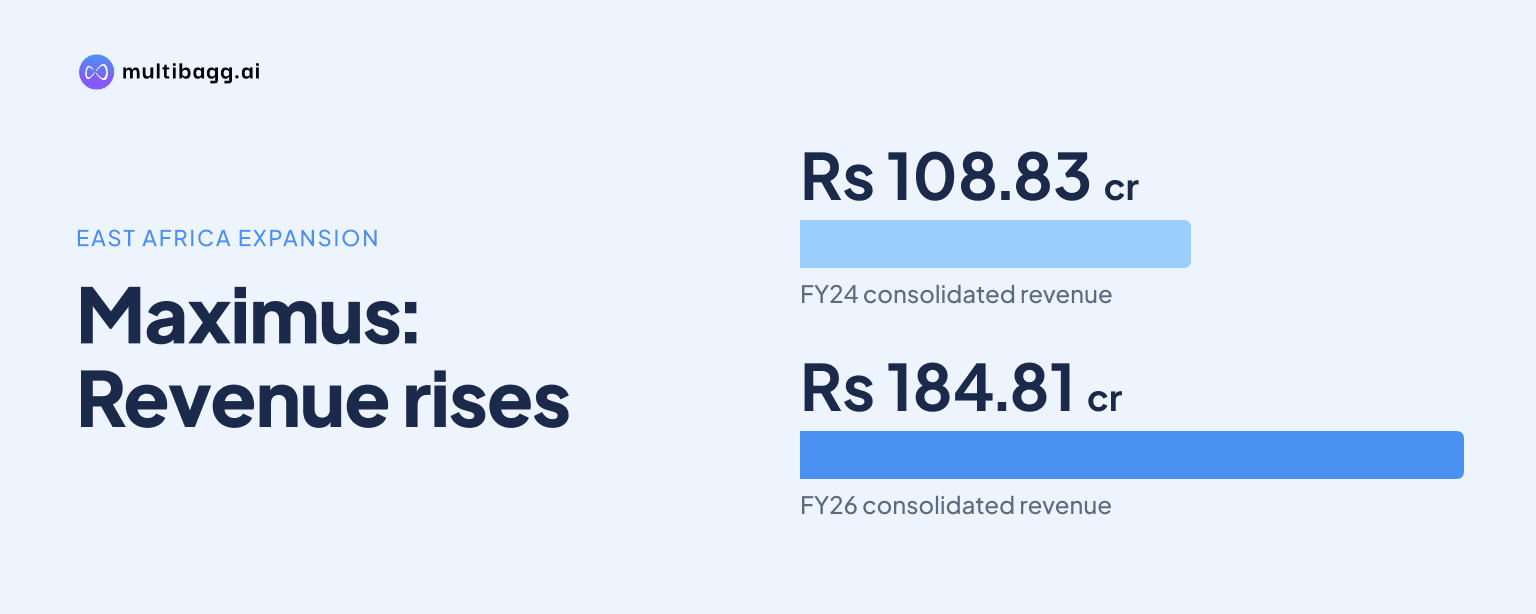
- Consolidated revenue rose from Rs 108.83 crore in FY24 to Rs 184.81 crore in FY26.
- Maximus plans two new East African manufacturing facilities without disclosing locations or capacities.
powered by IRIS
Maximus International is planning a phased Tanzania entry beginning with warehousing and distribution, while targeting a grease manufacturing facility at its Kenya plant in Q3 FY27 and two additional East African facilities. The plan extends Maximus's existing 50,000 kilolitres (KL) of owned blending capacity in the United Arab Emirates and Kenya.
Know Maximus International inside out
Results, valuation, peers and who's buying, in one view.
What is Maximus's Tanzania entry plan?
Maximus plans to enter Tanzania through warehousing and distribution before moving into manufacturing at an appropriate stage. Its SWOT analysis identifies a proposed Tanzania blending plant and says the warehousing and distribution facility is proposed in Q3, although it does not state the financial year for that milestone.
The presentation does not disclose Tanzania's proposed plant location, capacity, investment, construction date or commissioning schedule. Maximus presents the sequence as a phased market-expansion plan, rather than as an immediately committed manufacturing start, alongside its stated geographic ambitions in East Africa, the Gulf Cooperation Council, North Africa and South-East Asia.
Tanzania would add to, rather than replace, Maximus's existing manufacturing footprint in the United Arab Emirates and Kenya. The company identifies manufacturing access to Middle Eastern and African markets as a strength, while its Vision 2030 plan calls for broader penetration in domestic and international markets.
How will Maximus add East African manufacturing capacity?
Maximus says it plans two new manufacturing facilities in East Africa to expand regional capacity and strengthen its market presence. The presentation does not identify the two locations, their production capacity, capital expenditure, timing or whether the proposed Tanzania blending plant is included in that total.
The two-facility plan sits within Vision 2030, which also calls for increased working capital to support higher order execution and business expansion. Maximus says it intends to broaden its product portfolio through specialty lubricants, petrochemicals and value-added solutions, but gives no numerical regional sales or output target.
The starting manufacturing base is substantial relative to the undisclosed new projects: Maximus reports owned blending facilities in Ras Al Khaimah, United Arab Emirates, and Nairobi, Kenya, with combined capacity of 50,000 KL. The company says these facilities provide direct access to the Middle East and Africa market, which its presentation estimates could grow from USD 9.1 billion in 2024 to USD 12.4 billion in 2034.
When will Maximus commission its Kenya grease facility?
Maximus plans to commission a grease manufacturing facility at its Kenya plant in Q3 FY27. The company does not disclose the facility's annual grease capacity, commissioning cost, customer commitments or expected revenue contribution.
The planned Kenya project follows Maximus's broader manufacturing-modernisation programme, which includes a complete grease manufacturing unit with saponification kettles, finishing kettles and inline homogenizers. Other listed upgrades include programmable logic controller-driven automated batch blending, a high-shear solubilization unit, added tank-farm capacity and high-speed automatic filling lines for small packs, pails and drums; the presentation does not specify that all of those additions are located in Kenya.
Maximus also plans to introduce and manufacture high-end lubricants at facilities globally as part of its premium-product segment strategy. That objective is linked to specialty and industrial lubricants, an opportunity identified in the company's SWOT analysis, rather than to a disclosed product launch, price point or sales target.
Got a follow-up? Ask IRIS
How does the expansion plan compare with Maximus's current scale?
Maximus's expansion agenda follows consolidated revenue growth from Rs 108.83 crore in FY24 to Rs 184.81 crore in FY26. The company describes this as about 30% compound annual growth rate, or CAGR, driven by an export-oriented model serving more than 400 customers across more than 25 countries and over 50 industries.
Revenue increased by Rs 75.98 crore between FY24 and FY26. Separately, the presentation says total net profit increased 44% year on year to Rs 15.01 crore in FY26 and net margin reached 8.1%.
The profitability page also gives an unlabelled profit after tax, or PAT, sequence of Rs 8.43 crore, Rs 10.34 crore and Rs 11.06 crore. Maximus does not reconcile the Rs 15.01 crore FY26 total-net-profit figure with the final PAT figure in that sequence, so the presentation does not establish whether the measures cover identical periods or definitions.
What could affect Maximus's expansion execution?
Maximus identifies crude-oil and base-oil price fluctuations, export-market dependence and regional economic conditions as weaknesses relevant to an international expansion plan. It also identifies competition, commodity-price volatility, regulatory changes, trade barriers and geopolitical risks as threats that could affect exports and new-facility execution.
Management's stated response includes disciplined capital allocation, strategic asset monetization and increased working capital for business expansion. However, Maximus supplies no budget, funding mix, expected payback, utilisation target or volume target for Tanzania, the two proposed East African facilities or the Q3 FY27 Kenya grease project.
A separate domestic initiative remains at an early stage: the Board approved a proposal to purchase industrial land near Vadodara and authorised the managing director and chief financial officer to proceed, subject to a detailed project report. Maximus has not disclosed the land area, purchase price, final project purpose or construction timetable for that proposal.
Conclusion
Maximus has outlined a multi-part East African capacity strategy rather than a fully specified set of plant projects. Tanzania is intended to start with warehousing and distribution before manufacturing, two further East African manufacturing facilities are planned, and the Kenya grease facility has a Q3 FY27 target. Together, these initiatives build on 50,000 KL of existing United Arab Emirates and Kenya blending capacity and FY24-to-FY26 revenue growth of Rs 75.98 crore.
The next disclosed operating milestone is the Kenya grease-facility commissioning in Q3 FY27. Other items to watch are the timing of Tanzania's Q3 warehousing proposal, details of the two planned East African facilities, and completion of the detailed project report required for the proposed Vadodara industrial-land purchase.