










Maximus International derives 92% revenue from two regions
Key highlights
- Maximus derives 92% of geographical revenue from the Middle East and East Africa.
- The Middle East contributes 58% of geographical revenue, compared with 34% from East Africa.
- Maximus manufactures specialty, industrial and automotive lubricants in the UAE and Kenya.
- Maximus proposes a Tanzania warehousing and distribution facility in the third quarter, followed by manufacturing.
powered by IRIS
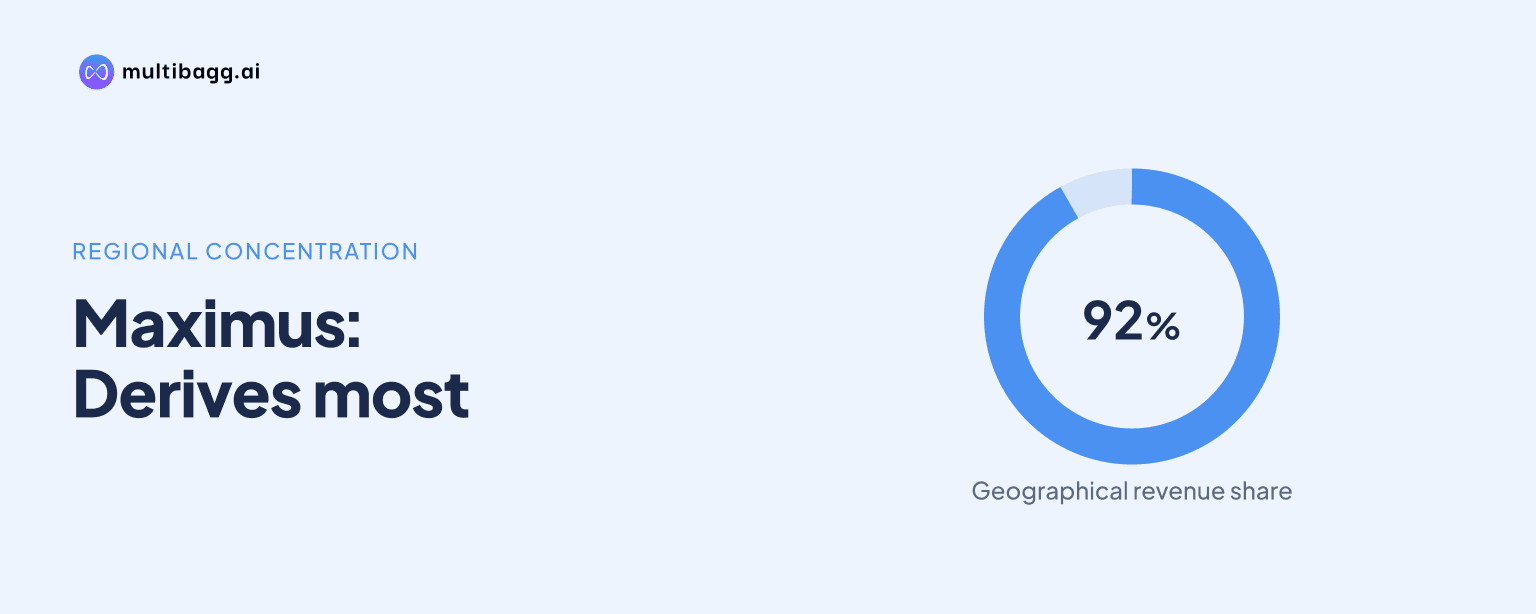
Maximus derives 92% of geographical revenue from the Middle East and East Africa, which contributed 58% and 34%, respectively, while manufacturing facilities in the UAE and Kenya support its lubricant operations. The company combines lubricant manufacturing with petrochemical trading and toll blending across its international footprint.
Know Maximus International inside out
Results, valuation, peers and who's buying, in one view.
How concentrated is Maximus's geographical revenue?
Maximus's geographical revenue is concentrated in the Middle East and East Africa, which together account for 92% of the total disclosed regional mix. The Middle East contributes 58%, East Africa contributes 34%, South-East Asia contributes 7%, and other markets contribute 1%.
The Middle East is Maximus's largest disclosed region, exceeding East Africa by 24 percentage points and South-East Asia by 51 percentage points. The presentation identifies dependence on export markets and regional economic conditions as a weakness, making the 92% concentration relevant to the operating model.
The remaining 8% of geographical revenue is split between South-East Asia at 7% and other markets at 1%. Maximus does not provide revenue values, prior-period regional shares, or country-level revenue within this geographical split, so the presentation does not show whether the concentration has increased or declined over time.
Which export markets support Maximus's core regions?
Maximus lists seven Middle Eastern export markets: the UAE, Oman, Iraq, Kuwait, Saudi Arabia, Jordan and Qatar. Those markets sit within the company's largest disclosed region, the Middle East, which accounts for 58% of geographical revenue.
East Africa's 34% contribution is supported by Kenya, Uganda and Burundi in the list of major export countries. Kenya has a dual role in the footprint because it is both an export market and one of Maximus's two manufacturing locations, alongside the UAE.
Maximus also lists Singapore in South-East Asia, Egypt and Libya in North Africa, Angola in Central Africa, and the Republic of Guinea in West Africa. The presentation does not allocate individual revenue shares to those countries, but it identifies markets beyond the Middle East and East Africa within the broader export network.
What businesses operate across Maximus's overseas footprint?
Maximus operates through three verticals: lubricant manufacturing, petrochemical trading and toll blending. Its manufacturing business produces specialty, industrial and automotive lubricants in the UAE and Kenya, while trading covers global sourcing and distribution of lubricants, additives and petrochemical products.
Toll blending provides contract manufacturing and private-label blending for multinational lubricant brands. This is distinct from Maximus's own lubricant manufacturing because the toll-blending operation is designed around third-party brand and contract requirements.
The lubricant portfolio covers automotive lubricants, metal-working fluids, textile oils, general-equipment oils, refrigeration oils, electrical fluids and specialty oils. Product examples include engine oils, gear oils and coolants; cutting oils, wire-drawing oils and rust-preventive oils; transformer oils; synthetic refrigeration oils; and printing oils.
The UAE and Kenya manufacturing presence therefore serves automotive, industrial and specialty product lines rather than a single product category. The trading vertical adds a separate sourcing and distribution mechanism, while toll blending links manufacturing capability to private-label demand from multinational lubricant brands.
Got a follow-up? Ask IRIS
How is Maximus scaling production in the UAE and Kenya?
Maximus's modernization and expansion initiative aims to scale overall plant throughput across automotive, industrial and specialty product lines. The programme includes a programmable logic controller, or PLC, driven Automated Batch Blending system with flow meters for precise dosing.
The company has also integrated a dedicated solubilization unit using high-shear mixing for polymer and viscosity-index, or VI, improver dissolution. These processing upgrades are specified mechanisms for handling batch blending and ingredient preparation, although the presentation gives no plant-throughput target or capacity figure.
Maximus has added a complete grease-manufacturing unit equipped with saponification kettles, finishing kettles and inline homogenizers. The initiative also includes additional tank-farm capacity and enlarged warehouse infrastructure for finished goods and raw materials to support higher volumetric output.
For packaging, Maximus has added high-speed, servo-driven automatic filling lines for small packs, pails and drums. Management says the lines are intended to streamline packaging operations and eliminate cross-contamination, but the presentation does not disclose capital spending, commissioning dates or output from the new equipment.
What risks and expansion plans does Maximus disclose?
Maximus identifies fluctuations in crude-oil and base-oil prices, dependence on export markets, and regional economic conditions as weaknesses. It also lists regulatory changes, trade barriers and geopolitical risks as threats that can affect exports across its Middle East and African markets.
The company identifies competition from domestic and international lubricant manufacturers and traders, with pricing pressure associated with competition and commodity-price volatility. Its strategy includes expansion into East Africa, the Gulf Cooperation Council, North Africa and South-East Asia, alongside local-talent development and a strategic presence supporting market expansion.
Maximus has proposed a blending plant in Tanzania to enhance its East African manufacturing footprint. The presentation says a warehousing and distribution facility is proposed in the third quarter, followed by manufacturing in Tanzania.
The source does not state the year of the proposed third-quarter facility, the Tanzania project's investment amount, blending capacity, construction timing or expected revenue contribution. The Tanzania plan is therefore a disclosed proposal, rather than a quantified operating addition to the Kenya and UAE manufacturing base.
Conclusion
Maximus's disclosed regional mix shows an export-led business concentrated in the Middle East and East Africa, which together provide 92% of geographical revenue. Manufacturing in the UAE and Kenya supports a three-vertical model spanning lubricant production, petrochemical trading and toll blending, with automation, grease equipment, storage and filling-line upgrades aimed at scaling output.
The next disclosed development to watch is the proposed Tanzania sequence: a warehousing and distribution facility in the third quarter, followed by manufacturing. Updates on its timing, capacity, spending and commissioning would show how Maximus intends to extend its East African manufacturing footprint beyond Kenya.