










Maximus targets Rs 100 crore first-year India plant revenue
Key highlights
- Maximus targets Rs 100 crore of first-year revenue from its planned Indian manufacturing facility.
- Management expects Rs 125 crore to Rs 150 crore of revenue from the India facility in its second financial year.
- Maximus’s 50,000 KL capacity in the United Arab Emirates and Kenya is operating at about 50% utilisation.
- Specialty lubricants contribute about 22% to 25% of Maximus revenue, according to management.
powered by IRIS
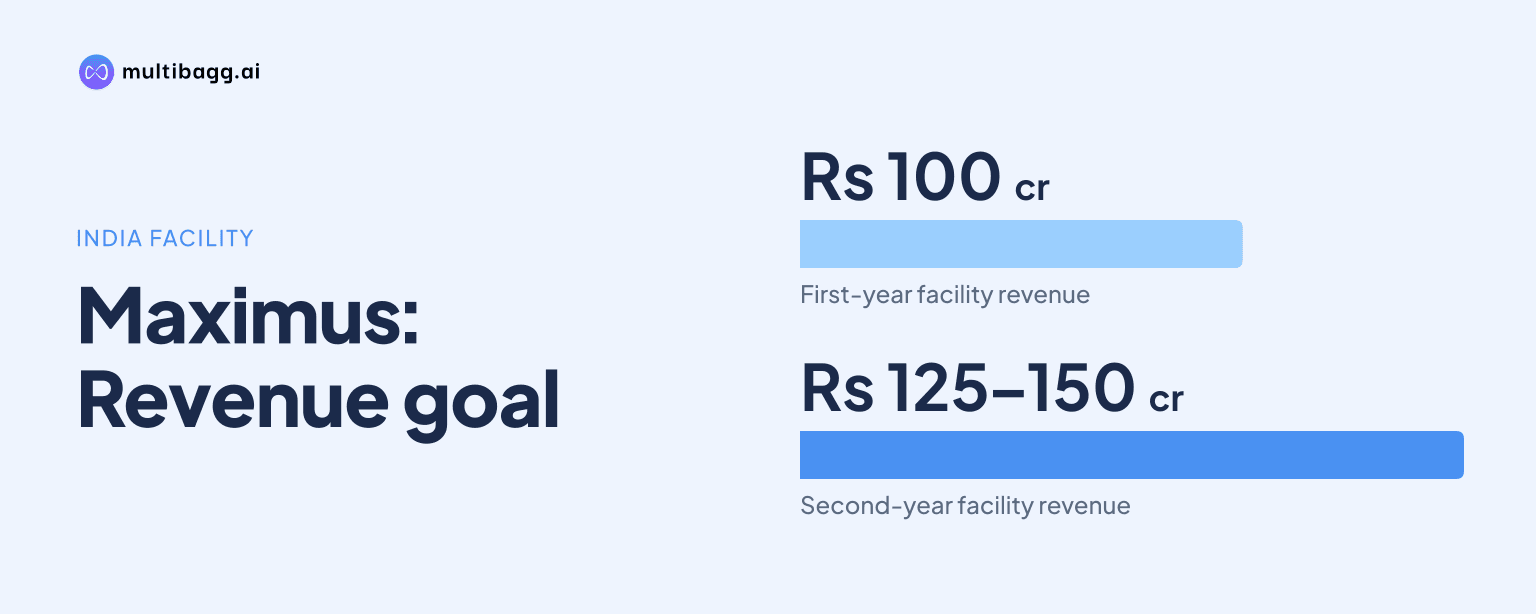
In its November 16, 2026 Q2 and H1 FY27 earnings call, Maximus said its planned Indian manufacturing facility is expected to generate Rs 100 crore of revenue in its first year and Rs 125 crore to Rs 150 crore in its second financial year. Management said manufacturing will lead longer-term growth.
Know Maximus International inside out
Results, valuation, peers and who's buying, in one view.
What revenue does Maximus expect from its India plant?
Maximus expects Rs 100 crore of first-year revenue from the Indian manufacturing facility it plans to establish. Management said the target would rise to Rs 125 crore to Rs 150 crore in the second financial year, implying an increase of Rs 25 crore to Rs 50 crore from the first-year target.
Management also projected earnings before interest, tax, depreciation and amortisation, or EBITDA, margin of about 8.5% to 9% and profit after tax, or PAT, of about 6.5% to 7% for the proposed facility. These are management expectations rather than reported results, and the call did not disclose a commissioning date, capital expenditure or plant-specific funding requirement.
The revenue target relates to a new Indian site, while Maximus’s current 50,000-kilolitre, or KL, production base is in the United Arab Emirates and Kenya. Management said the existing capacity was being used at about 50%, showing that the India plan is an expansion of the manufacturing network rather than a replacement for the two operating plants.
What will Maximus manufacture at the planned India facility?
Maximus plans to make conventional lubricants, automotive oil, industrial oil, grease, high-end lubricants and specialty lubricants at the India facility. Management said it was acquiring land of about 190,000 square feet near Vadodara and intended to build multiple units for different product lines.
The proposed high-end and specialty-lubricant units are intended to serve as a global manufacturing hub for Maximus, including its United Arab Emirates and Kenya operations. Management said the existing two plants do not manufacture those higher-end and specialty products, which differentiates the proposed Indian site from the current network.
Specialty lubricants currently contribute about 22% to 25% of revenue, according to management. Excluding disruption from current war-related economic conditions, management estimated that specialty-lubricant margins can be about 50% higher than conventional-lubricant margins, while cautioning that the outcome depends on the particular specialty product.
How does Maximus’s existing capacity support the expansion?
Maximus is using about 50% of its 50,000 KL manufacturing capacity in the United Arab Emirates and Kenya, and management aims to increase utilisation to 55% to 58% by the end of the financial year. That target represents a 5 to 8 percentage point increase from current average utilisation.
Manufacturing is the larger operating segment in Maximus’s disclosed mix, with about 65% of revenue coming from lubricant manufacturing and about 35% from petrochemical trading. Management said lubricant manufacturing produces gross margins of about 17% to 18%, compared with 11% to 12% in trading, a difference of 5 to 7 percentage points.
Management said manufacturing will lead longer-term growth, although it remains active in both manufacturing and trading. It cited the India project, a planned Tanzania distribution operation and a grease manufacturing facility in Kenya as the operating steps supporting that emphasis.
Got a follow-up? Ask IRIS
Why have costs and borrowings affected Maximus’s margins?
Maximus said margins declined both year on year and quarter on quarter because raw-material and landed costs increased. Management identified base oil and additives as key inputs, said base-oil prices are linked to crude oil, and cited raw-material availability, shipping access, freight, insurance, carrying and forwarding expenses during the Middle East war.
Management estimated that landed costs increased by nearly 50% to 60% on average. It said Maximus passed on a significant portion of the increase to customers without losing major business, but acknowledged that the cost movement suppressed margins.
An analyst cited consolidated borrowings of approximately Rs 51 crore in H1 FY27, and management linked the increase in borrowings to higher top-line activity and banking limits used for new customer deals, mainly in the United Arab Emirates. Management said finance costs changed in proportion to higher borrowings and added that capital and interest subsidies under government schemes could reduce financing costs for the India production facility, without quantifying the potential benefit.
How is Maximus building its manufacturing and distribution network?
Maximus aims to operationalise a Tanzania warehousing and distribution facility by the end of the financial year. Management said it was pursuing distribution approvals and assessing warehousing options in industrial parks, while separately referring to a Tanzania distribution setup targeted by the third quarter.
A Tanzania manufacturing facility would follow only after the business reaches an appropriate scale somewhat above break-even, according to management. The near-term plan is therefore distribution and warehousing, while the Kenya facility continues to support penetration in Tanzania, Rwanda and Uganda.
Management said Maximus already serves North African markets including Libya and Egypt and is expanding in Southeast Asia and China. It also said it had added major customers in China, but did not disclose revenue, volumes or a timetable for those markets.
For FY27, management said its top-line outlook depended on the Middle East war not worsening or extending. At the current run rate, management said it was confident of exceeding Rs 225 crore in consolidated revenue and referred to Rs 250 crore-plus on a pessimistic basis, while targeting a 50 to 100 basis point improvement in EBITDA margin. A basis point is one-hundredth of a percentage point.
Conclusion
Maximus has linked its manufacturing-led expansion to a specific India-facility target of Rs 100 crore in first-year revenue and Rs 125 crore to Rs 150 crore in the second year. Management’s rationale combines a reported 17% to 18% gross margin in lubricant manufacturing against 11% to 12% in trading with the planned addition of specialty products, which contribute about 22% to 25% of revenue.
The next disclosed milestones are land acquisition for the roughly 190,000-square-foot Vadodara site, operationalisation of the Tanzania warehouse by the end of the financial year and progress toward 55% to 58% utilisation of the existing 50,000 KL capacity. Management has not yet provided the India plant’s commissioning date, capital expenditure or funding structure.