










Megatherm targets Rs 250-300 crore in transformer revenue
Key highlights
- Megatherm targets Rs 250-300 crore of annual transformer revenue in about three to five years.
- Megatherm estimates the solar-transformer market at about Rs 2,500 crore and cast-resin transformers above 2.5 MVA at about Rs 950 crore.
- Solar-transformer revenue was about Rs 2-3 crore in H1 FY27 after two or three September dispatches.
- Megatherm said transformer capacity is fully utilised and key expansion machinery may take about one year to arrive.
powered by IRIS
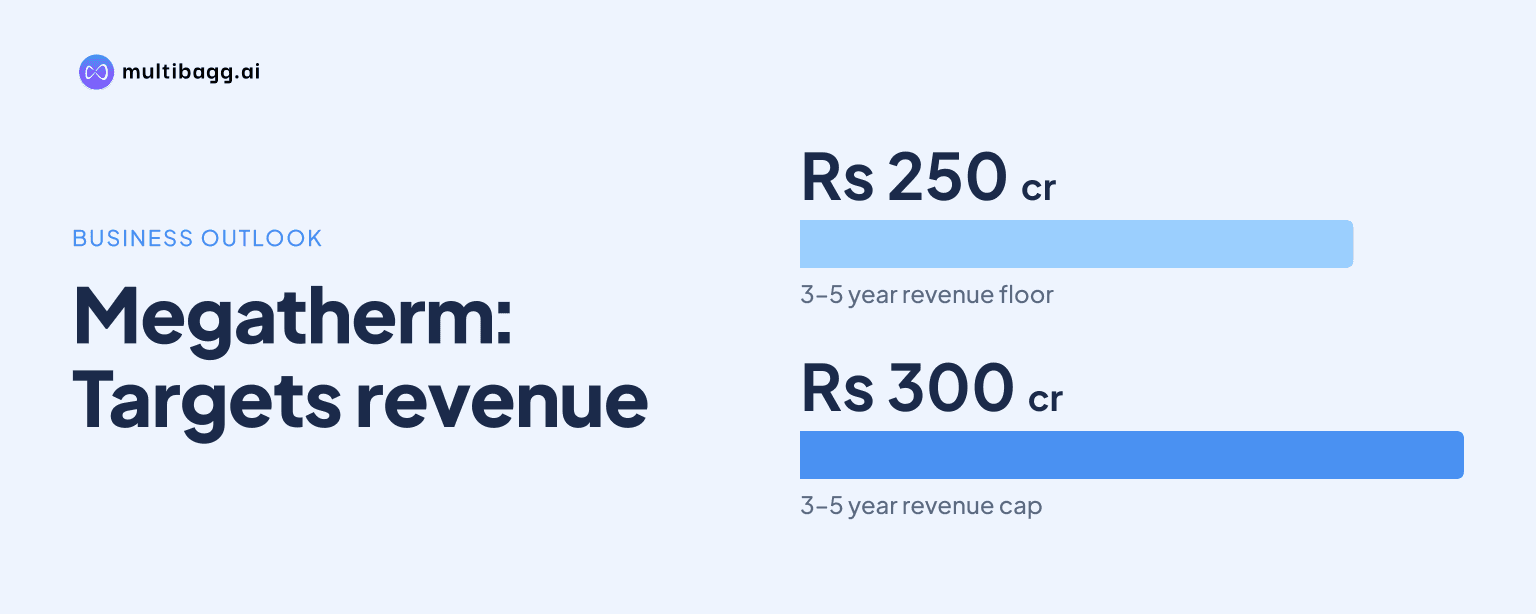
Megatherm Induction Ltd is targeting Rs 250-300 crore of annual transformer revenue in about three to five years through solar, cast-resin, multi-winding and industrial products, after solar-transformer dispatches contributed only about Rs 2-3 crore in H1 FY27. Management said it will avoid government-utility tender business and focus on specialised private-sector applications.
Know Megatherm Induction inside out
Results, valuation, peers and who's buying, in one view.
How much transformer revenue is Megatherm targeting?
Megatherm is targeting Rs 250-300 crore of transformer revenue in the next three to five years. Management said the plan is not to build a transformer business worth thousands of crores, but to develop a focused operation from investments already made and a proposed second investment.
The target is below management's illustration of a 10% share of its identified markets. It estimated India's solar-transformer market at about Rs 2,500 crore and the cast-resin transformer market above 2.5 megavolt-amperes, or MVA, at about Rs 950 crore. Management described the combined opportunity as about Rs 3,500 crore and said a 10% share would imply about Rs 350 crore, compared with its Rs 250-300 crore target.
Transformer revenue remained small in H1 FY27, when Megatherm dispatched two or three solar transformers in September and recorded about Rs 2-3 crore of related revenue. Management put revenue per transformer at roughly Rs 80-90 lakh, showing that the business was at an early dispatch stage relative to the three-to-five-year objective.
Which transformer segments will Megatherm pursue?
Megatherm will pursue renewable-energy, cast-resin, multi-winding and industrial transformers. Management identified multi-winding transformers as a key niche and said the company wants to address complicated applications rather than broad, standardised transformer categories.
Cast-resin transformers are part of the strategy because they are used in indoor applications including metros and airports, while management said industrial adoption is also increasing. It cited Tata and Jindal, along with large industrial facilities and mining operations, as examples of potential demand, and said eastern India has no producer of large cast-resin transformers.
Megatherm is also preparing for larger products. It has tested a 13.2 MVA transformer and plans a 20 MVA test at the Central Power Research Institute, or CPRI. Management said a new shed would accommodate larger induction-duty and arc-furnace transformers, while the existing shed would make lighter-duty products and units currently being outsourced.
Why is Megatherm avoiding utility transformer tenders?
Megatherm is avoiding government-utility tenders because management described them as commodity-style business awarded to the lowest bidder, or L1. It instead intends to sell to private-sector customers, where it believes design, equipment quality and operating life can be evaluated beyond the tender price.
Management said its designs maintain wider gaps between primary and secondary windings and use what it called lavish design parameters, including flux density, to support transformer operating lives of 15 to 20 years. It said customers must first assess the product, after which repeat orders could allow premium pricing; this is management's expectation rather than a disclosed pricing result.
Megatherm has used lower initial pricing on selected entry orders. Management said about 10 legacy transformers remained at lower prices and said competitive pricing for initial orders from groups such as Adani Green and Tata Green Co. could continue for six to 10 months at most, until customer approvals and repeat business develop.
Got a follow-up? Ask IRIS
How is Megatherm expanding transformer capacity?
Megatherm said its current transformer capacity is fully utilised, although it is operating two shifts rather than three. Management cited orders from Sprng Energy, a couple of GVNL projects, private-sector industrial customers and captive demand, and said it is outsourcing smaller-capacity transformers.
The company had stopped taking certain orders when capacity was constrained, but said it was reopening the order book to support deliveries from February and March onward. Manufacturing began during July and August, while dispatches began in September after customer inspections, design changes and drawing approvals; management put normal transformer lead time at about one-and-a-half to two months.
Management said it brought forward expansion because delivery schedules for capital equipment have lengthened. It said cast-resin, vacuum and winding machines ordered now may take about one year to arrive. The project includes a larger shed with heavy-duty cranes, a cast-resin plant and backward integration, while retaining infrastructure provision for 220 kilovolts, or kV, without immediate entry into that voltage class.
What could change transformer-sector economics?
Management said transformer-sector profits could begin to tighten from FY28 as manufacturers add capacity. It said companies currently earning high profits could face pressure when additional capacity enters the market, which is why Megatherm is not relying on a short-cycle opportunity in 220 kV or commodity utility tenders.
Megatherm's response is to target renewable, cast-resin, multi-winding and industrial transformer segments that management expects to have longer-term demand. Management said it would assess the 220 kV market after about one-and-a-half years and could enter if conditions remained supportive, but described the current infrastructure provision as optional rather than an immediate launch plan.
The difference between reported scale and the target remains substantial. Megatherm reported Rs 195 crore of H1 FY27 revenue, while solar transformers contributed about Rs 2-3 crore after only two or three September dispatches. Management said inventory bought upfront for transformer orders should be dispatched by the end of H2, but did not provide a full-year transformer-revenue forecast.
Conclusion
Megatherm's Rs 250-300 crore transformer-revenue ambition is a specialised expansion rather than a utility-tender strategy. The company is targeting solar, cast-resin, multi-winding and industrial applications, using private-sector customer relationships and customised equipment while accepting lower prices on some early orders to establish product credentials.
The next disclosed markers are H2 dispatches from inventory, fresh order intake for February and March deliveries, the planned 20 MVA CPRI test, and progress on the new shed, cast-resin plant and backward integration. Management also plans to reconsider 220 kV entry after about one-and-a-half years, while warning that sector economics could tighten from FY28 as capacity expands.