










Megatherm sees 15% EBITDA potential reaching steady state in FY29
Key highlights
- Megatherm said steady-state EBITDA should begin to show from FY29.
- Transformer overheads are currently about 18% to 20%, versus a cited 5% to 10% steady-state range.
- Megatherm estimated temporary H1 FY27 growth-related costs at around Rs 2 crore to Rs 2.5 crore.
- The spares, after-sales and service business contributes about 28% EBITDA, according to management.
powered by IRIS
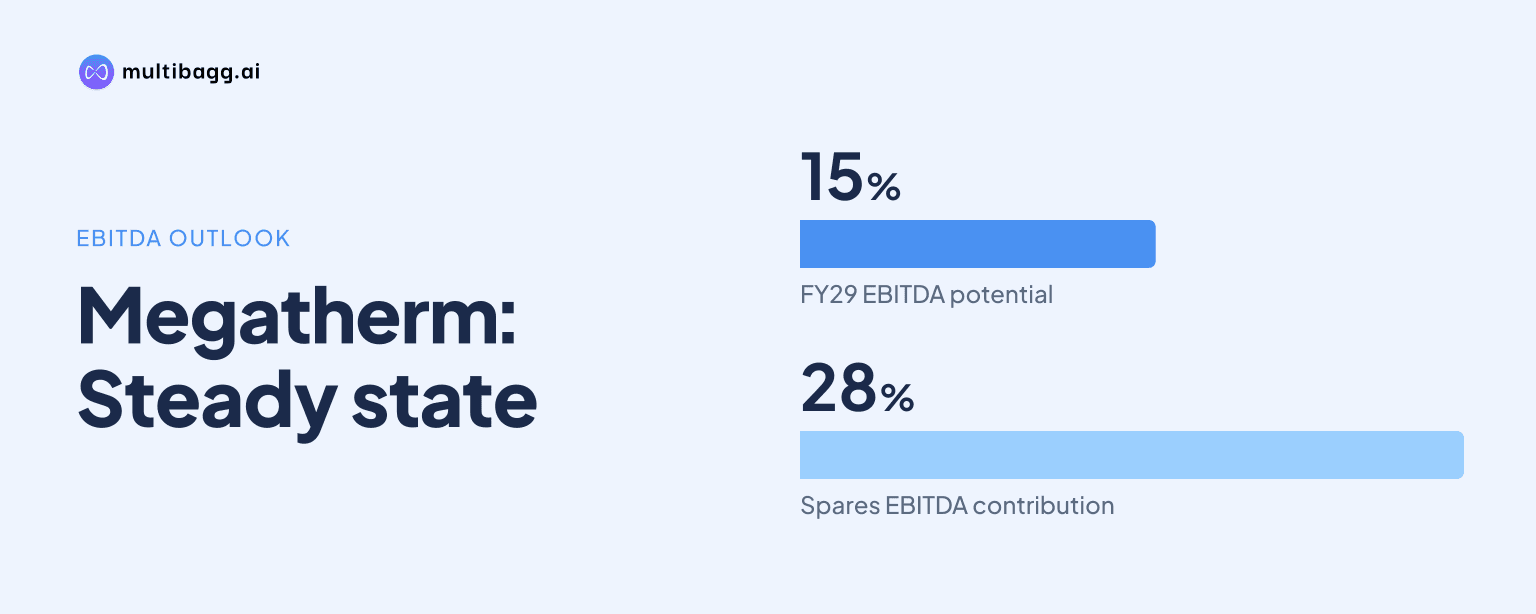
Megatherm Induction Ltd said its approximately 15% EBITDA potential should become visible from FY29, after market-entry pricing, expanded teams and new-business overheads ease; transformer overheads are currently about 18% to 20%, versus a cited steady-state industry range of 5% to 10%.
Know Megatherm Induction inside out
Results, valuation, peers and who's buying, in one view.
Why is Megatherm's EBITDA below its stated 15% potential?
Megatherm says its present earnings include spending required to establish transformer and engineering-product businesses rather than their eventual operating economics. In the H1 FY27 call, management said the company had yet to see EBITDA contribution from transformers, while its consolidated EBITDA margin was 9.1%, compared with the approximately 15% potential discussed for the combined portfolio.
The gap reflects both lower initial pricing and a higher cost base. Megatherm said it is undercutting competitors on early transformer orders to gain access to important customers and approvals, while also building manufacturing capacity, training staff and expanding commercial teams. Management described these outlays as growth investments, although they are presently recorded as costs in the accounts.
Management cited its after-sales, spares and service business as an offset, with EBITDA contribution of about 28%. The steel business was described as producing approximately 10% to 12% EBITDA. Megatherm's view is that these businesses, combined with normalised transformer economics, support a 15% margin outcome, but the transformer and heating-and-hardening operations remain in their build-out phase.
How far are Megatherm's transformer costs from a steady state?
Megatherm said transformer overheads are about 18% to 20% today, compared with the 5% to 10% range management cited for established industry participants. The stated reason is not only new capacity: the transformer team is larger than required for current output, and the business is incurring product-development, approval and training costs before revenue reaches its intended scale.
The company gave a similar comparison for heating and hardening. Management said that business should operate at around 10% overheads in a mature state, but its current overhead ratio is about 23%. These two cost structures indicate that the expected margin improvement depends substantially on greater utilisation of people, facilities and product-development work already in place.
Quantifying the temporary spend is difficult, according to management, because it is spread across research and development, production, labour and marketing. It nevertheless estimated that the relevant H1 FY27 expense was around Rs 2 crore to Rs 2.5 crore, rather than the Rs 4 crore to Rs 5 crore suggested by an analyst. The company said its transformer labour force has increased threefold, with roughly two-thirds of the team still in training.
Got a follow-up? Ask IRIS
When will Megatherm stop using entry-level transformer pricing?
Megatherm expects the lower-price phase for most existing transformer orders to last only about 6 to 10 months. Management said approximately 10 legacy transformers remain at lower prices, bought and stocked after the company accepted entry-level orders. It said subsequent transformer orders should not carry similarly low pricing, except potentially selected initial orders from major repeat customers.
The company identified Tata Power as one target customer and referred to possible initial business with Tata and Adani-related groups. Megatherm said it may still price competitively to secure a first order from groups that can generate repeat purchases. Management distinguished this approach from pursuing broad utility tenders, where the lowest bidder, or L1, generally wins and where it does not intend to compete as a commodity supplier.
Approval timing is central to this transition. Megatherm said National Thermal Power Corporation approval requires six months of 40 megawatts of supplied equipment, and that it has already supplied equipment toward this process. Management said this approval would enable participation in a wider set of orders, while customer testing, product establishment and other approvals can extend the time between capacity investment and established sales.
What does Megatherm expect from transformer expansion?
Megatherm expects revenue and EBITDA from the new transformer capacity to mature from the end of FY28, because machinery delivery alone can take about one year and approvals and product establishment require a further one to one-and-a-half years. The company said it has already begun piling work and is bringing forward investment because transformer capital-equipment lead times are lengthy.
Management said transformer EBITDA typically ranges from 12% to 15%, depending on product type. It put cast-resin transformer margins at more than 15% and inverter-duty transformers at around 12%. Those are management's stated segment economics, not reported Megatherm margins, because the company said transformer EBITDA contribution has not yet begun to appear in its results.
The stated market focus is specialised transformers for private-sector customers, including multi-winding, solar and cast-resin products, rather than mass-market utility supply. Megatherm estimated India's cast-resin transformer market above 2.5 megavolt-amperes at about Rs 950 crore and the solar transformer market at about Rs 2,500 crore. It is targeting Rs 250 crore to Rs 300 crore of transformer revenue over roughly three to five years after the next investment phase.
Management said its prior FY27 guidance of Rs 450 crore revenue and Rs 59 crore EBITDA remains broadly intact, despite around Rs 80 crore of Gulf orders being delayed at different stages. Some equipment is ready in the factory, some material is at sea, and in other cases customers have paid advances but cannot proceed, according to management. It also said the second half is typically larger than the first half and referred to H1 revenue of about Rs 190 crore.
Conclusion
Megatherm's stated FY29 timetable means management does not regard current profitability as representative of the intended operating model. The company attributes the difference to 18% to 20% transformer overheads, 23% heating-and-hardening overheads, temporary entry pricing and training costs of around Rs 2 crore to Rs 2.5 crore in H1 FY27. Its 15% EBITDA expectation depends on transformer approvals, pricing normalisation and a larger contribution from businesses already producing 28% and 10% to 12% EBITDA.
The next indicators are transformer dispatches, completion of the accelerated expansion and the release of delayed Gulf orders. Management expects new transformer capacity to begin producing mature revenue and EBITDA from FY28-end, while it says steady-state EBITDA should emerge from FY29. Investors will also watch whether Megatherm changes the accounting treatment of some growth expenditure when its FY27 audited report is issued, as management said that decision remains under consideration.