










Millworks targets build-to-spec majority with 3%-5% margin lift
Key highlights
- Millworks plans to move from a 70:30 build-to-print/build-to-spec mix to 50:50 before taking build-to-spec towards 70%.
- Management estimates build-to-spec projects can earn margins 3%-5% above build-to-print work.
- Nine metal 3D printers are intended to reduce some prototype lead times to 4 weeks from more than 3 months.
- Millworks' Rs 111 crore export defence order has a 6-month development phase and 12-to-14-month execution schedule.
powered by IRIS
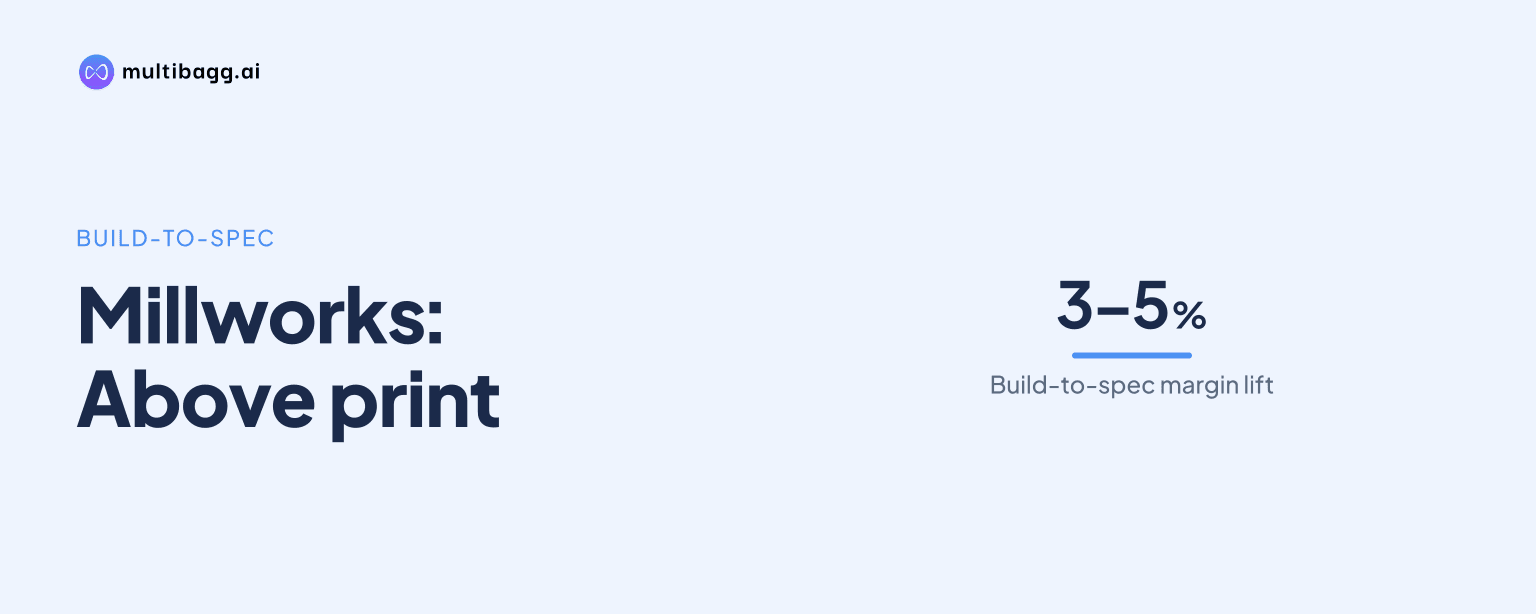
Millworks Technologies Limited plans to make build-to-spec work larger than build-to-print within two years, after first moving from its current 70:30 mix to 50:50. Management said build-to-spec projects can generate margins 3%-5% above build-to-print, supported by nine metal 3D printers and faster prototype development.
Know Millworks Technologies inside out
Results, valuation, peers and who's buying, in one view.
What build-to-spec mix is Millworks targeting?
Millworks is targeting a 50:50 build-to-print and build-to-spec mix before moving build-to-spec towards 70% and making it the larger business within two years. Management described the current mix as 70% build-to-print and 30% build-to-spec during the investor call, framing the change as a move into more development-led customer programmes.
Build-to-print work begins with a customer-provided drawing and three-dimensional model, which Millworks manufactures to specification. In build-to-spec work, the customer provides a requirement, then Millworks develops a prototype, obtains approval and moves the product into production. Management said this process can turn engineering work into a production chain for a final product rather than a standalone component order.
The mix plan also covers more assemblies and sub-assemblies rather than only machined components. Millworks' Rs 230 crore order book includes a Rs 111 crore export defence order for components, sheet-metal parts, bought-out items, assemblies and sub-assemblies, giving management a stated route to expand the range of work supplied to customers.
Why does Millworks expect higher build-to-spec margins?
Millworks expects build-to-spec margins to be 3%-5% above build-to-print because projects require additional engineering, prototype development and customer approval work. Management also described the premium as around 5%, saying customers accept higher pricing because Millworks spends time developing the product before it enters serial production.
The higher-margin work also has a longer gestation period. Management said build-to-spec programmes can take three to six months, and sometimes longer, because prototypes must be developed and approved before production starts. Changes in a customer's specification and approval to move into production were identified as the main constraints on converting development work into manufacturing revenue.
The margin objective follows H1 FY27 revenue from operations of Rs 17.37 crore and gross margin of about 37%, compared with around 38% in the second half of the prior year. Management attributed the decline to higher raw-material prices linked to global supply-chain effects, and said H1 EBITDA was Rs 1.81 crore while net loss was Rs 1.83 crore.
Management attributed the H1 loss to operating leverage during a period when much revenue moved to October. Employee costs were Rs 4.46 crore, finance cost was about Rs 1.81 crore and depreciation was Rs 1.46 crore. The expected build-to-spec premium is a management estimate, not a separately reported segment margin for H1 FY27.
What capabilities support Millworks' build-to-spec shift?
Millworks has installed nine metal 3D printers and expects some prototype lead times to fall to four weeks from more than three months earlier. Management said the printers, design software and component-scanning capability will help it produce prototypes, fixtures and tooling faster for aerospace and defence customers.
Millworks said one customer in Israel and one in Germany recently transitioned from build-to-print to build-to-spec work after working with the company for three to five years. Management did not identify the customers, but described both as global multinational companies and said it would market its expanded development capability now that its equipment, people and prototype timelines are in place.
The company has three active research and development projects. A German customer's complete assembly project has completed design, with prototyping under way and field trials expected within three months; management said that customer is funding the full research and development cost. An internal-combustion-engine project and a jet-engine project are being funded by Millworks, with management expecting revenue implications in two years once products are ready.
Millworks had spent Rs 28.73 crore of the Rs 61.03 crore allocated to machinery from initial public offering proceeds and installed more than 17 new machines at Unit 4. Management said the expansion will increase capacity for complex, high-precision jobs, while new machines can also serve semiconductor machinery, aerospace and defence parts.
Got a follow-up? Ask IRIS
What could delay Millworks' mix and margin targets?
Millworks' mix shift could be delayed by the prototype approval cycle, specification changes and the three-to-six-month or longer gestation period for build-to-spec programmes. The stated 3%-5% margin difference depends on development work progressing from prototype to repeat production, rather than remaining at an engineering stage.
Aerospace customer qualification is another dependency. All four Millworks factories are certified to AS9100D Revision D through May 2027, and management is pursuing two large aerospace customers. Following an initial audit that identified infrastructure and process requirements, the next audit is scheduled for February 2027, when management hopes at least one large European aerospace company will clear Millworks for trial orders.
Millworks is also installing an anodising plant at Unit 4, which management expects to be operational in January 2027 after installation and trials. Management intends to pursue National Aerospace and Defense Contractors Accreditation Program certification about six months later, or around July or August 2027, to support in-house delivery of machining, sheet metal and special processes.
Working-capital timing remains relevant to defence-led growth. Management said Indian defence programmes have staged approval processes, whereas export defence work offers clearer payment timing and advances. It said export terms for one European country had been changed to 30% advance with the purchase order and payment within 30 to 45 days from invoicing.
How does build-to-spec fit Millworks' growth plans?
Millworks sees build-to-spec as part of a wider plan to increase work in defence, rail, aerospace and semiconductor machinery. Management said defence would remain the largest segment, followed by rail, aerospace and semiconductor machinery parts, while it aims to move aerospace ahead of rail through qualification, clean-room infrastructure and customer audits.
The Rs 111 crore export defence order has a stated initial development period of six months and total execution period of 12 to 14 months. Management said the Statement of Account and Inspection process would take three months before production orders start, making the order an operational test of its ability to combine development, components and assembly work.
Management said Millworks had crossed Rs 50 crore of top line by October and expected to exceed Rs 200 crore in FY27, while clarifying that it had not formally revised a revenue target. For the following year, management said it wanted 60%-70% year-on-year growth, supported by European first-article samples converting into orders and by a greater share of build-to-spec, assembly and sub-assembly projects.
Conclusion
Millworks is seeking to change its role from producing to customer drawings towards developing, prototyping and then manufacturing approved products. Its stated path from a 70:30 mix to 50:50 and then towards 70% build-to-spec is tied to management's estimated 3%-5% margin premium, but that outcome depends on project approvals and production conversion.
The next disclosed markers are the January 2027 commissioning target for the Unit 4 anodising plant, the February 2027 aerospace audit and the planned July or August 2027 accreditation effort. Investors can also watch whether the Israeli and German customer transitions lead to scaled production, and whether the Rs 111 crore export order moves from development into manufacturing over its 12-to-14-month schedule.