










Mold-Tek plans 50,000-51,000 tonnes on 70,000-tonne capacity
Key highlights
- Mold-Tek plans about 70,000 tonnes of capacity at the beginning of the next financial year, up from 66,900 tonnes.
- Mold-Tek targets 50,000-51,000 tonnes of output next financial year versus 46,000-47,000 tonnes estimated for the current year.
- Mold-Tek said IML represented close to 77% of quarterly volume and 78.25% of value, up from 76% of value a year earlier.
- Mold-Tek reported Rs 24 crore of first-half pharma turnover and projected Rs 70 crore to Rs 75 crore for next financial year.
powered by IRIS
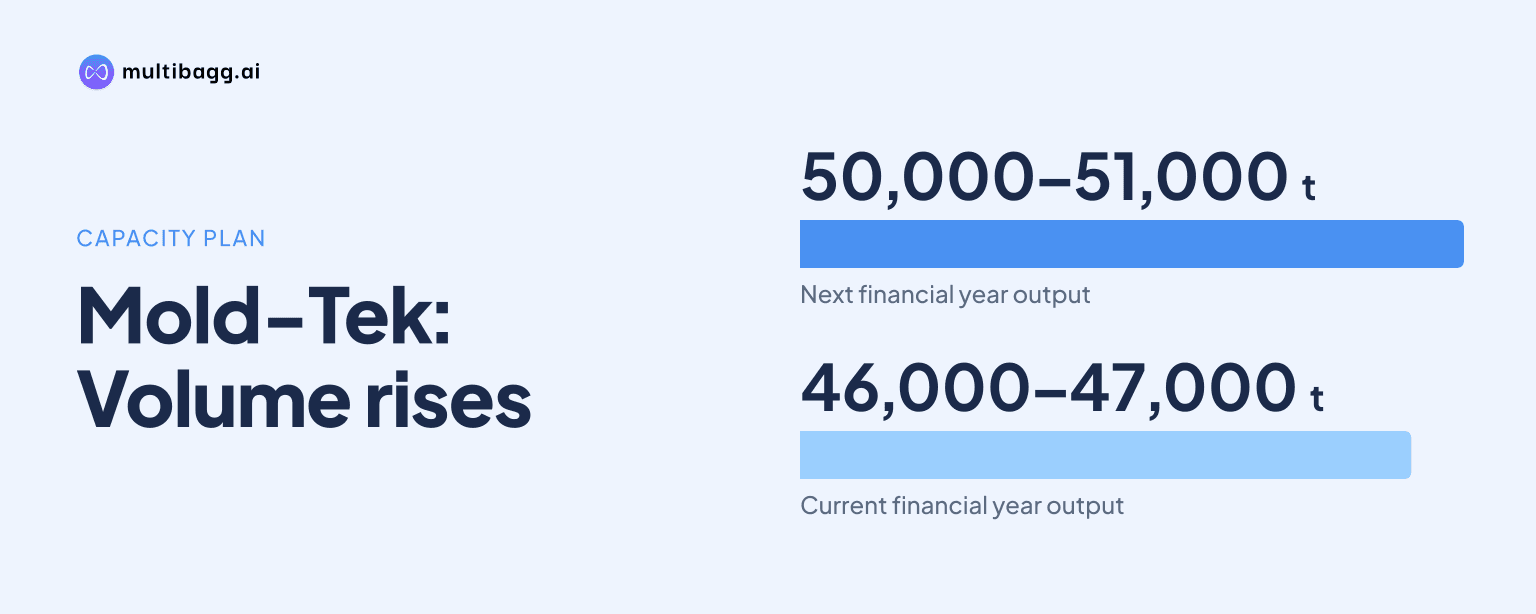
Mold-Tek plans to start the next financial year with about 70,000 tonnes of capacity and produce 50,000-51,000 tonnes, compared with an estimated 46,000-47,000 tonnes in the current year. Management said machines already added and further machines in transit support the capacity increase from 66,900 tonnes.
Know Mold-Tek Packaging inside out
Results, valuation, peers and who's buying, in one view.
What capacity and output is Mold-Tek targeting next year?
Mold-Tek is targeting about 70,000 tonnes of capacity at the beginning of the next financial year and 50,000-51,000 tonnes of output during that year. Management said its 66,900-tonne capacity would “definitely” become 70,000 tonnes, after capacity additions in the current year and the arrival of additional machines.
The target would increase output by about 3,000-5,000 tonnes from management’s estimate of 46,000-47,000 tonnes for the current year. It would also extend the rise from around 42,000 tonnes produced last year, although management did not disclose a revenue target linked specifically to the 50,000-51,000-tonne plan.
Management said around 70% capacity utilisation is appropriate for an injection-moulding operation, while utilisation above 75% is generally not workable because of mould complexity and machine underutilisation. The 50,000-51,000-tonne target on 70,000 tonnes of capacity implies utilisation of roughly 71%-73%, within that stated operating range.
How will product mix affect Mold-Tek's volume growth?
Mold-Tek says tonnes no longer capture the full economic effect of growth because food, fast-moving consumer goods and pharma packs are lighter than traditional paint pails but generate more revenue and earnings before interest, tax, depreciation and amortisation per tonne. Management said paint’s contribution to tonnage is broadly stagnant and lubricant volumes are falling, while growth is increasingly coming from food, FMCG and pharma.
Management contrasted a 20-litre paint pail weighing about 1 kilogram with thin-wall ice-cream cups weighing 18 grams, 20 grams or 25 grams each. It said a 10% volume increase in the current product mix could be comparable with 14%-15% growth three years ago, when paint made a larger contribution to revenue and profit.
The changing mix is also reflected in labelled products. Management said IML accounted for close to 77% of quarterly volumes and 78.25% of value, with value share increasing from 76% in the prior-year second quarter. It also cited rising IML adoption at Asian Paints as one reason for healthy paint-segment growth.
Paint was growing at 9% at the time of the call, and management said full-year growth of 10%-11% was possible if current demand conditions continued. In contrast, it said lubricant volumes had declined after the loss of customers and input issues at major private lubricant companies, making food, FMCG and pharma growth more important to the volume plan.
Got a follow-up? Ask IRIS
Which businesses could support Mold-Tek's output target?
Mold-Tek expects Panipat, Qpack, pharma and potentially Vibe specialty closures to support the next financial year’s output target. Management said the Panipat plant was ready, food and FMCG clients were being added, and Qpack was expanding into detergents with supplies for a new customer expected to start from the end of November.
Pharma contributed Rs 24 crore of turnover in the first half, and management said Mold-Tek remained on track for more than Rs 50 crore in the full year. It also said it was adding two or three major pharma customers every quarter and projected pharma turnover of Rs 70 crore to Rs 75 crore for the next financial year.
Mold-Tek expects ophthalmic products at Sultanpur B block to begin production by March, followed by commercial production in April or May of the next financial year. The company has registered new land for possible future auto-injector pen manufacturing, semiconductor trays or both, but management said no final decision had been made on its use.
Vibe could add revenue from the next financial year if client trials lead to commercial orders. Seven Vibe specialty-closure products had been developed and approved, while commercial moulds would take about four months after an order signal; management said 14 components could be ready by year-end and contribution could become sizeable in the second half if they move into commercial production.
What could affect Mold-Tek's production and earnings mix?
Mold-Tek’s output target depends on demand conversion in new product lines and a recovery or stabilisation in weaker lubricant volumes. Management said lubricant decline had continued quarter after quarter, with first-half movement reaching nearly 15%, because some private lubricant customers faced input issues and the company had earlier lost clients.
Auto-injector pens remain at an earlier stage than Vibe. Management said customer sample assessments were continuing and there was nothing imminent in the following two to three months; any initial agreement could involve representing and selling a partner’s products in India before domestic manufacturing is considered.
Raw-material prices and working-capital borrowing could also affect earnings. Management said finance cost had increased from 4.1% to nearly 5% of revenue, partly because higher raw-material prices required greater short-term borrowing, and it was modelling finance cost of about 4.5%-4.7% for the year.
Management said finance cost could return to about 4%-4.2% of revenue if raw-material prices decline, but it did not expect a rapid reduction without a complete peace in West Asia. It also said total inventory, including raw material, semi-finished goods and finished goods, is usually about one month, with carrying time at 52 days during the call.
Conclusion
Mold-Tek’s plan combines a capacity increase from 66,900 tonnes to about 70,000 tonnes with an output target of 50,000-51,000 tonnes next financial year. The intended production increase follows an estimated 46,000-47,000 tonnes this year, while management expects lighter food, FMCG, pharma and Vibe products to raise revenue and EBITDA contribution per tonne relative to heavier paint pails.
The next disclosed milestones are ophthalmic commercial production in April or May, potential Vibe commercial production after trials and mould completion, and the conversion of Panipat and Qpack customer additions into shipments. Management’s full-year target of double-digit volume growth, versus about 8% in the first half, and its 4.5%-4.7% finance-cost assumption are further measures to watch.