










MOLD-TEK Packaging Limited H1 revenue up 28% on 8% volume
Key highlights
- MOLD-TEK reported H1 FY27 revenue of Rs 574.68 crore, up 28% year on year, while volume rose 8% to 23,117 metric tonnes.
- H1 FY27 EBITDA increased to Rs 107.70 crore from Rs 88.86 crore, while profit after tax rose 23% to Rs 46.64 crore.
- H1 FY27 EBITDA margin declined 55 basis points to 18.74% as material cost rose 35% to Rs 344.85 crore.
- MOLD-TEK consolidated five plants into two locations and increased label capacity by 50% after adding offset printing and AI-based inspection.
powered by IRIS
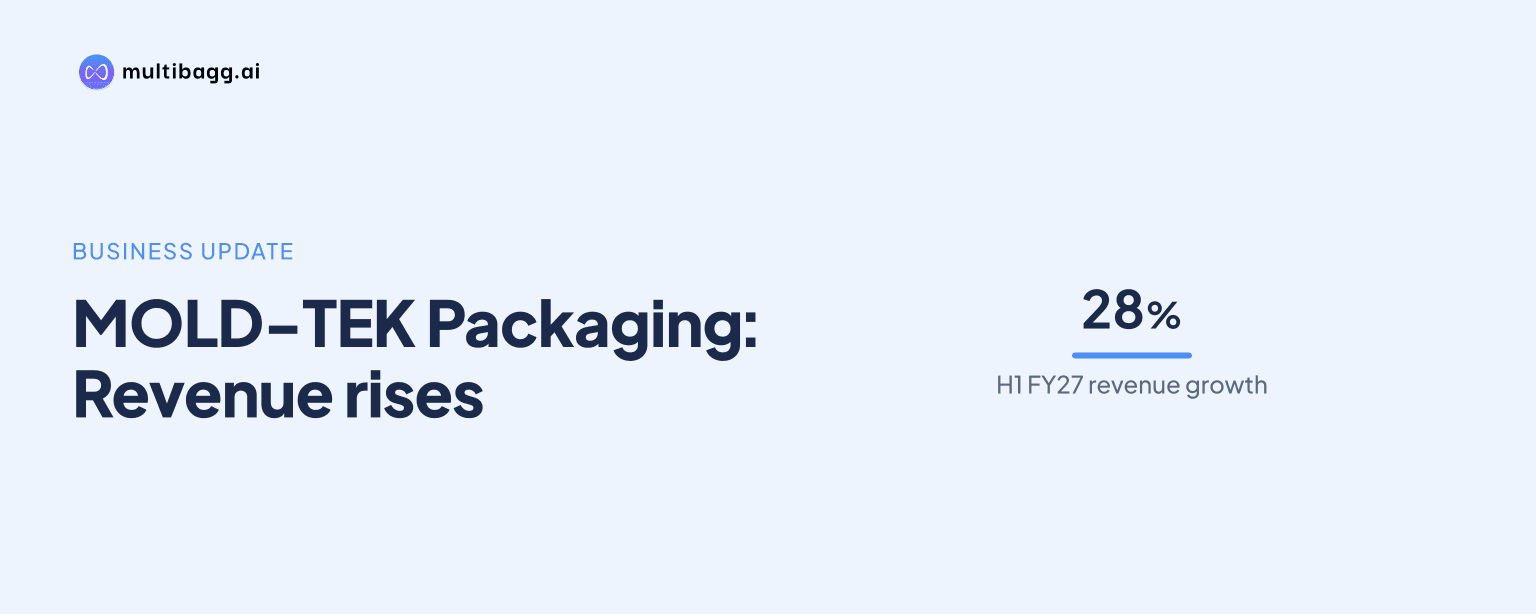
MOLD-TEK Packaging Limited reported H1 FY27 revenue of Rs 574.68 crore, up 28% year on year, while volume rose 8% to 23,117 metric tonnes. Earnings before interest, tax, depreciation and amortisation (EBITDA) per kg increased 15% to Rs 46.59, meaning revenue and operating-profit growth exceeded shipment growth during the six-month period.
Know Mold-Tek Packaging inside out
Results, valuation, peers and who's buying, in one view.
Why did MOLD-TEK's H1 revenue outpace volume growth?
MOLD-TEK's H1 FY27 revenue outpaced volume growth because revenue increased 28% to Rs 574.68 crore while volume rose 8% to 23,117 metric tonnes. In H1 FY26, revenue was Rs 450.32 crore and volume was 21,396 metric tonnes. The differing growth rates indicate higher revenue generated per unit shipped, although the presentation does not provide a separate realisation figure or a price-and-mix bridge.
The same pattern was visible in Q2 FY27. Revenue increased 31% year on year to Rs 274.23 crore, compared with a 10% increase in volume to 11,028 metric tonnes. Revenue and volume each declined 9% from Q1 FY27, when they stood at Rs 300.45 crore and 12,088 metric tonnes, respectively. That sequential alignment indicates the first-half difference between sales and tonnage was primarily a year-on-year development.
What drove MOLD-TEK's EBITDA per kg higher?
MOLD-TEK's EBITDA per kg rose to Rs 46.59 in H1 FY27 from Rs 40.61 in H1 FY26, a reported 15% increase. Q2 FY27 EBITDA per kg increased 18% year on year to Rs 46.49 from Rs 39.43, but was nearly unchanged from Rs 46.68 in Q1 FY27. The Q2 result retained most of the per-kg improvement despite lower sequential revenue and volume.
Management attributed EBITDA improvement to cost control, lower process wastage, label making under one roof, better capacity utilisation, plant consolidation and increasing pharma sales. During the year, MOLD-TEK consolidated five plants into two locations and said this translated into better EBITDA growth. Its label operations added offset printing and an artificial intelligence-based inspection system, raised capacity by 50%, and produced 20% more labels and 37% more stock-keeping units.
MOLD-TEK also disclosed manufacturing and product initiatives that could affect unit economics. The company established and streamlined random copolymer polypropylene usage, introduced laser-engravable and metallised in-mould labels, optimised cycle times and introduced lower-weight packs. These are management-described operational mechanisms, not a quantified breakdown of the Rs 5.98 per kg year-on-year increase in EBITDA per kg.
Got a follow-up? Ask IRIS
Why did MOLD-TEK's EBITDA margin decline despite earnings growth?
MOLD-TEK's H1 FY27 EBITDA margin fell 55 basis points to 18.74% from 19.29%, although EBITDA increased to Rs 107.70 crore from Rs 88.86 crore. Material cost increased 35% to Rs 344.85 crore, exceeding the 28% revenue increase. Employee expense rose 14% to Rs 40.99 crore and other expense increased 12% to Rs 82.43 crore.
Profit after tax rose 23% to Rs 46.64 crore from Rs 37.88 crore, while finance costs increased 35% to Rs 11.23 crore and depreciation rose 20% to Rs 34.13 crore. Profit before tax increased 23% to Rs 62.34 crore. Profit-after-tax margin was 8.12%, down 29 basis points from 8.41%, while cash profit after tax rose 22% to Rs 80.77 crore and cash margin declined 69 basis points to 14.06%.
The presentation contains two different H1 FY26 EBITDA bases. Its detailed profit and loss statement shows EBITDA of Rs 88.86 crore, while the H1 highlights page shows Rs 86.88 crore and labels the H1 FY27 EBITDA increase as 24%. Both show H1 FY27 EBITDA of Rs 107.70 crore, leaving a Rs 1.98 crore difference in the prior-year figure that requires company clarification.
Which segments and actions shaped MOLD-TEK's performance?
MOLD-TEK reported 32% pharma growth in the first half after adding squeeze-lock child-resistant closures and vial holders and onboarding new clients. In Q2 FY27, pharma quantity rose to 322 from 255 a year earlier, while value increased to Rs 13.63 crore from Rs 10.81 crore. The operating update identified pharma as a contributor to EBITDA improvement but did not quantify its contribution.
Food recorded 40% growth in the operating update, while the Q2 segment table showed food value rising 35% year on year to Rs 59 crore and quantity increasing to 1,780 from 1,320. MOLD-TEK installed F&F capacity in Panipat and started supplies. Management said encouraging leads from northern India could drive this segment over the next two to three years, and identified sippers, confectionery packs and Horlicks packs as new introductions.
Quarterly trends varied across other segments. Paints value rose to Rs 116 crore in Q2 FY27 from Rs 92 crore in Q2 FY26, while Q Pack value increased to Rs 48 crore from Rs 33 crore and quantity rose 16% to 2,107. Lube quantity declined 12% to 1,557 from 1,776, and MOLD-TEK said lubricant-pack sales were affected by public-sector undertaking tenders and a general industry decline.
Conclusion
MOLD-TEK's H1 FY27 results show that 28% revenue growth and a 15% increase in EBITDA per kg occurred alongside 8% volume growth, indicating that sales mix or revenue per unit contributed alongside shipment expansion. The 55-basis-point EBITDA-margin decline and 35% material-cost increase show that higher operating earnings did not translate into a higher margin percentage.
The next disclosures should show progress at the Panipat F&F capacity, where supplies have started and management sees potential from northern leads over two to three years. MOLD-TEK also said its enterprise resource planning implementation covered six of eight departments, while artificial intelligence inspection and automation in quality control, ink mixing, finished-goods handling and lid printing were being implemented.