










Mold-Tek Vibe targets Rs 50-60 crore, 30% EBITDA margin
Key highlights
- Mold-Tek targets Rs 50 crore to Rs 60 crore of Vibe revenue within two years, with EBITDA margin of around 30%.
- Seven Vibe specialty-closure and spout products were approved for commercial client trials in November.
- Mold-Tek expects Vibe commercial production around March or April if trials lead to orders and moulds are completed.
- Mold-Tek reported Q2 FY27 volume growth of 10.1%, with pharma volume up 26.3% and food and FMCG volume up 23.7%.
powered by IRIS
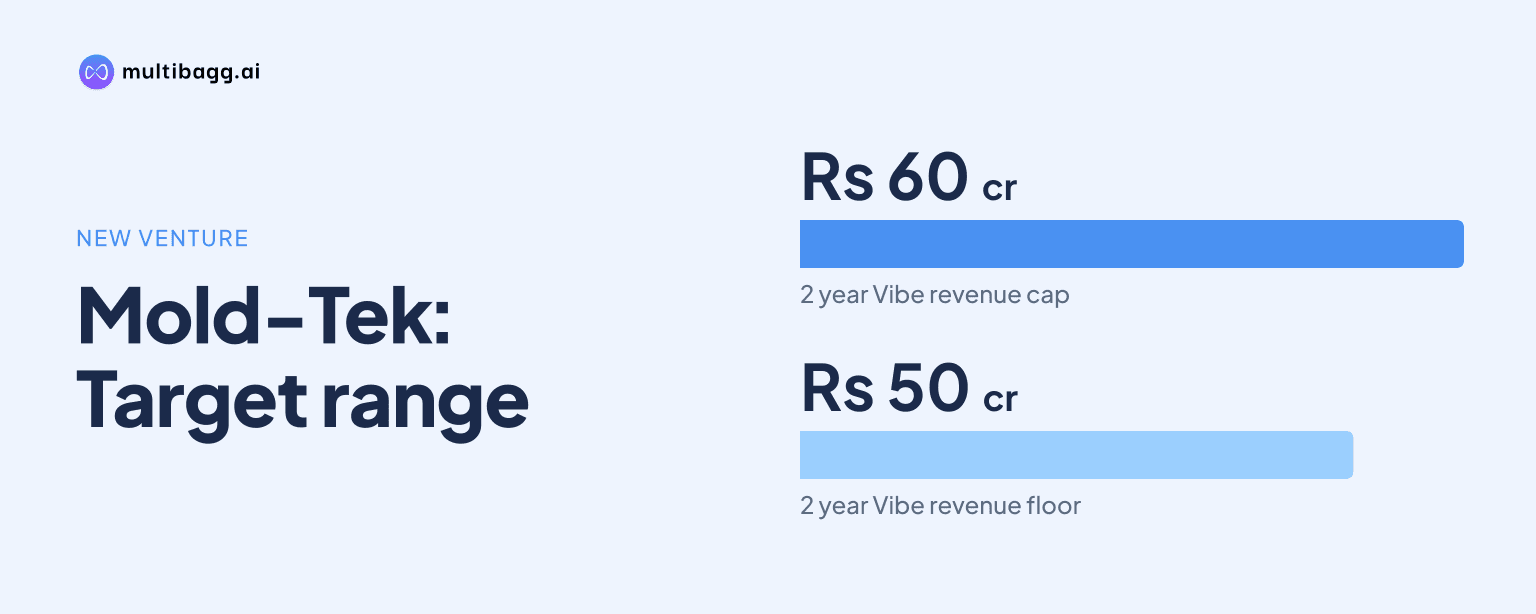
Mold-Tek Packaging Limited said its Vibe specialty-closures venture could generate Rs 50 crore to Rs 60 crore of annual revenue within two years at EBITDA margin of around 30%. The target follows approval of seven products for client trials in November, with management expecting commercial production around March or April if orders follow.
Know Mold-Tek Packaging inside out
Results, valuation, peers and who's buying, in one view.
What revenue and margin has Mold-Tek projected for Vibe?
Mold-Tek has projected Vibe revenue of at least Rs 50 crore to Rs 60 crore within two years, with EBITDA margin of around 30%. Chairman and Managing Director J. Lakshmana Rao gave the target in response to an analyst’s question on the specialty-closures opportunity and said the margin would be higher than the pharma business.
This is a management outlook rather than reported revenue. Mold-Tek said Vibe volumes would build gradually and become a considerable business in one or two years, meaning the revenue target depends on successful client trials, orders and a subsequent manufacturing ramp.
The Vibe target can be compared with Mold-Tek’s existing pharma plan, although the two businesses are at different stages. Management said pharma turnover was Rs 24 crore in the first half and was on track to exceed Rs 50 crore for the full year, while Vibe is expected to start generating revenue only in the next financial year.
Mold-Tek’s Q2 FY27 performance provides context for its focus on specialised products. Sales volume rose 10.1% year on year, profit increased 36%, and EBITDA per kg rose to Rs 46.5 from about Rs 39 in the prior-year quarter, with pharma and food and fast-moving consumer goods, or FMCG, growing faster than lubricant packaging.
What products will Mold-Tek make through Vibe?
Mold-Tek will manufacture specialty closures and spouts for Vibe, while Vibe will handle marketing. Management described the line as being mainly intended for the United States and European markets, separating it from Mold-Tek’s domestic discussions on auto-injector pens.
Seven Vibe products had been developed and approved before the Q2 FY27 call, and they were scheduled for commercial client trials in November. Management said the products had already undergone internal testing, but it had not reported orders from customers at the time of the call.
The identified manufacturing sequence is important because commercial moulds are needed after orders are received. Mold-Tek said making those moulds could take another four months, placing a defined lead time between a successful commercial trial and commercial output.
Mould development is central to Mold-Tek’s role in the venture. Management also cited its tool room and mould-making expertise in discussing semiconductor trays, where several product variants and moulds may be required, although it described semiconductor packaging as an opportunity from 2028 onward rather than part of Vibe’s near-term plan.
When could Mold-Tek begin Vibe production and revenue?
Mold-Tek expects Vibe commercial production around March or April, subject to November client trials producing orders and commercial moulds being completed. The March-April timing is therefore conditional, not a committed production-start date.
Management expects Vibe to begin contributing revenue in the next financial year. It did not give a first-year revenue target, quarterly sales forecast or committed customer volume, and the Rs 50 crore to Rs 60 crore objective applies to the two-year ramp rather than the initial launch period.
Vibe’s prospective launch is broadly aligned with another mould-led product introduction. Mold-Tek said ophthalmic eye-dropper moulds were expected by January, followed by at least two months of trials, with the products potentially ready for testing and commercial production by March; ophthalmic revenue is expected from the next financial year.
The core packaging business is also adding products while Vibe is prepared. Food and FMCG volume grew 23.7% in Q2 FY27 and pharma volume rose 26.3%, compared with a 12.3% decline in lubricant-pack volume, underscoring the different growth rates across the existing portfolio.
Got a follow-up? Ask IRIS
How does Vibe fit Mold-Tek’s product-mix strategy?
Vibe fits Mold-Tek’s stated shift toward lighter products that generate more value per unit of weight. Management said paint volume rose 8.6% in Q2 FY27 while paint value increased 26%, and it expects food, FMCG, pharma and eventually Vibe to make a larger contribution to revenue and EBITDA than weight-based volume alone suggests.
Mold-Tek’s overall volume growth was 8% in the first half of FY27, improving from 7% in Q1 to 10.1% in Q2. Management retained its aim of double-digit volume growth for the full year, while saying EBITDA growth was a more relevant measure as the mix shifts from heavy paint pails to thin-wall food and pharma packs.
Management expects EBITDA per kg of around Rs 45 to Rs 46 for the established business in the full year, compared with Rs 40.7 in the previous full year. That measure is not directly comparable with Vibe’s projected 30% EBITDA margin because the former is calculated per kg and the latter is a percentage of revenue.
Mold-Tek also expects wider packaging capacity of 66,900 tonnes to reach about 70,000 tonnes by the beginning of the next financial year. Management indicated output could rise from an estimated 46,000 to 47,000 tonnes in FY27 to 50,000 to 51,000 tonnes in the following year, without allocating specific capacity to Vibe.
What could affect Mold-Tek’s Vibe revenue ramp?
The immediate dependencies are client trials, orders and the four-month commercial-mould cycle. Although seven products were approved for November trials, a delay in customer validation or ordering would move the management’s March-April production expectation.
Vibe is intended mainly for US and European markets, while Mold-Tek said export growth had been steady rather than rapid because freight costs had increased amid conflict. Management did not disclose assumed Vibe export volumes, customer concentration, pricing or currency conditions behind the Rs 50 crore to Rs 60 crore target.
Raw-material costs are another disclosed consideration for the wider business, though management did not link them specifically to Vibe. It said finance cost had increased from 4.1% of revenue to nearly 5% as higher raw-material prices increased working-capital use, and it was factoring finance cost of 4.5% to 4.7% for the year.
Conclusion
Mold-Tek has set a quantified two-year goal for Vibe of Rs 50 crore to Rs 60 crore in revenue and EBITDA margin of around 30%, making specialty closures a planned addition to its higher-value product mix. The target follows Q2 FY27 volume growth of 26.3% in pharma and 23.7% in food and FMCG, against a 12.3% decline in lubricant packs.
The next disclosed milestones are November commercial client trials for the seven Vibe products, orders following those trials and commercial-mould production that management said could take four months. The key point to watch is whether production begins around March or April and whether Vibe starts contributing revenue in the next financial year, as management expects.