










Mold-Tek Packaging expects Rs 45-46 EBITDA per kg in FY27
Key highlights
- Mold-Tek reported Rs 46.5 EBITDA per kg in Q2 FY27, versus about Rs 39 in Q2 FY26.
- Food and FMCG volume grew 23.7% and pharma volume rose 26.3% in Q2 FY27.
- Lubricant-pack volume fell 12.3% in Q2 FY27, while paint volume rose 8.6%.
- Mold-Tek reported Rs 24 crore of pharma turnover in H1 FY27 and is targeting Rs 50 crore-plus for FY27.
powered by IRIS
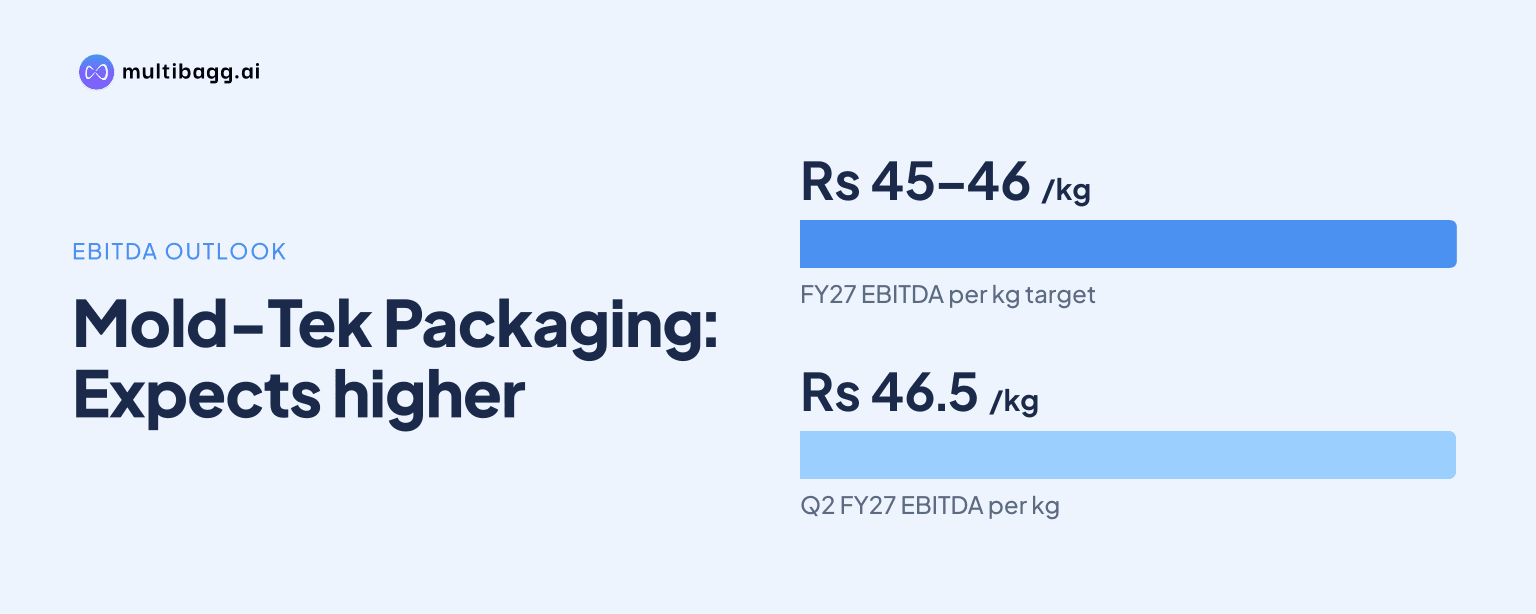
Mold-Tek reported Rs 46.5 of EBITDA per kg in Q2 FY27 and management expects Rs 45-46 per kg through FY27, citing food, fast-moving consumer goods (FMCG) and pharma volume growth of 23.7% and 26.3%, respectively, against a 12.3% decline in lubricant packs.
Know Mold-Tek Packaging inside out
Results, valuation, peers and who's buying, in one view.
Why did Mold-Tek's EBITDA per kg rise in Q2 FY27?
Mold-Tek's EBITDA per kg rose because faster-growing packaging segments made a larger contribution than lubricant packs. Q2 FY27 sales volume increased 10.1% year on year, while profit rose 36%, taking EBITDA per kg to Rs 46.5 from about Rs 39 in Q2 FY26. Management described the almost 18% improvement in the per-kg measure as the result of better-contributing segments growing faster than paint and lubricants.
Food and FMCG volume grew 23.7% in Q2 FY27 and pharma volume increased 26.3%, both ahead of Mold-Tek's 10.1% overall volume growth. Paint volume rose 8.6%, while lubricant-pack volume fell 12.3%. The mix shifted towards food, FMCG and pharma during the quarter because these segments expanded faster than the company average while lubricants contracted.
Can Mold-Tek maintain Rs 45-46 EBITDA per kg?
Mold-Tek's management said it was confident of maintaining EBITDA per kg in a Rs 45-46 range after delivering Rs 46.5 in Q2 FY27. The chairman said Q3 FY27 had started strongly and that the ongoing momentum could support the range. This is management's expectation, rather than a formal financial forecast, and depends on continued execution in food, FMCG and pharma.
The Rs 45-46 range would remain above the Rs 40.7 per kg EBITDA that management cited for full-year FY26. Management said Rs 46 per kg would be a significant increase over that FY26 result while double-digit volume growth remained possible. The comparison points to a higher per-unit outcome despite the continued decline in lubricant-pack volumes.
Which segments are changing Mold-Tek's product mix?
Food, FMCG and pharma are changing Mold-Tek's mix because their Q2 FY27 volume growth of 23.7% and 26.3%, respectively, exceeded paint's 8.6% growth and contrasted with the 12.3% lubricant decline. Management said the faster growth of these better-contributing segments was the principal reason profitability improved in the quarter.
Paint also added growth, although at a slower rate than food, FMCG and pharma. Management said paint value rose 26% in Q2 FY27 and described 8% to 10% as the general growth range for the paint industry. Orders from customers near the Cheyyar facility were being added gradually, and management said paint growth could approach double digits in the second half.
Pharma is another part of the mix plan. Mold-Tek reported pharma turnover of Rs 24 crore in H1 FY27 and said it was on track for Rs 50 crore-plus turnover in FY27. That target implies a larger second-half contribution, although management did not disclose a segment margin or the value of individual pharma orders.
Got a follow-up? Ask IRIS
Why are lubricant packs still weighing on Mold-Tek?
Lubricant packs are weighing on Mold-Tek because volume declined 12.3% in Q2 FY27 and management said the H1 FY27 decline had reached almost 15%. The chairman attributed the pressure to input issues at a couple of major private lubricant companies and lost volumes from some clients. Management also said Mold-Tek does not supply public-sector lubricant companies.
Management indicated that the lubricant trend could remain negative through FY27 rather than outlining a near-term recovery. It said the year-on-year comparison was affected because the prior year did not have the same war-related or disruption-related conditions. Food, FMCG, pharma and Qpack therefore need to grow faster to offset lower lubricant volumes.
Qpack was expanding into detergents and had received an order from another major player, with supplies expected to begin at the end of November 2026. Artwork had been shared and labels were under development when management spoke on November 2, 2026. Management did not disclose the customer, order value or expected volume, but said the programme could add to results in coming quarters.
What projects could add to Mold-Tek's food, FMCG and pharma growth?
Mold-Tek expects the Panipat plant, the revived Iodex balm project and new customer programmes to add to food and FMCG growth. Management said Panipat had begun adding clients and anticipated better northern-region numbers from January or February 2027. The Iodex project, which had been on hold for more than three years, was cleared with changes, with commercial production expected in December 2026 or January 2027.
Management also said three products for three multinational companies were under development and expected to launch around late December 2026 or January 2027. It described the programmes as sizeable in quantity and said they would support food and FMCG growth in coming years. Separately, three or four new food and FMCG products were moving into production in November and December 2026, with new moulds being added.
In pharma, ophthalmic eye-dropper-pack moulds were expected to be ready by January 2027, followed by at least two months of trials. Management said products in three sizes could be ready for testing and commercial production by March 2027, with revenue expected from the first or second quarter of the next financial year. By contrast, dosage-pen discussions and sample evaluations were continuing, with little expected over the following six months.
Conclusion
Mold-Tek's Q2 FY27 performance indicates that product mix, rather than total volume growth alone, drove the increase in EBITDA per kg. Total sales volume rose 10.1%, while food and FMCG grew 23.7% and pharma grew 26.3%; lubricant packs fell 12.3%. That divergence helped lift EBITDA per kg to Rs 46.5 and underpins management's Rs 45-46 expectation.
The next disclosed milestones are the Panipat ramp-up from January or February 2027, the expected December 2026 or January 2027 start for Iodex balm packs, and food and FMCG launches around late December 2026 or January 2027. Mold-Tek's progress towards its Rs 50 crore-plus FY27 pharma turnover target and the unresolved lubricant-volume decline will also determine how the mix develops.