










Mold-Tek targets ₹250 crore EBITDA and FY27 cash surplus
Key highlights
- Mold-Tek targets FY27 EBITDA of Rs 250 crore, compared with Rs 173 crore last year.
- Management targets FY27 cash flow of Rs 215 crore, compared with Rs 107 crore previously.
- FY27 capital expenditure is expected at Rs 75 crore to Rs 80 crore, including Rs 60 crore spent in the first seven months.
- Management said overall debt may start declining by FY27 year-end if the projected cash surplus is delivered.
powered by IRIS
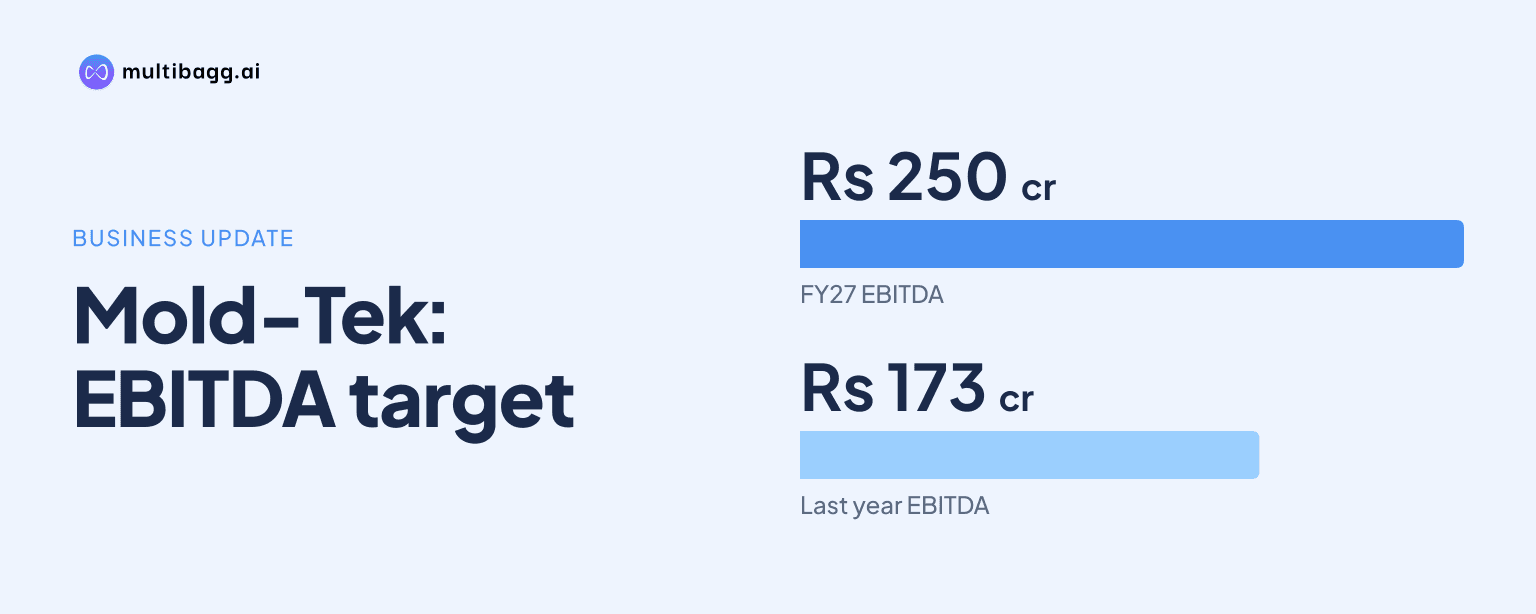
Mold-Tek is targeting Rs 250 crore of EBITDA in FY27, versus Rs 173 crore last year, and management expects lower capital expenditure of Rs 75 crore to Rs 80 crore to leave a cash surplus that could start reducing overall debt by year-end. Its cash-flow target is Rs 215 crore, compared with Rs 107 crore previously.
Know Mold-Tek Packaging inside out
Results, valuation, peers and who's buying, in one view.
How does Mold-Tek expect to generate a FY27 cash surplus?
Mold-Tek expects a FY27 cash surplus by targeting Rs 215 crore of cash flow while restricting full-year investment to Rs 75 crore to Rs 80 crore. Management said it was maintaining the cash-flow objective announced at the beginning of the year, which is double the earlier Rs 107 crore level.
The company had spent Rs 60 crore during the first seven months, leaving planned expenditure on machinery, one printing machine, balancing equipment and moulds. Management said investment was at lower levels than during the preceding three to four years, which is the principal change behind its expectation that more operating cash can remain available.
Management described expected inflows, after interest, income tax and dividend outflows, at about Rs 100 crore to Rs 125 crore, against further outflows of Rs 80 crore to Rs 85 crore. It said this would create adequate cash in the system, but this is a management forecast rather than reported free cash flow for FY27.
What is Mold-Tek targeting for FY27 EBITDA?
Mold-Tek is targeting FY27 EBITDA of Rs 250 crore, which management said would be about 23% to 24% above Rs 173 crore in the previous year. The target exceeded an analyst's assumption of Rs 210 crore to Rs 220 crore, and management reaffirmed Rs 250 crore during the cash-flow discussion.
Management said EBITDA, or earnings before interest, tax, depreciation and amortisation, had increased by almost 30% in absolute terms in the first half, while profit before tax rose 35% year on year. It also said EBITDA per kilogram increased to Rs 46.60 in the current first half from Rs 40.60 in the prior-year first half, an increase of about 15% to 18% over two quarters.
The company reported first-half volume growth of about 8%, compared with 7% in the first quarter, and management still aims for double-digit volume growth for FY27. It said October was its best month so far on a month-on-month growth basis, although April through July are seasonal demand months and demand normally picks up again in February and March.
Why is Mold-Tek spending less on expansion?
Mold-Tek expects capital expenditure to ease because capacity added during the year and machines already on order should lift capacity from 66,900 to around 70,000 by the beginning of the next financial year. Management therefore did not signal a major additional capacity requirement for FY28.
Management expects production tonnage to rise from around 42,000 tonnes last year to about 46,000 to 47,000 tonnes in FY27, followed by 50,000 to 51,000 tonnes in the next financial year. It said around 70% utilisation is appropriate in injection moulding, while utilisation above 75% is generally not workable because mould complexity can leave machine capacity unused.
The lower spending plan does not rule out selective projects. For Vibe, management said a Phase 1 investment of around Rs 10 crore to Rs 15 crore in moulds and machinery could support turnover of roughly Rs 40 crore to Rs 50 crore, but it will wait for firm commercial orders before committing the expenditure.
Got a follow-up? Ask IRIS
When could Mold-Tek's debt start declining?
Mold-Tek said overall debt, including long-term debt, may begin declining by the end of FY27 if it delivers the projected cash surplus. Management did not disclose a debt balance, a repayment amount or a formal debt-reduction schedule, so the outlook depends on achieving the Rs 215 crore cash-flow target and Rs 75 crore to Rs 80 crore capital-spending range.
Working-capital funding remains exposed to raw-material prices. Management said higher raw-material prices increased short-term working-capital usage and lifted finance cost from 4.1% of revenue earlier to almost 5%; it is budgeting finance cost at about 4.5% to 4.7% of revenue for the year.
Management said finance cost could return to about 4% to 4.2% of revenue if raw-material prices decline. It added that raw-material prices had risen 60% over the preceding six months and were not expected to fall quickly unless there was a sudden resolution of the West Asia conflict.
What supports Mold-Tek's higher cash-generation target?
Mold-Tek's plan relies partly on a product mix that generates more value per tonne than its older paint-heavy portfolio. Management said a 20-litre paint pail weighs about 1 kilogram, while thin-wall food and pharmaceutical products such as ice-cream cups weigh only 18 grams to 25 grams, yet can generate higher revenue and EBITDA per tonne.
Management said 10% growth under the changing mix may be broadly comparable to 14% to 15% growth under the product mix of the prior three years. Food, fast-moving consumer goods and pharmaceutical packaging are expected to account for more growth, while paint contribution to tonnage is broadly stagnant and lubricants are declining.
In-mould labelling, or IML, represented 77% of volume and 78.25% of value in the reported quarter. The value share rose from 76%, while management said rising IML adoption by Asian Paints was one contributor to growth in paint packaging.
Pharmaceutical packaging is another stated growth area. Management said it was adding two or three large pharmaceutical clients each quarter and projected pharmaceutical revenue of more than Rs 50 crore for the full year, followed by Rs 70 crore to Rs 75 crore in the next financial year.
Conclusion
Mold-Tek's expected FY27 cash surplus combines a Rs 250 crore EBITDA target, a Rs 215 crore cash-flow objective and capital expenditure of Rs 75 crore to Rs 80 crore. Relative to Rs 173 crore of EBITDA last year and the investment levels of the preceding three to four years, management expects more cash to remain after funding equipment, interest, tax and dividends. A reduction in overall debt is an anticipated outcome, not a quantified commitment.
The next items to watch are whether second-half volume growth reaches management's 10% target, completion of the remaining Rs 15 crore to Rs 20 crore of planned capital expenditure, and finance-cost movement within the projected 4.5% to 4.7% of revenue range. Management also expects seven Vibe products to move toward commercial mould development after trials, while ophthalmic production at Sultanpur B block is planned to start by March and commercial production by April or May of the next year.