










Moneyview targets over Rs 800 crore FY27 profit, 40% income growth
Key highlights
- Moneyview is targeting more than Rs 800 crore of FY27 PAT and at least 40% top-line growth.
- Moneyview reported Rs 375 crore of PAT in H1 FY27 and Rs 201 crore of profit in Q2 FY27.
- Q2 FY27 disbursals were Rs 7,701 crore, while managed AUM was about Rs 23,900 crore at September-end.
- Moneyview's average borrowing cost fell to 14% from 14.8%, while incremental borrowing costs were about 12.5% to 12.8%.
powered by IRIS
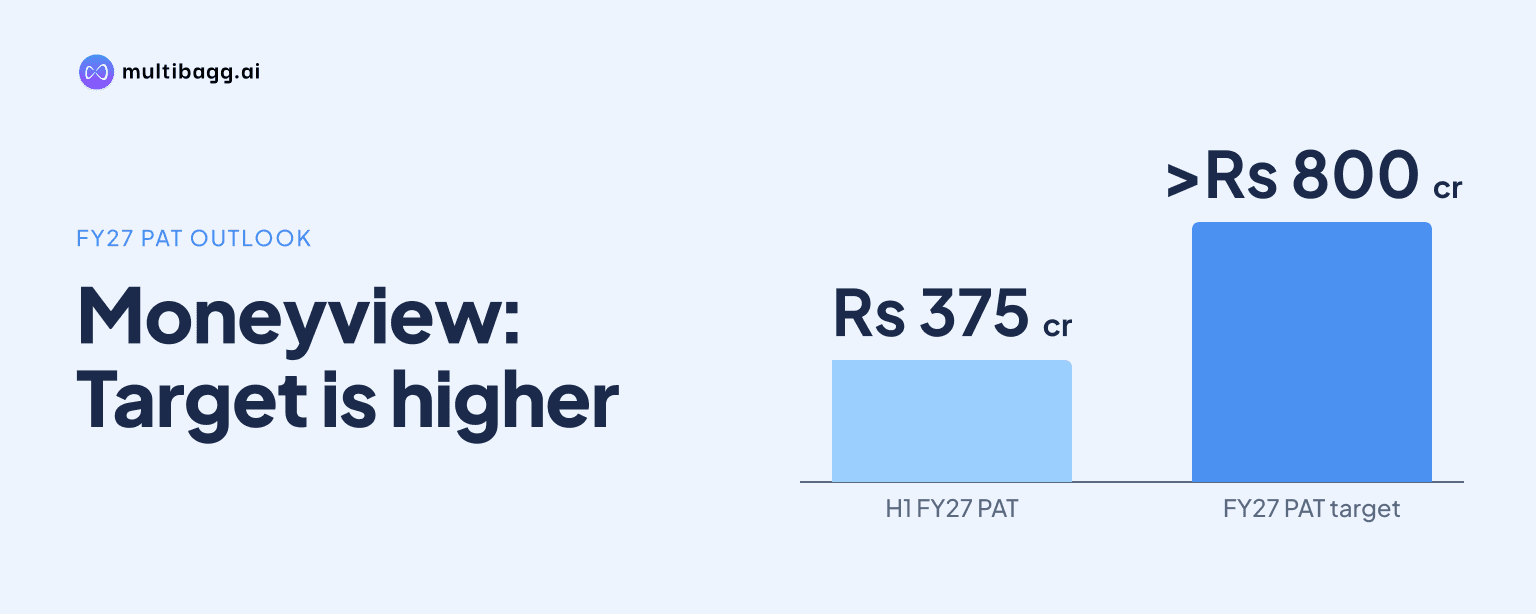
Moneyview Limited is targeting profit after tax of more than Rs 800 crore and at least 40% top-line growth in FY27, after reporting Rs 375 crore of profit after tax in H1 FY27. Management said festive-season disbursal momentum, lower funding costs, partnership margins and operating efficiencies are expected to support the plan.
Know Moneyview inside out
Results, valuation, peers and who's buying, in one view.
What is Moneyview targeting for FY27?
Moneyview is targeting at least 40% top-line growth and profit in excess of Rs 800 crore for FY27. Chief Financial Officer Saurav Goyal said the profit ambition would amount to more than 100% growth over the prior year's normalized profit, with operating efficiency and margin improvement contributing alongside loan-volume growth.
The target follows Rs 375 crore of profit after tax, or PAT, in H1 FY27. Chief Executive Officer Puneet Agarwal said Moneyview was entering the festive season with continued momentum in disbursals, collections and operating efficiency, while management characterized the outlook as an ambition rather than a guarantee.
Management identified four levers for the FY27 plan: disbursal growth, a lower cost of capital in its non-banking financial company, or NBFC, operating leverage and lower customer acquisition cost, or CAC. Goyal also said Moneyview intends to improve the 23.5% margin cited on the call through the rest of FY27.
What did Moneyview report in Q2 FY27?
Moneyview reported Q2 FY27 disbursals of Rs 7,701 crore, up 7% quarter on quarter, and managed assets under management, or AUM, of about Rs 23,900 crore at the end of September. Total income increased 8% from the preceding quarter to Rs 1,146 crore, while quarterly profit rose 16% to Rs 201 crore.
Profit grew faster than income during Q2 FY27. Management said pre-tax margin increased to 23% of total income from 21% in the prior quarter, driven by higher partnership-business margins, lower NBFC funding costs, better credit costs and operating efficiencies.
Moneyview reported return on equity, or ROE, of 27.9% for the quarter after correcting the initially stated 27.8% figure. Management said this calculation included initial public offering, or IPO, capital in the equity base; it separately said normalized ROE, excluding the new IPO equity from net worth, rose to 31% from 29%.
How will lower borrowing costs support Moneyview's FY27 plan?
Moneyview said its average cost of borrowing fell to 14% from 14.8% in Q2 of the previous year, while current incremental borrowing costs were about 12.5% to 12.8%. Goyal attributed the reduction to the earlier rating move from the BBB category to A- with a positive outlook.
The company gave a similar H1 FY27 comparison: incremental borrowing costs were 12.7% to 12.8%, against an average 14.5% to 14.8% in the prior year. Management described this as about a 2 percentage-point benefit on new borrowing, while noting that the effect on the profit and loss account takes time as older debt is repaid.
Moneyview expects the average funding cost to decline further over the next year as lower-cost borrowings replace existing facilities. Its own NBFC accounts for 25% of the business, while lending partners provide capital for 75% through the lending service provider, or LSP, model; management said an improved NBFC cost of capital can also support platform margins.
Got a follow-up? Ask IRIS
How are operating leverage and customer acquisition costs changing?
Moneyview said CAC was 1.6% of disbursals in the quarter ended September, compared with roughly 1.9% to 2% a year earlier. Goyal attributed the lower blended ratio to the mix of direct sourcing, embedded partner journeys and repeat customers, while agreeing that new-customer CAC was unchanged.
Repeat customers account for almost 65% of Moneyview's AUM. Of newly acquired customers, management said about 75% are sourced directly and 25% through embedded journeys with large consumer-internet partners; within direct sourcing, organic and paid marketing each account for roughly half.
Technology is another stated efficiency lever in the FY27 plan. Moneyview said its cloud-native, modular engine manages customer journeys from application through servicing, with artificial intelligence embedded across functions, and management said technology use is reducing operating costs.
What will Moneyview do with its IPO capital?
Moneyview invested Rs 250 crore of IPO proceeds in its NBFC during October and retained the balance at the platform. Shares were allotted on September 29, but management said the money became effectively available only after the October 1 listing because it had been held in a monitoring account.
Management said it does not plan to use the proceeds to repay debt. Instead, Goyal said Moneyview intends to use the additional NBFC capital to raise debt for business growth and is discussing with rating agencies whether the new equity can support a further rating improvement.
Asset-quality indicators were stable through October, according to management. September collection efficiency was 98.64%, October was at a similar level, and Stage 1 assets were 94.6% for the quarter ended September, similar to the preceding quarter.
Conclusion
Moneyview's FY27 plan combines more than Rs 800 crore of PAT with at least 40% top-line growth, following Q2 FY27 disbursals of Rs 7,701 crore, total income of Rs 1,146 crore and profit of Rs 201 crore. Management's stated mechanisms are lower NBFC borrowing costs, partnership economics, lower blended CAC and technology-led operating leverage.
The next issues to watch are whether festive-season disbursals maintain momentum, whether collection efficiency remains close to September's 98.64%, and how quickly the average borrowing cost declines from 14% toward the 12.5% to 12.8% incremental range. Management's rating-agency discussions after the Rs 250 crore NBFC capital infusion also remain unresolved.