










Moneyview says repeat-led lending helps lower acquisition costs
Key highlights
- Moneyview said almost 65% of its business comes from repeat customers.
- Moneyview said direct channels supply about 75% of new customers, while embedded journeys supply about 25%.
- Moneyview reported CAC of 1.6% of September-quarter disbursals, versus roughly 1.9%-2% a year earlier.
- Moneyview said its largest platform-capital partner contributes about 10%-11%, with no partner above 13%-14%.
powered by IRIS
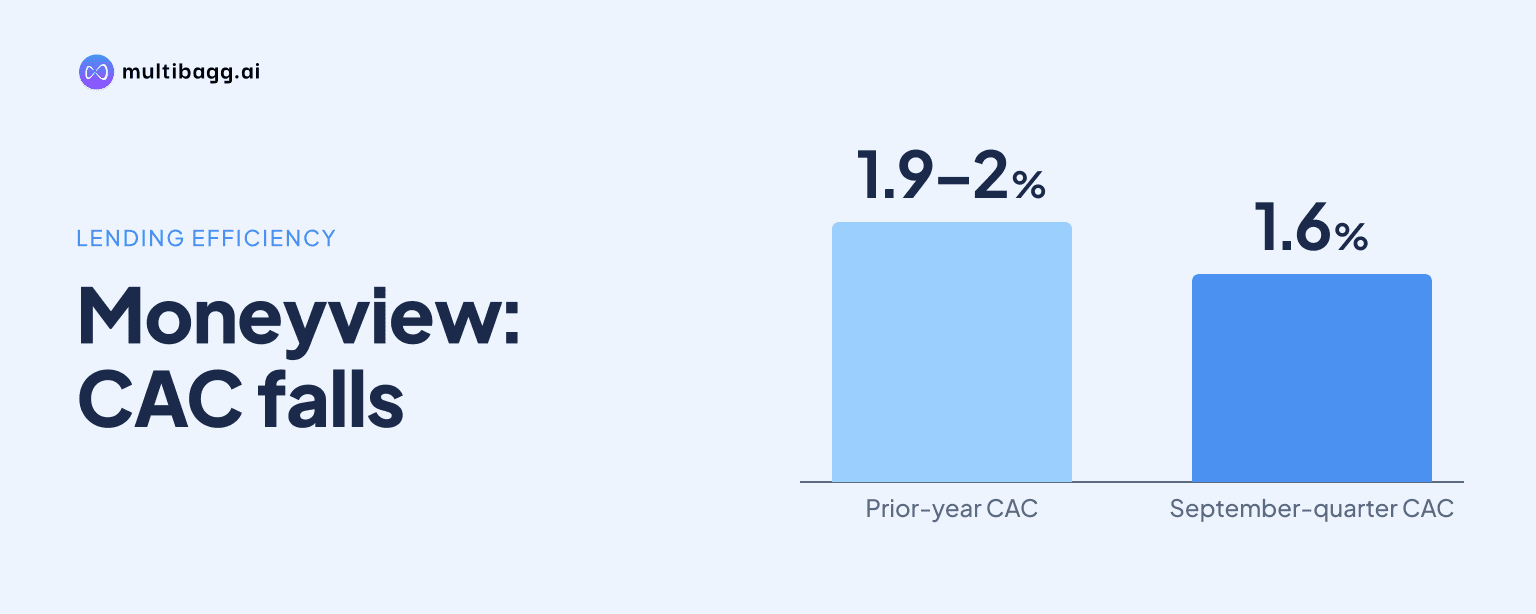
Moneyview said almost 65% of its business came from repeat customers, and management linked that mix to customer acquisition cost of 1.6% of disbursals in the quarter ended September, down from roughly 1.9%-2% a year earlier. Direct channels accounted for about 75% of new customers, while its largest platform-capital partner represented about 10%-11%.
Know Moneyview inside out
Results, valuation, peers and who's buying, in one view.
How does Moneyview source lending customers?
Moneyview sources most lending activity from existing users, with repeat customers accounting for almost 65% of its business. For new customers, management separates acquisition into direct sourcing and embedded journeys with partners. The repeat share matters because returning customers do not require the same acquisition process as a new user joining the platform.
Moneyview said direct channels deliver about 75% of new customer acquisitions. Organic and paid marketing each account for roughly half of this direct share, management said, without disclosing the separate volumes or spending behind either source. The other 25% of new customers comes through embedded journeys with large consumer-internet partners.
Moneyview said its risk-assessment engines are integrated with partner data in these embedded journeys, allowing its offers to be presented to partner customers. Management did not name those partners or give channel-level volumes, but described the 25% embedded share as a distinct acquisition route alongside direct sourcing.
Why has Moneyview's acquisition cost declined?
Moneyview said customer acquisition cost, or CAC, declined to 1.6% of disbursals in the quarter ended September from roughly 1.9%-2% a year earlier. The 0.3-0.4 percentage-point change was attributed to the growing share of repeat business, the direct-business mix and embedded partnerships, rather than a disclosed reduction in the cost of acquiring every new customer.
Management identified three mechanisms behind the lower blended CAC: direct business can benefit as brand awareness grows, embedded-partnership CAC does not materially change, and repeat transactions reduce acquisition cost across total disbursals. When an analyst asked whether CAC at the new-customer level was probably unchanged, management agreed.
Moneyview also said operating expenses were 34.5% of total income in the current quarter, compared with 35.9% in the previous quarter. For the first half, the ratio was roughly 35%, compared with close to 39% in the first half of the prior year. Management corrected its initial description of the measure, clarifying that it was operating expenses as a percentage of total income rather than assets under management.
Got a follow-up? Ask IRIS
How diversified is Moneyview's lending-partner funding?
Moneyview said 75% of its business uses platform capital and 25% is funded through its own non-banking financial company, or NBFC. The platform had close to 17 live lending partnerships, and management said its objective is to add two to three new partnerships each year to reduce dependence on any individual balance-sheet provider.
Moneyview said no platform partner contributes more than 13%-14% of platform capital, while its largest current partner represents about 10%-11% of the mix. Management said the balance is distributed across partnerships, but did not disclose lender-by-lender allocations or provide a detailed split between banks and NBFCs.
Moneyview said it had onboarded one bank last year or in the early part of the current year and was integrating with additional banks. Management said these integrations take time, but adding partners with lower costs of capital could enable the platform to lend to a larger set of users and improve its margins.
What links Moneyview's funding costs to platform margins?
Moneyview said lower funding costs at its NBFC can influence economics across the platform because the NBFC is one of the largest platform partners. Its average borrowing cost had fallen to 14% from 14.8% in the comparable earlier period, while incremental borrowing in the first half was about 12.7%-12.8%.
Management said the lower incremental rate would reach the profit and loss account gradually as older borrowings are repaid. It said last year's average borrowing cost was about 14.5%-14.8%, indicating a reduction of roughly 2 percentage points in the cost of new funding. Management expects the average rate to continue moving lower over the next year.
Moneyview downstreamed Rs 250 crore of IPO proceeds into the NBFC in October and said it did not intend to use the capital to repay debt. Management said the purpose was to support additional borrowing and growth. It was also discussing a possible rating improvement with rating agencies after a previous move from the BBB category to A- with a positive outlook.
Conclusion
Moneyview's model combines repeat-led business, direct acquisition and a dispersed platform-capital base. Almost 65% of business from repeat customers and direct sourcing of about 75% of new customers underpin management's explanation for CAC falling to 1.6% of September-quarter disbursals. Close to 17 lending partnerships and a largest-partner share of about 10%-11% provide the disclosed evidence of funding diversification.
The next developments to watch are Moneyview's plan to add two to three lending partnerships annually, progress on additional bank integrations and whether incremental borrowing costs of 12.7%-12.8% feed through as older debt is repaid. Management also expects at least 40% full-year top-line growth and profit above Rs 800 crore while pursuing further operating-efficiency and margin improvement.