










NCC cuts trade-receivable days to 53 as retention money rises
Key highlights
- NCC reduced trade-receivable days to 53 in Q2 FY27 from 68 in June and 78 a year earlier.
- Retention money increased Rs 151 crore sequentially to Rs 2,547 crore at September 30, 2026.
- Unbilled revenue declined Rs 240 crore sequentially to Rs 7,174 crore, equal to 37% of revenue.
- Consolidated net debt increased to Rs 3,887 crore at September 30, 2026, from Rs 3,513 crore in June.
powered by IRIS
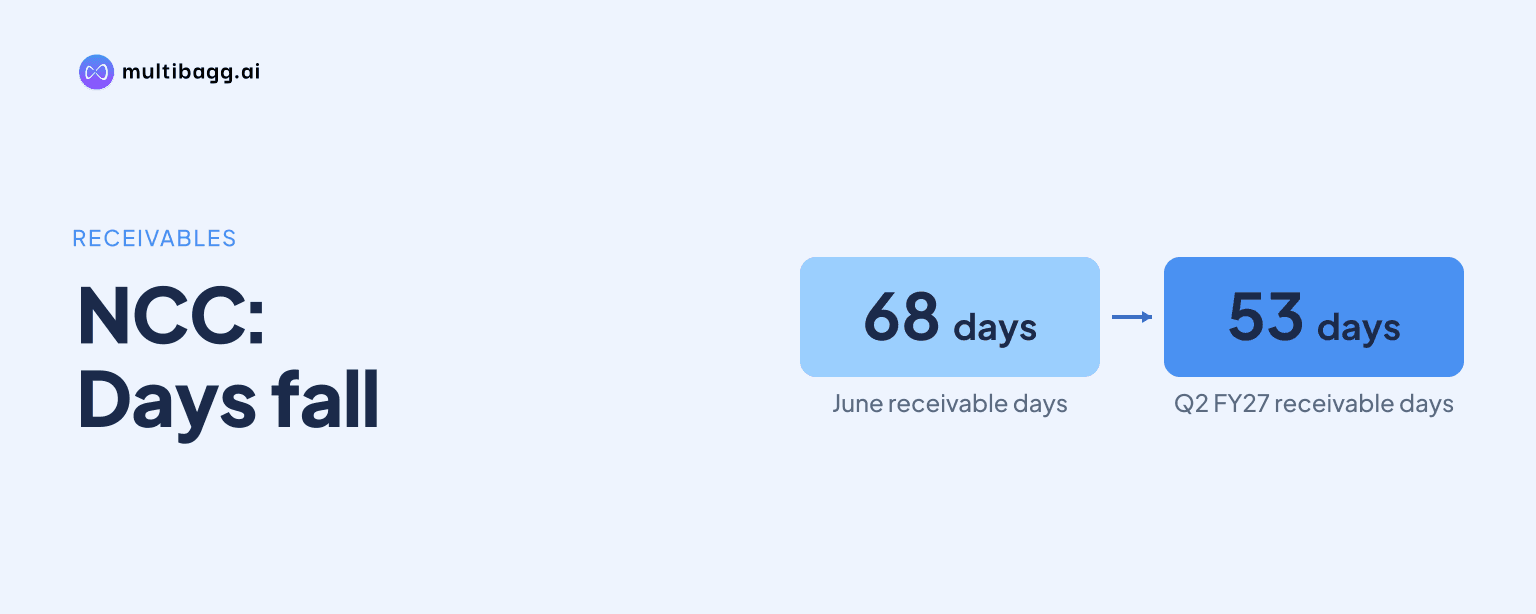
NCC Limited reduced trade-receivable days to 53 in Q2 FY27 ended September 30, 2026, from 68 days in June, while retention money increased Rs 151 crore sequentially to Rs 2,547 crore as newer contracts generally carry retention clauses, including up to 20% in some electrical contracts.
Know NCC inside out
Results, valuation, peers and who's buying, in one view.
Why did NCC's trade-receivable days fall to 53?
NCC's trade-receivable days fell because payment cycles improved generally, including Jal Jeevan Mission payments, management said. Trade receivables declined Rs 358 crore to Rs 2,697 crore at September 30 from Rs 3,055 crore at June 30. The days measure declined 15 days sequentially from 68 and was also below 78 days in Q2 FY26.
Management said Jal Jeevan Mission payments were arriving regularly. As on the call date, NCC put its outstanding across Jal Jeevan Mission projects in various states at Rs 2,246 crore. It separately cited Rs 344 crore of trade receivables and Rs 2,009 crore of unbilled revenue for those projects, showing that the company tracks billed and unbilled project amounts separately.
Why did NCC's retention money rise to Rs 2,547 crore?
NCC's retention money rose to Rs 2,547 crore at September 30 from Rs 2,396 crore in June and Rs 2,250 crore in March. The Rs 151 crore quarterly increase and Rs 297 crore six-month increase contrast with the reduction in trade receivables over the same periods. Retention money is withheld under contract terms and is released according to contractual conditions.
Management attributed the increase to contract mix. It said contracts worth about Rs 20,000 crore obtained around 1.5 years earlier had no retention-money requirement, whereas almost all current contracts carry 5% retention. Some contracts in the electrical transmission and distribution division have retention as high as 20%, and Mumbai concrete-road contracts also have high retention requirements.
NCC said reductions will depend on individual agreements rather than on a company-wide release target. Some contracts allow 50% of retention money to be substituted with bank guarantees after contract completion, while other amounts are released after the defect-liability period. Management said retention would continue to depend on contract composition and prevailing terms.
Is NCC's unbilled revenue improving?
NCC's unbilled revenue declined Rs 240 crore sequentially to Rs 7,174 crore in Q2 FY27, equal to 37% of revenue, from Rs 7,414 crore, or 38% of revenue, in June. The balance remained above Rs 6,663 crore in Q2 FY26, although its share of revenue then was higher at 41%. Both the lower absolute balance and lower revenue share marked a sequential change.
Management said engineering, procurement and construction, or EPC, contracts are billed against milestones rather than simply against quantities executed. It identified BharatNet and Andhra Pradesh Capital City projects as major contributors to the unbilled balance because substantial work is under way. Management said there was no sticky unbilled revenue and that amounts were progressively realising.
NCC nevertheless expects unbilled revenue to remain at a similar level in coming periods. That management outlook reflects the timing between execution and billing milestones on active projects, rather than a disclosed target to reduce the Rs 7,174 crore balance. Conversion into billed receivables will therefore remain linked to milestones under individual EPC contracts.
Got a follow-up? Ask IRIS
What happened to NCC's cash and debt in Q2 FY27?
NCC's standalone cash and cash equivalents declined to Rs 178 crore at September 30 from Rs 404 crore in June and Rs 584 crore in March, while standalone net debt rose to Rs 2,293 crore. Net debt is borrowings after cash and cash equivalents. The Rs 226 crore quarterly reduction in cash occurred alongside lower trade receivables and mobilisation advances.
Standalone debt increased Rs 61 crore from the beginning of Q2, while consolidated net debt rose Rs 374 crore from Rs 3,513 crore in June. The standalone debt-to-equity ratio was 0.32 at September 30, compared with 0.31 at June 30 and 0.29 a year earlier. Working capital excluding cash and margin-money deposits was Rs 5,532 crore, or 28% of turnover and 96 days.
Mobilisation advances declined to Rs 2,925 crore at September 30 from Rs 3,163 crore in June and Rs 3,386 crore in March. Of the September balance, 53% was interest-bearing at an average interest rate of 9.07%, compared with 60% at the start of Q2. Margin-money deposits and other balances rose to Rs 740 crore from Rs 633 crore in June.
Can NCC restore debt and working capital to March levels?
NCC management said it hopes to bring working capital and debt back to March 2026 levels by the end of FY27, but did not provide a numerical deleveraging target. The comment followed an analyst's question about the increase from March. It is management's stated expectation rather than a committed financial outcome.
Capital expenditure remains another demand on cash. NCC spent Rs 83 crore in Q2 FY27 and Rs 253 crore in the first half against a Rs 500 crore FY27 budget. Management said FY28 spending would generally be similar, although the Amrapali mining project in Jharkhand may require additional capital expenditure because it is capital-intensive.
Conclusion
NCC's Q2 FY27 working-capital position improved in some measures but not across all cash-related balances. Trade-receivable days fell to 53 and unbilled revenue declined to Rs 7,174 crore, while retention money increased to Rs 2,547 crore, cash fell to Rs 178 crore and consolidated net debt rose to Rs 3,887 crore.
The next developments to watch are billing progress on BharatNet and Andhra Pradesh Capital City projects, releases or bank-guarantee substitution of retention balances, and progress toward management's stated hope of returning debt and working capital to March 2026 levels by FY27-end. Management also expects to recover the full Rs 270 crore Vizag receivable by the end of Q4.