










NCC expects UP Jal Jeevan backlog completion by March 2027
Key highlights
- NCC expects substantial completion of its major Uttar Pradesh JJM backlog by March 2027.
- NCC reported JJM backlog excluding operations and maintenance of Rs 5,412 crore as of September 2026.
- NCC received about Rs 1,720 crore from JJM during the first half of FY27.
- NCC's trade receivables fell to Rs 2,697 crore and 53 days in Q2 FY27 from Rs 3,055 crore and 68 days.
powered by IRIS
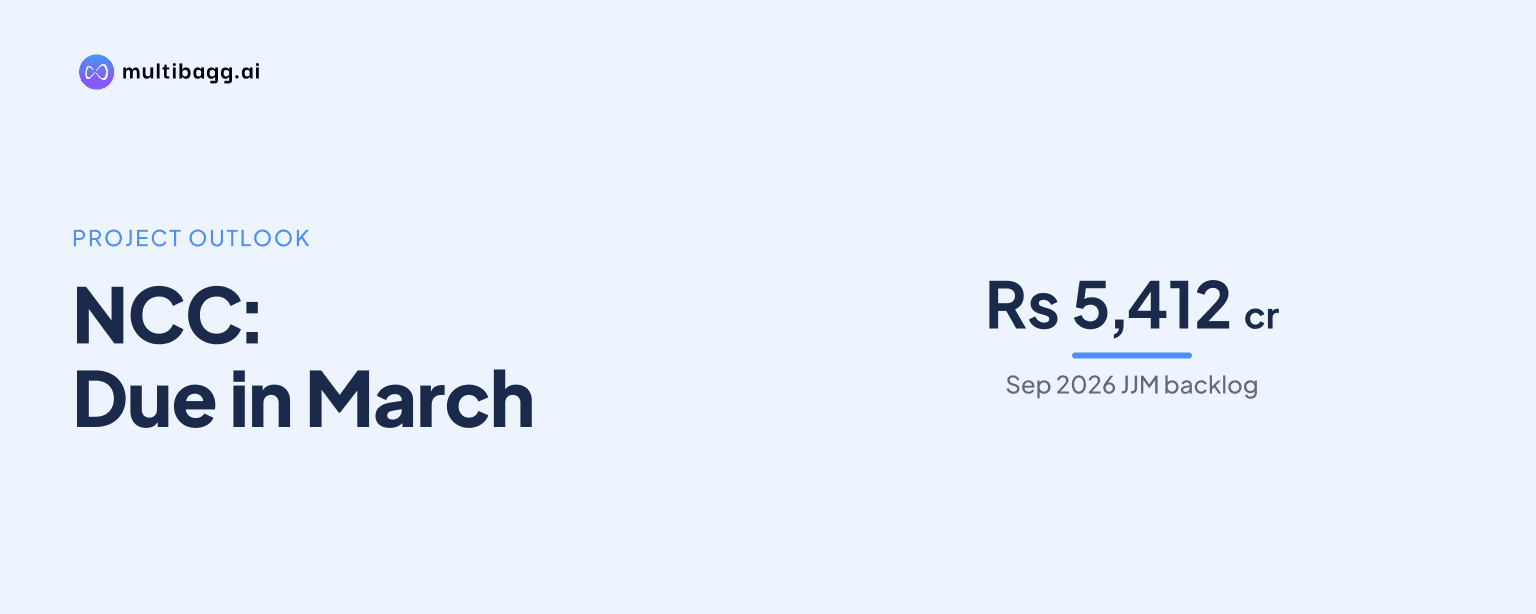
NCC expects its major Uttar Pradesh Jal Jeevan Mission backlog to be substantially completed by March 2027, while its total Jal Jeevan Mission backlog excluding operations and maintenance was Rs 5,412 crore as of September 2026. Management said JJM payments were arriving regularly and reported Rs 1,720 crore of programme receipts in the first half of FY27.
Know NCC inside out
Results, valuation, peers and who's buying, in one view.
When will NCC complete its Uttar Pradesh Jal Jeevan Mission work?
NCC expects the major Jal Jeevan Mission, or JJM, order backlog in Uttar Pradesh to be substantially completed by March 2027. Management made the statement while separating the main Uttar Pradesh work from new JJM projects received in other states, which are included in the broader outstanding portfolio.
NCC disclosed JJM order backlog of Rs 5,412 crore, excluding operations and maintenance, as of September 2026. During its explanation of the timeline, management referred instead to Rs 5,142 crore and said that amount included new JJM projects from other states; it did not reconcile the Rs 270 crore difference during the call.
The March 2027 statement covers substantial completion of the major Uttar Pradesh backlog rather than all JJM work nationally. New projects in other states remain part of the reported Rs 5,412 crore portfolio, so the transcript does not establish a completion date for NCC's entire JJM order book.
Have Jal Jeevan Mission payments improved for NCC?
NCC said payment cycles were improving generally, including for JJM projects, with payments coming regularly. The company received about Rs 1,720 crore from JJM during the first half of FY27, which is the clearest disclosed measure of programme collections for the six-month period.
As of the call, NCC put outstanding balances across JJM projects in several states at Rs 2,246 crore. When asked for the composition, management cited Rs 344 crore of trade receivables and Rs 2,009 crore of unbilled revenue, which total Rs 2,353 crore and were not reconciled to the stated overall balance.
Company-wide trade receivables fell to Rs 2,697 crore at the end of Q2 FY27 from Rs 3,055 crore, while receivable days declined to 53 from 68. The corresponding quarter of the prior year recorded 78 receivable days, showing a shorter collection cycle both sequentially and year on year.
Why will NCC consider new Jal Jeevan Mission projects?
NCC said it would take new JJM projects if opportunities arise because management does not expect the earlier degree of tightness in government payment releases to recur. This was management's outlook, not an order-intake target, and followed its comments on more regular payments from existing JJM sites.
An analyst noted that JJM payments had been an issue over the previous couple of years. Management said governments were coming up with JJM schemes, mentioning Andhra Pradesh and other locations, but did not provide a value target for future JJM awards or a state-wise pipeline.
NCC said its wider prospective construction-project pipeline remained Rs 2.5 lakh crore, unchanged from the figure disclosed in May. Management does not provide a segment-wise breakup for this pipeline, so the call did not identify the share that could relate to water-supply or JJM projects.
Got a follow-up? Ask IRIS
What does NCC's working-capital position show?
NCC reported working capital excluding cash and margin-money deposits of Rs 5,532 crore at the end of Q2 FY27, equal to 28% of turnover and 96 days. Management said it hoped to return to the March 2026 level by the end of FY27, without giving a numerical working-capital target.
Unbilled revenue decreased to Rs 7,174 crore, or 37% of revenue, in Q2 FY27 from Rs 7,414 crore, or 38%, in the preceding period. It was Rs 6,663 crore, or 41% of revenue, in the corresponding quarter of the prior year; management attributed the balance mainly to BharatNet and Andhra Pradesh Capital City projects billed on engineering, procurement and construction milestones.
Retention money rose to Rs 2,547 crore in Q2 FY27 from Rs 2,396 crore at the end of June 2026 and Rs 2,250 crore at March 2026. NCC said many current contracts retain 5% of bills, while some electrical and Mumbai concrete-road contracts have higher retention, with release dependent on completion and the defects-liability period.
Mobilisation advances fell to Rs 2,925 crore on September 30, 2026 from Rs 3,163 crore on June 30 and Rs 3,386 crore on March 31, 2026. The interest-bearing share declined to 53% from 60% in Q2 FY27, at an average interest rate of 9.07%, while cash and cash equivalents fell to Rs 178 crore from Rs 404 crore at June-end.
What else could affect NCC's FY27 execution?
NCC retained its FY27 revenue-growth guidance of 8% to 10% despite an analyst citing first-half growth of more than 21%. Management said the mining division and several other projects supported first-half revenue, but it retained annual guidance after project-level reviews and said discussion of Q3 was premature.
Capital expenditure was Rs 83 crore in Q2 FY27 and Rs 253 crore in the first six months, against NCC's FY27 budget of Rs 500 crore. Management said FY28 capital expenditure could be similar, although the Amrapali mining project in Jharkhand may require further spending because it is capital-intensive.
BharatNet is another execution variable within NCC's electricals and transmission-and-distribution segment. The company said it had executed about 11% of its total BharatNet contract value in Madhya Pradesh and Uttarakhand, spent about Rs 1,000 crore on the work, and begun billing, although the conversion from execution to billing and realisation takes longer.
Conclusion
NCC's stated March 2027 timetable for substantial completion of its major Uttar Pradesh JJM backlog is linked to Rs 1,720 crore of first-half FY27 JJM receipts and management's account of regularising payments. However, the wider JJM backlog was Rs 5,412 crore in September 2026, and the company did not disclose a state-wise split or reconcile differing figures cited for backlog and outstanding balances.
The next disclosures to watch are execution progress toward March 2027, conversion of JJM unbilled revenue into collections, and any new JJM awards. Management retained FY27 revenue-growth guidance of 8% to 10%, hopes to return working capital to its March 2026 level by year-end, and said it will return with an FY28 capital-expenditure number as the Amrapali mining project develops.