








Nisus sees AUM above Rs 4,000 crore after deployment
MAX Plan at ₹4,999/yr

Find your next multibaggerBe a Pro Investor
Research stocks and track your picks on the go. Download the app.
Key highlights
- Nisus deployed approximately Rs 673 crore across five India and UAE investments in H1 FY27.
- Nisus reported AUM of about Rs 3,304 crore and targets Rs 4,000 crore or more by March 2027.
- Nisus deployed approximately Rs 330 crore in Mumbai, Bengaluru and Pune during H1 FY27.
- Nisus reported a 3.9% annualised revenue-to-AUM yield against a 3.5% target.
powered by IRIS
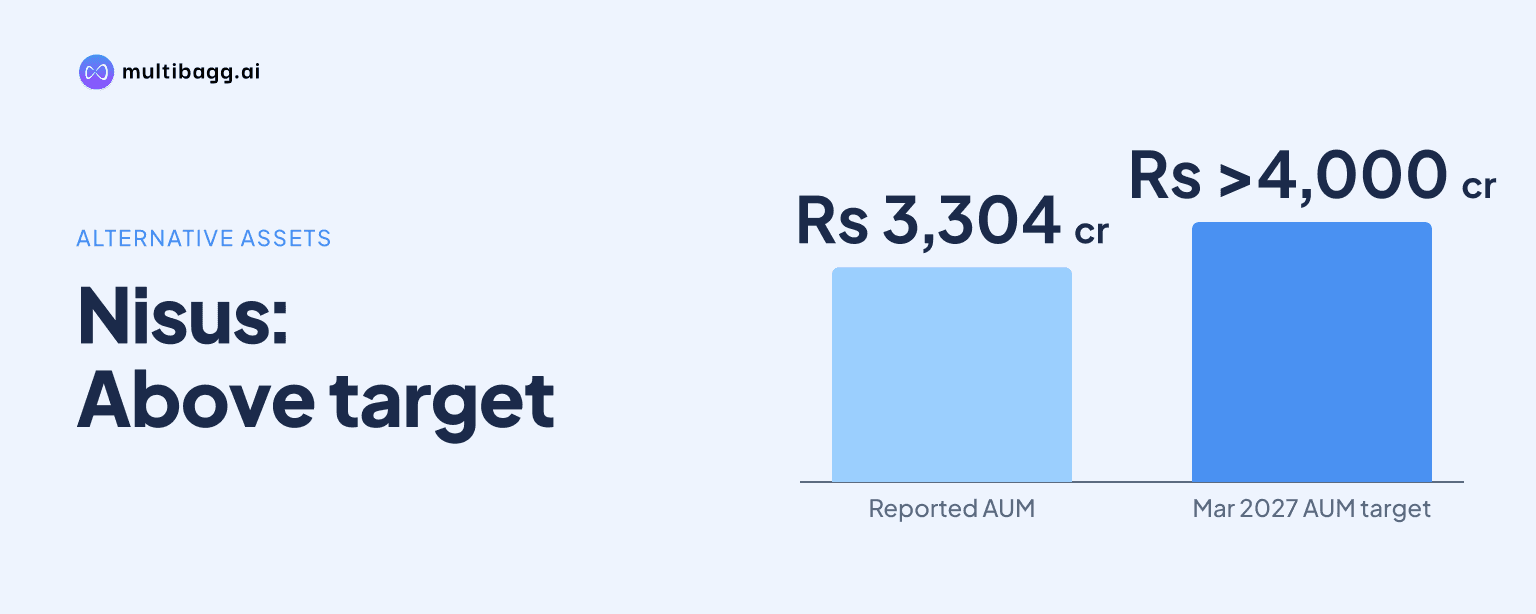
Nisus Finance Services Company Limited deployed about Rs 673 crore across five India and UAE investments in H1 FY27, taking assets under management (AUM) to about Rs 3,304 crore; management said strong fund demand could lift AUM beyond its Rs 4,000 crore-plus target by March 2027.
Know Nisus Finance Services Co inside out
Results, valuation, peers and who's buying, in one view.
How much did Nisus deploy in H1 FY27?
Nisus deployed approximately Rs 673 crore across five investments in India and the UAE during H1 FY27. The activity took its AUM to about Rs 3,304 crore, providing the starting point for management’s stated aim of closing FY27 with more than Rs 4,000 crore of AUM.
Management described the Rs 673 crore as additional deployment, indicating new investment activity rather than a stated valuation change. It linked AUM to top-line income because its advisory and asset-management operations earn revenue from capital managed, making deployment pace and new fund inflows central to the second-half FY27 outcome.
Nisus reported an annualised revenue-to-AUM yield of 3.9% in H1 FY27, compared with management’s 3.5% target. Management also cited an industry range of 1% to 2%, though it did not identify the companies or period underlying that comparison.
What supports Nisus’s Rs 4,000 crore-plus AUM target?
Nisus’s FY27 planning framework envisages closing AUM of Rs 4,000 crore or more by March 2027, and management said it was likely to exceed that level. The basis cited was a strong demand pipeline for its funds, alongside additional India and UAE investment opportunities during the balance of FY27.
A planned contributor is Ni-YAM, a newly approved Securities and Exchange Board of India (SEBI) alternative investment fund (AIF) offering of Rs 2,500 crore. Management said the product had received strong investor interest and was likely to complete a first closing soon, but did not disclose either the amount committed or the expected closing date.
Nisus also disclosed an application for a small and medium real estate investment trust (SM REIT) licence, prospective Gujarat International Finance Tec-City offerings and tokenisation initiatives in the region. These are proposed platforms or regulatory processes, not reported additions to the Rs 3,304 crore H1 FY27 AUM figure.
The company described four operating engines: fund management in India and the UAE, investment banking, a non-banking financial company (NBFC) providing proprietary capital and loans, and engineering, procurement and construction (EPC) through New Consolidated Construction Company Limited. Investment banking contributed roughly 68% of core revenue in H1 FY27, according to management, separating a large part of current core revenue from the longer-term AUM build-out.
Got a follow-up? Ask IRIS
Where did Nisus deploy capital in India and the UAE?
Nisus deployed approximately Rs 330 crore in Mumbai, Bengaluru and Pune during H1 FY27, accounting for nearly half of the Rs 673 crore total India and UAE deployment. Management tied the India activity to urban-infrastructure demand, capital inflows and interest in dollar-denominated or currency-hedged opportunities.
Management said elevated interest rates and persistent inflation were supporting demand for private credit in India. It also said its underwriting remained selective and reported zero delinquencies, zero delays and zero defaults in the investment book discussed on the H1 FY27 call.
In the UAE, Nisus said real-estate prices moderated after regional conflict earlier in 2026, followed by inflation and a recalibration of demand. Management said it had seen a measured rebound in recent months and acquired two UAE assets that were fully pre-leased and income-generating.
Dubai Islamic Bank was added as an institutional bank supporting the acquisition of the two UAE assets, according to management. The transcript did not provide deal values, asset valuations, lease income or expected returns for either those assets or the five H1 FY27 investments.
What could change Nisus’s AUM and profit trajectory?
Nisus said it would remain cautious on deployment because residential sales had slowed, although commercial and industrial activity showed reasonable momentum. Management said a large part of its India investments were in residential real estate and that new funds would pivot towards other asset classes while retaining underwriting discipline.
That approach could affect the timing of AUM growth because management said it would be selective on the amount of capital deployed in India. In the UAE, it said it was pursuing a significant pipeline but would wait for opportunistic transactions and negotiate entry points before committing additional capital.
Management’s FY27 planning framework calls for core income of Rs 140 crore to Rs 150 crore or more, profit after tax (PAT) of Rs 60 crore to Rs 65 crore or more, and AUM of Rs 4,000 crore-plus. During the question-and-answer session, management also said it continued to expect PAT in a Rs 65 crore to Rs 75 crore range, while adopting a more conservative stance amid volatility.
Management attributed potential near-term PAT costs to hiring for the SM REIT platform, UAE expansion and tokenisation products. It did not quantify these costs or set launch dates, but said the spending was intended to build the talent, properties and tools required for the new offerings.
Conclusion
Nisus’s H1 FY27 deployment of Rs 673 crore lifted AUM to Rs 3,304 crore and gave management a numerical basis for expecting more than Rs 4,000 crore by March 2027. The growth plan combines India private-credit activity, UAE real-estate acquisitions and the Rs 2,500 crore Ni-YAM AIF, while investment banking supplied roughly 68% of H1 core revenue.
The next developments to watch are Ni-YAM’s first closing, further deployment in India and the UAE, and progress on the SM REIT licence, Gujarat International Finance Tec-City offerings and tokenisation plans. Management has also set FY27 planning ranges of Rs 140 crore to Rs 150 crore or more in core income and Rs 60 crore to Rs 65 crore or more in PAT.

