








Nisus Finance Services Co. Limited may retain debt this year
MAX Plan at ₹4,999/yr

Find your next multibaggerBe a Pro Investor
Research stocks and track your picks on the go. Download the app.
Key highlights
- NiFCO said it can repay debt within the current financial year, subject to lender agreement.
- Management cited 20% investment yields against borrowing costs of 12% to 14%.
- NiFCO’s total promoter share pledge stood at around 22.4% in September.
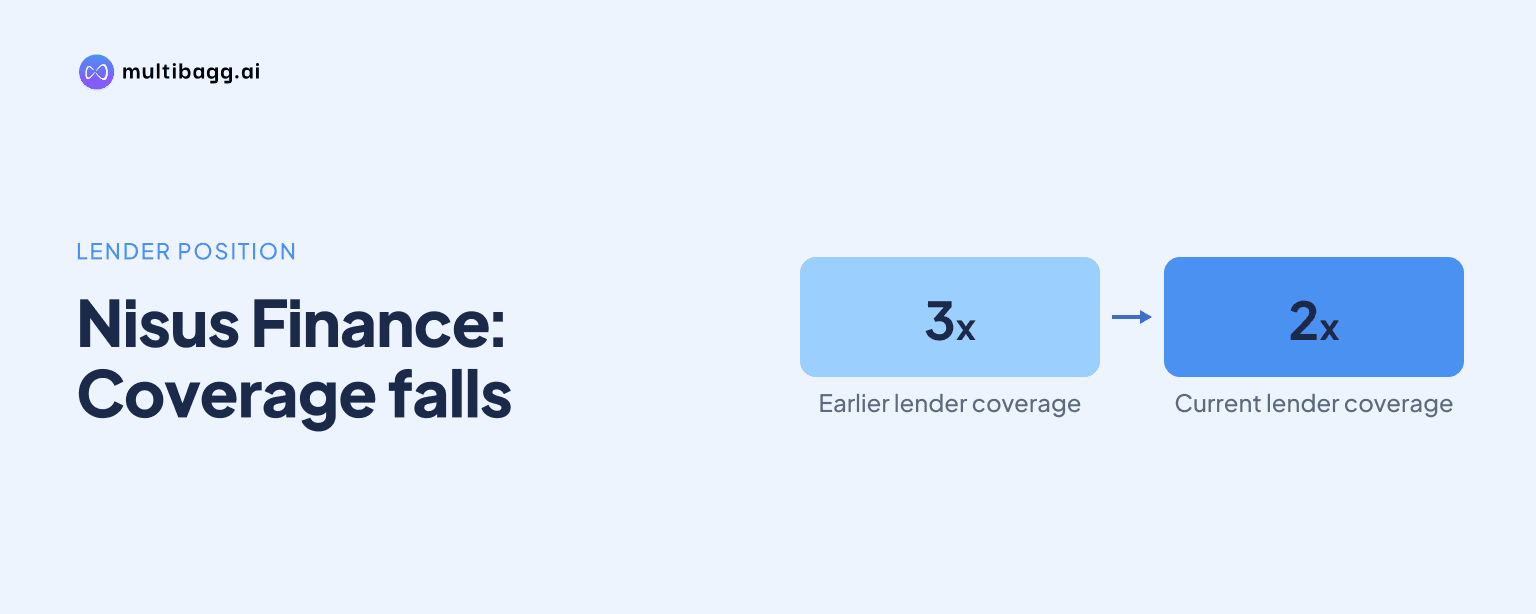
- The lender coverage requirement declined to 2x from about 3x earlier.
powered by IRIS
Nisus Finance Services Co. Limited said it can repay its debt within the current financial year, but may retain some borrowing into the next year because management cited investment yields of 20% against debt costs of 12% to 14%; promoter shares pledged stood at about 22.4% in September.
Know Nisus Finance Services Co inside out
Results, valuation, peers and who's buying, in one view.
Can NiFCO repay its debt this financial year?
Yes, NiFCO said it has the ability to repay its debt within the current financial year, although it did not commit to clearing every borrowing by then. Amit Goenka said the company could repay the debt immediately, while Manish Meena said NiFCO was ahead of repayment schedules and had liquidity in place.
NiFCO’s repayment timing remains conditional on lender agreement and management’s capital-allocation decision. Meena said the company would seek repayment as early as possible when liquidity was available, subject to lenders’ agreement. The call did not disclose the total debt outstanding at the end of the first half, scheduled instalments, maturity dates or the amount that may remain after the current financial year.
Management described the position as repayment capacity rather than a fixed debt-free deadline. Goenka said NiFCO might keep a balance of debt at the end of the current financial year and completely exhaust it in the following financial year. That leaves the eventual timeline dependent on the economics of retaining borrowings, liquidity and lender consent.
Why could NiFCO retain borrowings into next year?
NiFCO could retain some borrowings because management said its fund investments generate a higher yield than the cost of debt. Goenka contrasted investments described as generating 20% with debt costing 12% to 14%, saying the company needed to calibrate the use of equity against repayment of what he called cheap borrowing.
The cited spread is 6 to 8 percentage points between the 20% investment yield and the 12% to 14% borrowing cost. Management’s view was that repaying debt removes financing obligations, but retaining some debt can preserve equity for investments in its funds. The 20% figure was management’s explanation of its capital-allocation approach, not guidance that every investment will deliver that return.
The source does not provide the duration of the borrowings, the yields of individual investments, fund fees, credit losses or realised-return history supporting the cited comparison. It also does not state that NiFCO will keep debt for a particular investment. The disclosed mechanism is simply that management will weigh investment returns against funding costs before deciding how quickly to reduce debt.
Got a follow-up? Ask IRIS
What is NiFCO’s promoter pledge position?
NiFCO’s total promoter share pledge stood at around 22.4% as of September, according to Meena. He said this represented 2x cover for the total exposure, compared with an earlier lender requirement of about 3x cover.
Meena said the 22.4% pledge percentage reflected lower market prices. He added that the proportion of shares pledged would reduce if market prices improved because the lender coverage requirement is now 2x. This describes how collateral coverage works and does not amount to a share-price forecast or a commitment to release a specified number of shares.
The reduction in the lender requirement from about 3x to 2x is the clearest change in the collateral terms disclosed on the call. A lower required cover can reduce collateral needed for the same exposure, but the actual pledge percentage will also depend on the value of the shares and the outstanding exposure. NiFCO did not disclose the pledged-share count, promoter shareholding, loan-to-value ratio, trigger price or margin-call threshold.
What lender and debt details remain undisclosed by NiFCO?
NiFCO did not disclose its debt balance, loan-to-value ratio or repayment maturity profile in the supplied call excerpt. The investor specifically asked about loan-to-value levels after a share-price decline, but management answered with the 22.4% pledge figure and 2x cover rather than a numerical loan-to-value measure.
Management named Tata Capital and HDFC while discussing lender relationships. Goenka said both lenders were comfortable with loan performance and were looking to expand their relationships with NiFCO. He also said that an interest-rate increase had not been passed on to the company, but the call did not state the relevant rate, benchmark, increase size or effective date.
The unresolved information is material to the path of debt reduction because the company’s stated ability to repay is subject to lender agreement. NiFCO has disclosed a 2x cover requirement and a 22.4% September pledge, but not the rupee value of the secured exposure or the terms that would require additional collateral. Management has therefore retained flexibility both on the repayment schedule and on the level of borrowing carried into the next financial year.
Conclusion
NiFCO has presented the debt decision as an optimisation between repayment and investment deployment, rather than as a shortage of liquidity. Management said it can repay debt in the current financial year, but may retain some because it cited 20% investment yields against debt costs of 12% to 14%. The promoter pledge was about 22.4% in September, with lender coverage reduced from about 3x to 2x.
The next development to watch is management’s decision by the end of the current financial year on the amount of debt it will retain, if any, into the following year. Investors can also watch for disclosure of outstanding borrowings, repayment maturities and loan-to-value terms, as well as changes in the 22.4% pledge level under the 2x lender-cover requirement.

