










Novus Loyalty’s AutoPay deal targets transit payment growth
Key highlights
- Novus Loyalty signed an SPA to acquire an 80.87% stake in AutoPay.
- Novus Loyalty reported about Rs 98 crore of revenue in H1 FY27, compared with about Rs 71 crore in H1 FY26.
- Digital vouchers produced about Rs 49 crore of H1 FY27 revenue, the largest of Novus Loyalty’s four reported lines.
- Management expects AutoPay’s longer-run PAT margin to range from 17% to 20%.
powered by IRIS
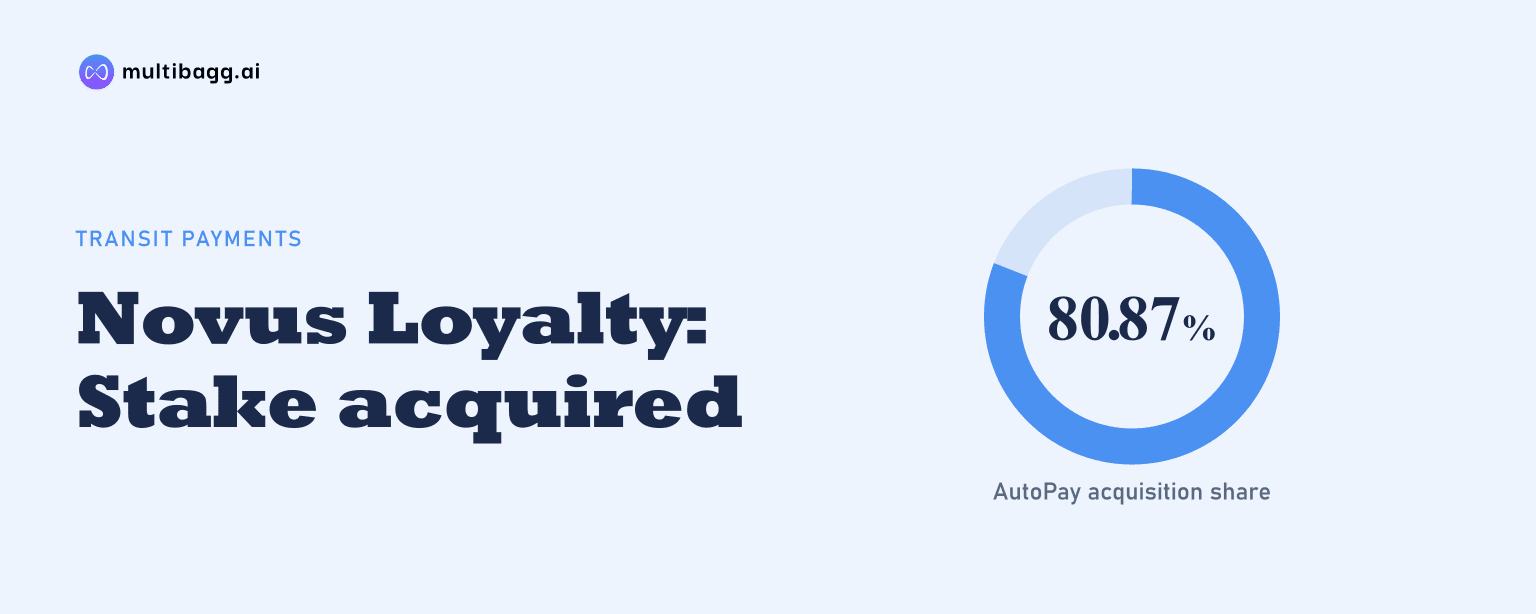
In H1 FY27, Novus Loyalty Limited said it signed a share purchase agreement to acquire 80.87% of AutoPay, aiming to add transit-payment infrastructure, merchant collections and a potential prepaid payment instrument licence pathway after reporting about Rs 98 crore of revenue. Management expects the transaction to close within six months.
Know Novus Loyalty inside out
Results, valuation, peers and who's buying, in one view.
Why is Novus Loyalty acquiring AutoPay?
Novus Loyalty is acquiring AutoPay to extend its loyalty platform into payments, especially transit-linked redemption and merchant collections. Management said it first signed a term sheet and then a share purchase agreement, or SPA, for an 80.87% stake. An analyst on the call referred to proposed consideration of around Rs 130 crore, while management said the valuation reflected discussions with selling shareholders, AutoPay’s profit record and its future opportunity.
AutoPay’s transit infrastructure is central to the stated rationale. Management said AutoPay works with Indian Railway Catering and Tourism Corporation, or IRCTC, and metro systems in major cities, including Mumbai’s airport line and Delhi Metro stations. Novus Loyalty expects the platform to give bank clients low-value, high-frequency reward-redemption choices, contrasting with the high-value, lower-frequency redemption options that have historically been more common in banking loyalty programmes.
The acquisition also addresses a collection issue in Novus Loyalty’s merchant offering. Management said Novus Loyalty can provide loyalty programmes and offers to merchants, but cannot currently collect payments for them, which can lengthen payment cycles. AutoPay’s technology is intended to let Novus Loyalty combine collection capability with its existing loyalty and offer products after the transaction is completed.
How could a PPI licence change Novus Loyalty’s products?
Novus Loyalty plans to apply for a prepaid payment instrument, or PPI, licence in AutoPay after the acquisition closes, according to management. Management said such a licence could reduce the need to pay another provider for card issuance. It did not say an application had been filed, specify a regulatory timetable or state that approval was assured.
The potential PPI licence is also part of management’s plan to change voucher economics. Management said the digital-voucher business currently generates a gross margin of about 5% to 7% because Novus Loyalty does not hold a PPI licence. It said a licence could allow the company to retain voucher breakage, meaning unspent voucher value, and create combined vouchers across three to five restaurants when loyalty points expire.
That potential change matters because vouchers are Novus Loyalty’s largest reported revenue line, but not its highest-margin line. In H1 FY27, management reported about Rs 49 crore of digital-voucher revenue, compared with about Rs 7.5 crore in technology revenue. It said technology and merchant-promotion revenue each convert fully into gross margin, whereas redemption has direct costs and vouchers currently have the lowest margin conversion.
Got a follow-up? Ask IRIS
What does AutoPay add beyond transit payments?
AutoPay brings an established IRCTC payment business and a newer Delhi Metro Rail Corporation, or DMRC, Saathi app operation, management said. It described the IRCTC business as historically higher margin, while DMRC-related development reduced profitability as AutoPay invested in technology, research and development, or R&D, and the newer revenue line had not yet fully scaled.
Management said AutoPay developed a virtual transit-card system through the Saathi app. A physical metro smart card costs Rs 80 to print and deliver, according to management, while the virtual card is designed to work without customers inserting a physical card into a machine. The call did not provide adoption numbers, transaction volumes or separate revenue for the virtual-card product.
An analyst said AutoPay’s profit after tax, or PAT, margin had fallen to about 13.8% from about 21.9%. Management attributed the decline to DMRC investment, R&D and minimum-guarantee commitments, or MMGs, rather than a deterioration in the IRCTC business. It said AutoPay spent around Rs 1.5 crore on MMGs, reported FY26 revenue of about Rs 102 crore, PAT of more than Rs 14 crore and earnings before interest, tax, depreciation and amortisation, or EBITDA, of close to Rs 23 crore.
Management expects AutoPay’s longer-run PAT margin to be between 17% and 20% as the newer revenue stream develops. This is management’s expectation, not a reported result. It also said Novus Loyalty and AutoPay had submitted an expression of interest for a proposed Indian Railway transit-loyalty system, but disclosed no award date, contract value or certainty of selection.
How does the deal fit Novus Loyalty’s H1 FY27 performance?
Novus Loyalty is pursuing the AutoPay transaction after reporting about Rs 98 crore in H1 FY27 revenue, compared with about Rs 71 crore in H1 FY26. Management described overall growth as roughly 35% to 40%. Technology revenue grew about 50% year on year, redemption revenue about 25%, merchant-promotion revenue about 37% and digital-voucher revenue about 45%.
The revenue mix shows why management focuses on margin conversion rather than gross revenue alone. Vouchers represented about 48% of gross revenue in H1 FY27 and reward redemption about 39%, while technology represented about 7% and merchant promotion about 6%. Management said merchant promotion could become a larger profit driver as its transaction processing, customer segmentation and campaign capabilities mature.
Novus Loyalty said banking, financial services and insurance, or BFSI, accounts for 90% to 92% of its business. Its other stated priorities are deeper BFSI penetration, expansion of reward choices, international growth and development of 12 specialised artificial-intelligence, or AI, agents. Management said the AI agents are presently included in the enterprise platform rather than separately billed to enterprise clients, but are intended to support merchant-promotion and redemption revenue while reducing account-management work.
When could Novus Loyalty combine loyalty and payments?
Novus Loyalty expects the AutoPay transaction to be completed within the next six months, after which management intends to combine payment and loyalty products. The company did not disclose integration costs, closing conditions or a quantified first-year revenue contribution from the combined offering.
Management also expects growth from its overseas activity during the same period. Novus Loyalty has established a Dubai subsidiary and hired three people there, with some revenue impact expected in the next six months and a larger contribution expected in the following financial year. It also said it had onboarded two African banks through partners and was working with clients in Saudi Arabia, although it did not link these contracts directly to AutoPay.
Conclusion
The proposed 80.87% AutoPay acquisition would expand Novus Loyalty from loyalty technology and rewards into transit-linked payments and merchant collections. The strategy combines AutoPay’s IRCTC and metro capabilities with Novus Loyalty’s bank-focused reward programmes, while a possible PPI licence could eventually affect card-issuance costs and voucher margins. The plan follows H1 FY27 revenue of about Rs 98 crore, up from about Rs 71 crore a year earlier.
The next items to watch are whether the transaction closes within management’s six-month target, whether Novus Loyalty submits its planned PPI licence application and whether AutoPay’s DMRC business improves profitability after its R&D and around Rs 1.5 crore of MMG spending. The unresolved Indian Railway transit-loyalty expression of interest is another potential development disclosed by management.