










Novus Loyalty says merchant promotions will drive profit
Key highlights
- Novus reported about Rs 98 crore of revenue in H1 FY27, compared with about Rs 71 crore in H1 FY26.
- Novus said merchant-promotion and technology revenue each convert 100% to gross margin.
- Novus reported about Rs 49 crore of voucher revenue in H1 FY27, with a stated 5-7% gross-margin conversion.
- Novus expects its acquisition of an 80.87% stake in AutoPay to complete within six months.
powered by IRIS
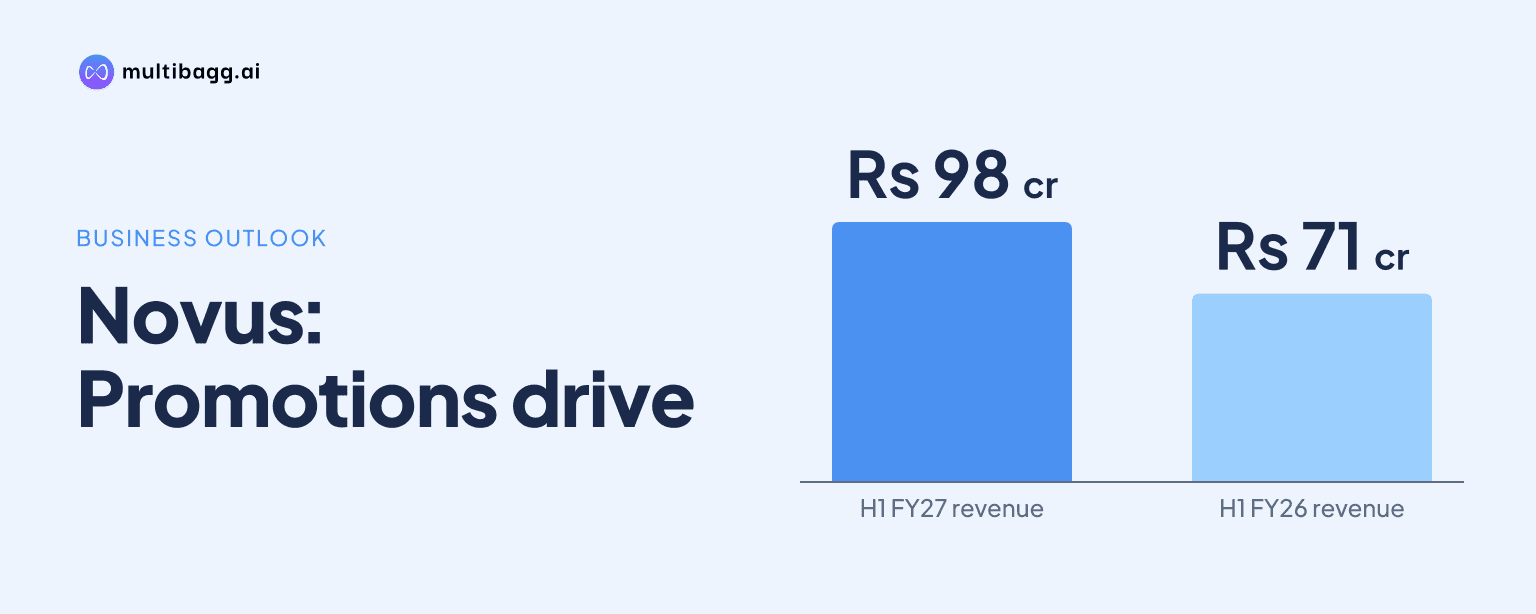
In H1 FY27, Novus Loyalty said merchant-promotion revenue, which it says converts 100% to gross margin, should generate more incremental profit than gift vouchers, where conversion is 5-7%. The distinction came as Novus reported about Rs 98 crore of revenue, including roughly Rs 49 crore from vouchers.
Know Novus Loyalty inside out
Results, valuation, peers and who's buying, in one view.
Why will merchant promotions drive Novus profit?
Merchant promotions should drive Novus’s incremental profit because management said 100% of merchant-promotion revenue goes to gross margin, compared with 5-7% for gift vouchers. Management said redemption and voucher revenue should also increase, but that the greater contribution to profit after tax would come from merchant-promotion income as the platform processes more transactions.
The mechanism is merchant monetisation alongside loyalty and reward activity. Novus said its platform can process transactions and generate campaigns for merchants, while its Noxcy AI tools can recommend campaigns automatically rather than requiring as much work from account-management teams using the rule engine. For enterprise customers, Noxcy AI is currently included in the platform rather than sold as a separately billed product.
How do Novus revenue streams compare on gross-margin conversion?
Novus said technology and merchant-promotion revenue both convert 100% to gross margin, making them its highest-converting disclosed streams. Redemption revenue converts at about 16-18% because direct costs are involved, while vouchers convert at 5-7%, placing them last in management’s stated profitability ranking.
The difference means equal reported revenue across segments would not produce equal gross-margin contribution. For a Central Bank of India programme with a contract value of about Rs 88 crore over five years, management said roughly 10%, or Rs 8.8 crore, would be technology revenue and 90%, or Rs 79.2 crore, redemption revenue. It estimated the redemption portion could generate about Rs 15 crore to Rs 16 crore of net revenue, in addition to the Rs 8.8 crore technology component.
Management’s comparison concerns gross-margin conversion rather than separately reported profit after tax by segment. It nevertheless ranked technology and merchant promotions first, redemption third and vouchers last for profitability. That ranking is why management’s focus on merchant promotions is more relevant to incremental earnings than voucher sales growth alone.
What did H1 FY27 revenue show about Novus's mix?
H1 FY27 showed that vouchers were Novus’s largest disclosed revenue stream at about Rs 49 crore, while merchant promotions contributed a little over Rs 5 crore. Total revenue was around Rs 98 crore, compared with about Rs 71 crore in H1 FY26, showing that the lower-converting voucher business can still make a substantial contribution to reported revenue growth.
Management reported year-on-year growth of around 45% in vouchers, about 37% in merchant promotions and about 25% in redemption revenue. It also described technology revenue growth of around 50% year on year. Merchant promotions therefore grew faster than redemption, but from a much smaller disclosed revenue base than vouchers.
Novus also said about 90% of its technology customers now use software as a service, or SaaS, while about 10% use on-premise installations. Management said SaaS allows it to manage product modules, upgrades and downgrades more effectively, whereas some clients, including the National Payments Corporation of India and certain banks, continue to choose on-premise deployment. The technology line’s 100% conversion matters even though voucher revenue is larger.
Got a follow-up? Ask IRIS
Can AutoPay improve Novus voucher economics?
AutoPay could improve Novus’s voucher economics if the proposed transaction allows a prepaid payment instrument, or PPI, licence application, but management described that as a plan rather than a current outcome. Novus said a PPI licence could let it retain breakage from unused vouchers and issue combined vouchers spanning three, four or five restaurants, potentially changing the present 5-7% voucher conversion.
Novus has signed an agreement to acquire about 80.87% of AutoPay Payment Solution and said the transaction was still in progress, with completion expected within six months. Management said it plans to apply for a PPI licence in AutoPay and expects the licence to reduce card-issuance fees paid to other parties. Until a licence is obtained, the stated voucher margin remains 5-7%.
AutoPay is also intended to broaden low-value, high-frequency redemption options through transit-payment links, including Indian Railway Catering and Tourism Corporation and metro systems. Management said AutoPay’s profit-after-tax margin fell from about 21.9% to 13.8% after investment in the Delhi Metro Rail Corporation Saathi app and related research and development. It expects AutoPay’s longer-run margin to be 17-20% as revenue from newer lines develops.
When could AI and merchant promotions affect Novus earnings?
Noxcy AI is already intended to support merchant-promotion income and reduce account-management work, but Novus does not yet receive separate enterprise-client fees for the product. Management said smaller SaaS customers are charged separately for AI capabilities, while enterprise customers receive them within the platform fee. It described the current earnings contribution as indirect through merchant monetisation and redemption activity.
Management estimated Noxcy AI could take 1.5 to 2 years to break even on its cost. It also said Novus plans eventually to sell Noxcy AI agents separately, but provided no pricing structure or implementation date. The timeline means the immediate margin case rests on AI supporting existing platform revenue rather than a disclosed standalone AI revenue line.
For H2 FY27, management said performance should be aligned with H1 and would not be lower. It said seasonality is limited, with summer periods about 5-10% better and Diwali about 2-5% better, while individual bank clients’ campaign decisions have a larger effect on revenue. That client-led activity directly affects the transaction volumes from which merchant-promotion income can arise.
Conclusion
Novus’s disclosures show that revenue mix, rather than headline growth alone, is central to its profit outlook. Vouchers generated about Rs 49 crore in H1 FY27 but had a stated 5-7% gross-margin conversion, while merchant promotions generated a little over Rs 5 crore and converted fully to gross margin. Technology has the same stated conversion, and redemption sits between those categories at 16-18%.
The next items to watch are the expected completion of the 80.87% AutoPay transaction within six months, the planned PPI licence application and whether merchant-promotion revenue rises from its H1 FY27 base. Management has also targeted consolidated revenue of more than Rs 500 crore by 2029 and Rs 600 crore to Rs 650 crore by 2030, while estimating base-business organic growth of around 15%.