










Novus Loyalty Targets Rs 7-8 Crore Middle East Revenue
Key highlights
- Novus Loyalty expects Rs 7-8 crore of Middle East revenue in FY27.
- Novus Loyalty targets Rs 12-15 crore from the UAE and Middle East in the following financial year.
- Novus Loyalty has completed its Dubai subsidiary setup and hired about three local employees.
- Novus Loyalty reported around Rs 98 crore of H1 FY27 revenue, versus about Rs 71 crore in H1 FY26.
powered by IRIS
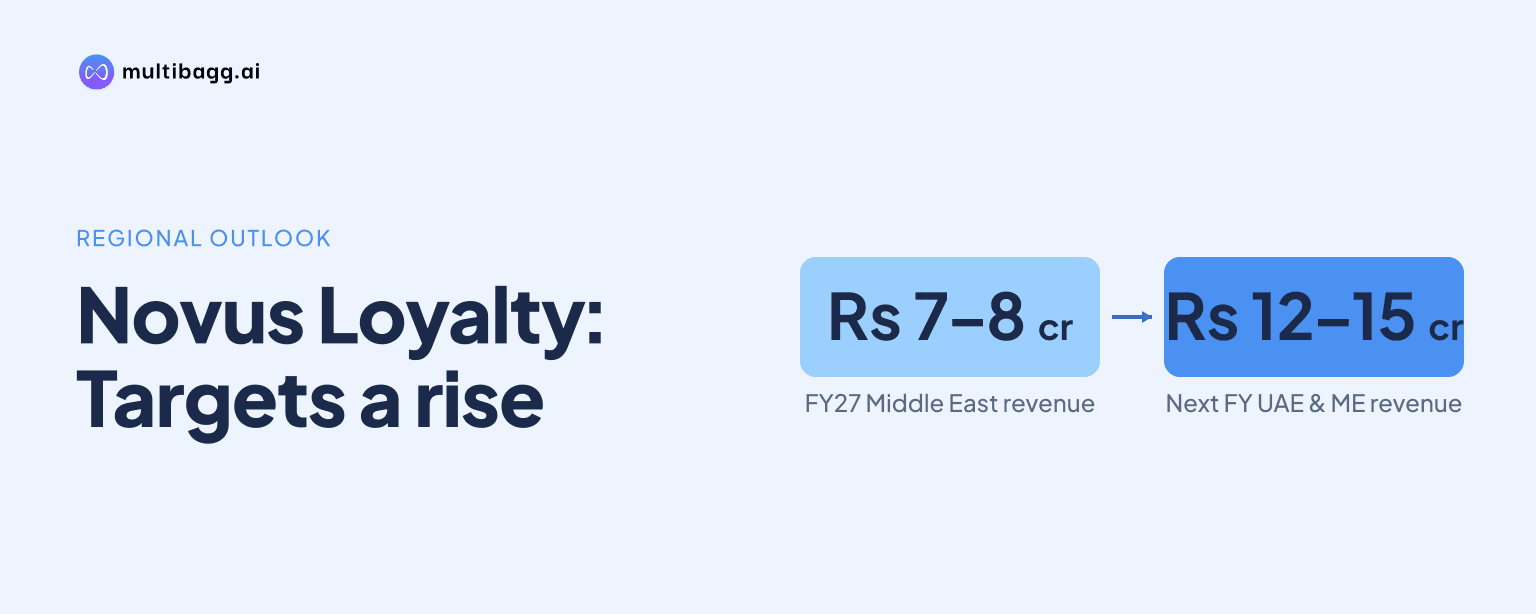
Novus Loyalty Limited expects Rs 7-8 crore of Middle East revenue in FY27 after completing its Dubai subsidiary and hiring about three local employees, while management targets Rs 12-15 crore in the following financial year. The company said FY27 includes only about six months of regional contribution.
Know Novus Loyalty inside out
Results, valuation, peers and who's buying, in one view.
How much Middle East revenue does Novus Loyalty expect?
Novus Loyalty expects Rs 7-8 crore of revenue from Dubai, Saudi Arabia and the broader Middle East in FY27. Management said the estimate reflects a partial year of operations because the Dubai unit’s revenue effect is expected over the next six months, while the larger contribution should come in the following financial year.
Management subsequently expects at least Rs 12-15 crore from the United Arab Emirates and wider Middle East market in the following financial year. The target represents a potential increase of Rs 5-8 crore from the FY27 range, although it is management’s stated expectation rather than reported revenue or formal guidance.
The regional forecast comes after Novus Loyalty completed the process of setting up its Dubai subsidiary and hired about three experienced people there. Management said the entity provides access to the Gulf Cooperation Council, or GCC, market, and that the company has also started working with some clients in Saudi Arabia.
What international business has Novus Loyalty already built?
Novus Loyalty has onboarded two African banks through partners and is asking those partners to pitch its loyalty technology to additional banks. Management named Bank of Abyssinia and Bank of Sparkle as customers, and said the Africa activity so far is technology revenue rather than redemption or voucher revenue.
That revenue mix is relevant because management said technology revenue converts fully into net revenue, unlike redemption and digital-voucher sales that involve direct costs. In H1 FY27, Novus Loyalty recorded total revenue of around Rs 98 crore, compared with about Rs 71 crore in H1 FY26, while management cited about 50% growth in technology revenue year on year.
Novus Loyalty also runs a programme for Novo Nordisk in Oman, Qatar and Bahrain. Management said Novo Nordisk plans to extend that programme to 30 other countries, but did not disclose a timetable or revenue estimate for the proposed expansion.
Why is the Dubai subsidiary important to Novus Loyalty?
The Dubai subsidiary is important because Novus Loyalty views it as its operating base for pursuing GCC customers directly. The company has completed the entity setup, added about three local employees and said revenue should begin contributing during the next six months of FY27.
Novus Loyalty’s platform provides enterprise loyalty and customer-engagement technology for banks, fintech companies, retailers and healthcare businesses. Management said it processes more than 150 crore transactions a month, providing the underlying system for rewards, personalised offers, redemption programmes and merchant campaigns.
The overseas push remains linked to a banking-led customer base. Management said banking, financial services and insurance, or BFSI, accounts for 90-92% of Novus Loyalty’s business, and the company plans to deepen BFSI penetration while pursuing banks in Africa and customers in the Middle East.
Got a follow-up? Ask IRIS
What revenue mix supports Novus Loyalty’s expansion plan?
Novus Loyalty’s H1 FY27 revenue of around Rs 98 crore was spread across technology, redemption, merchant promotion and digital vouchers. Management said technology contributed about Rs 7.5 crore, redemption about Rs 36 crore, merchant promotion more than Rs 5 crore and digital vouchers around Rs 49 crore.
The change from H1 FY26 was broad-based rather than limited to one business line. Management cited approximately 25% growth in redemption revenue, 37% in merchant promotion and 45% in digital vouchers, alongside about 50% growth in technology revenue, compared with total revenue growth from about Rs 71 crore to Rs 98 crore.
Management identified technology and merchant promotion as the segments with the highest gross-margin conversion because it said both translate fully into net revenue. It said redemption produces a gross margin of about 16-18%, while digital vouchers currently contribute about 5-7%, making the product mix a factor in how overseas sales affect profitability.
What must Novus Loyalty do before entering the US and Australia?
Novus Loyalty said it cannot yet directly serve several interested US and Australian credit-union clients because they require professional liability cover, general liability cover and data-localisation arrangements. Management said these requirements make buyers in those BFSI markets hesitant to contract directly with an Indian company.
Management’s options are to establish a small wholly owned subsidiary in the US, acquire a small digital agency there, or work through a local partner. It said current US and Australian revenue is not significant and expects potential meaningful revenue only in the next financial year after arranging a stronger local presence or partnership.
This places the US and Australia behind the Dubai-led GCC plan in execution readiness. The Dubai operation has a completed entity and about three hires, whereas the US and Australia still require a structure that meets customer insurance, data and local-operating requirements.
What could determine whether Novus Loyalty meets its targets?
Meeting the Rs 7-8 crore FY27 target depends on converting Dubai and Saudi customer activity into billings during a six-month contribution period. Management did not provide a client-by-client Middle East revenue schedule, leaving the pace of customer onboarding, implementation and billing unresolved.
Product development is a further execution factor. Novus Loyalty is working on 12 specialised artificial-intelligence agents across platform, member, merchant and partner functions, and management said it currently includes these capabilities in the enterprise platform rather than charging enterprise clients separately.
Management expects the cost of Noxcy AI to break even in about 1.5-2 years and plans eventually to charge separately for the agents. It also said the proposed acquisition of an 80.87% stake in AutoPay Payment Solutions is expected to complete within six months, potentially combining payment and loyalty capabilities for customers.
Conclusion
Novus Loyalty has set a specific international revenue objective after establishing its Dubai subsidiary: Rs 7-8 crore from Dubai, Saudi Arabia and the wider Middle East in FY27, rising to Rs 12-15 crore in the following financial year. The plan is supported by local hiring, GCC market access, Saudi activity and two partner-led African bank customers, alongside H1 FY27 revenue of around Rs 98 crore versus about Rs 71 crore a year earlier.
The next point to watch is whether Dubai converts its initial six months of activity into the FY27 revenue range and whether partner-led African sales add further bank mandates. Management also needs to establish a local partner or entity for the US and Australia, while completing the proposed 80.87% AutoPay acquisition within six months and progressing its 12 AI agents toward the stated 1.5-2-year break-even period.