










Msafe steel scaffolding rentals reach Rs 10 crore in H1 FY27
Key highlights
- Msafe generated approximately Rs 10 crore of steel scaffolding rental revenue in H1 FY27, versus approximately Rs 3.5 crore in FY26.
- Rentals accounted for around 52% of Msafe revenue in H1 FY27, compared with approximately 51% in FY26.
- Msafe reached 9,000 tonnes per annum of MS scaffolding capacity and revised its target to 15,000 tonnes per annum.
- Msafe reported H1 FY27 revenue from operations of approximately Rs 72 crore, up 47% year on year.
powered by IRIS
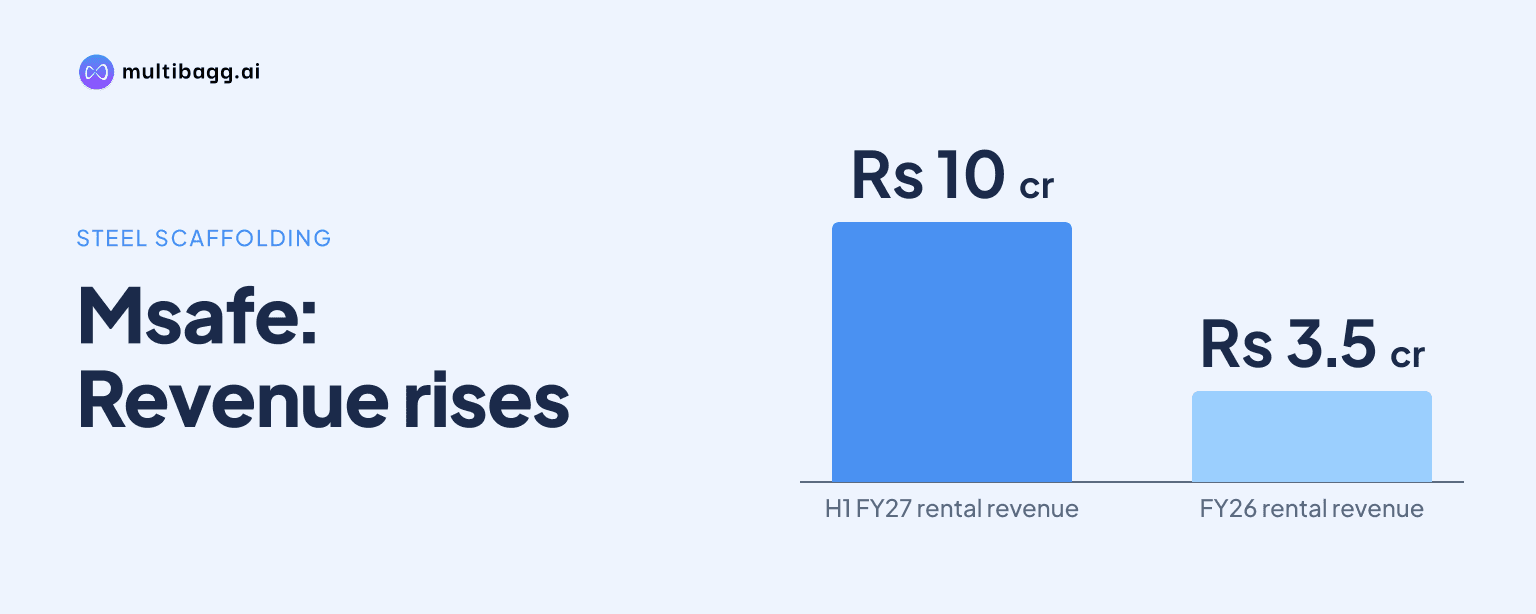
Msafe Equipments Limited generated approximately Rs 10 crore of steel scaffolding rental revenue in H1 FY27, compared with approximately Rs 3.5 crore in FY26, making six-month revenue nearly three times the prior full-year level. Management identified rental expansion, new customers and aluminium sales as drivers of its FY27 growth outlook.
Know Msafe Equipments inside out
Results, valuation, peers and who's buying, in one view.
What drove Msafe’s steel scaffolding rental growth?
Msafe said steel scaffolding rental revenue reached approximately Rs 10 crore in H1 FY27, versus approximately Rs 3.5 crore for the full previous financial year. The reported increase was approximately Rs 6.5 crore, although management did not disclose the number of rental assets, customers or pricing changes behind the gain.
Management attributed its approximately 50% FY27 growth outlook to new customer additions, growth in aluminium sales, rental revenue and other businesses. It also said demand in both rental and sales was very strong, while monthly MS scaffolding production capacity exceeded 750 tonnes in the month before the 2 November 2026 call.
The steel rental increase forms part of Msafe’s rental-led model. Rental contributed approximately 51.5% of Q2 FY27 revenue, according to management, which described rental as its core focus because it was more profitable. Msafe did not disclose a Q2-only steel scaffolding rental figure, so the H1 amount cannot establish the second-quarter contribution.
How large is rental business within Msafe revenue?
Msafe said rentals represented around 52% of revenue in H1 FY27 and sales around 48%, compared with approximately 51% rentals and 49% sales in FY26. The one-percentage-point movement means rental remained the larger component of the revenue mix.
Revenue from operations rose 47% year on year to approximately Rs 72 crore in H1 FY27, while profit after tax, or PAT, increased 50% to Rs 15.76 crore. In Q2 FY27, revenue from operations grew 53% year on year to approximately Rs 40 crore and PAT rose 55% to Rs 8.49 crore.
Q2 earnings before interest, tax, depreciation and amortisation, or EBITDA, increased 49% to Rs 15.61 crore, with an EBITDA margin of 38.65%. Management expects the sales-rental mix to remain broadly on the same trajectory and said it aims to maintain at least 50% contribution from sales.
The rental model requires investment in assets before rental income is generated, Chairman and Managing Director Pradeep Aggarwal said. That funding mechanism is relevant as Msafe expands capacity and warehouses, and management indicated an additional debt requirement of approximately Rs 20 crore to Rs 25 crore for the factory and working-capital needs.
Got a follow-up? Ask IRIS
Can Msafe’s capacity expansion support rental growth?
Msafe has reached 9,000 tonnes per annum of MS scaffolding capacity and revised its next capacity target to 15,000 tonnes per annum. Management said capacity was approximately 3,200 tonnes before the issue, rose to 6,285 tonnes in April, and reached the 9,000-tonne level ahead of the initially planned schedule.
Management said it was operating at high utilisation, prompting repeated increases in MS scaffolding capacity. Its warehouse network expanded from 21 to 24 locations, which management said would improve pan-India reach and customer service; it did not provide an MS scaffolding utilisation percentage.
MS scaffolding rental yields are approximately 32% to 38%, compared with approximately 60% to 66% for aluminium scaffolding, management said. It added that MS scaffolding has an estimated economic life of approximately 15 to 20 years, versus approximately five to seven years for aluminium scaffolding.
The average MS scaffolding rental tenure is approximately one year, with contracts ranging from three months to two years. Aluminium scaffolding has nearly 80% utilisation, management said, and its average rental order lasts approximately four months, although individual orders can range from one day to one or two years.
When could aluminium formwork alter Msafe’s revenue mix?
Msafe does not expect aluminium formwork to make a significant contribution in FY27, but management expects it to account for at least 15% of total business from the next financial year. Trial production has started, with commercialisation targeted for December 2026 at a rented facility with planned initial capacity of 500 tonnes annually.
Management said the enquiry, order-conversion and execution cycle for aluminium formwork is relatively long, so its FY27 contribution may be modest. Msafe plans to supply the product for high-rise construction, mass housing and infrastructure projects, and management said some infrastructure and civil-contractor customers could overlap with its scaffolding base.
Msafe is also increasing aluminium scaffolding and ladder capacity from 1,500 tonnes to 2,500 tonnes. Its integrated manufacturing facility at Mathura is under construction and is expected to become operational in May 2027, alongside the revised 15,000-tonne MS scaffolding capacity target.
Management maintained guidance for annual top-line growth of 50% to 70% and bottom-line growth of 40% to 50%. It said aluminium formwork was not assumed to provide a significant FY27 contribution, while rental expansion and customer additions were among the stated growth drivers.
Conclusion
Msafe’s approximately Rs 10 crore of steel scaffolding rental revenue in H1 FY27 exceeded the approximately Rs 3.5 crore recorded through all of FY26, providing a disclosed measure of the rental business’s acceleration. The increase coincided with H1 revenue of approximately Rs 72 crore, a rental revenue mix of around 52%, and MS scaffolding capacity of 9,000 tonnes per annum.
The next disclosed milestones are the December 2026 commercialisation target for aluminium formwork and the planned May 2027 opening of the Mathura facility. Investors can also monitor progress toward the 15,000-tonne MS scaffolding capacity target, operating cash flow, which management said it wants to keep positive, and the indicated additional debt requirement of approximately Rs 20 crore to Rs 25 crore.