










Msafe targets Europe as exports seen at 7%-8% of FY27 revenue
Key highlights
- Msafe expects exports to contribute approximately 7%-8% of FY27 total revenue.
- Msafe said it has required European approvals and plans to approach Europe next year.
- MS scaffolding capacity has risen from approximately 3,200 tonnes per annum to 9,000 tonnes, with a 15,000-tonne target.
- Msafe said monthly MS scaffolding production exceeded 750 tonnes before the call.
powered by IRIS
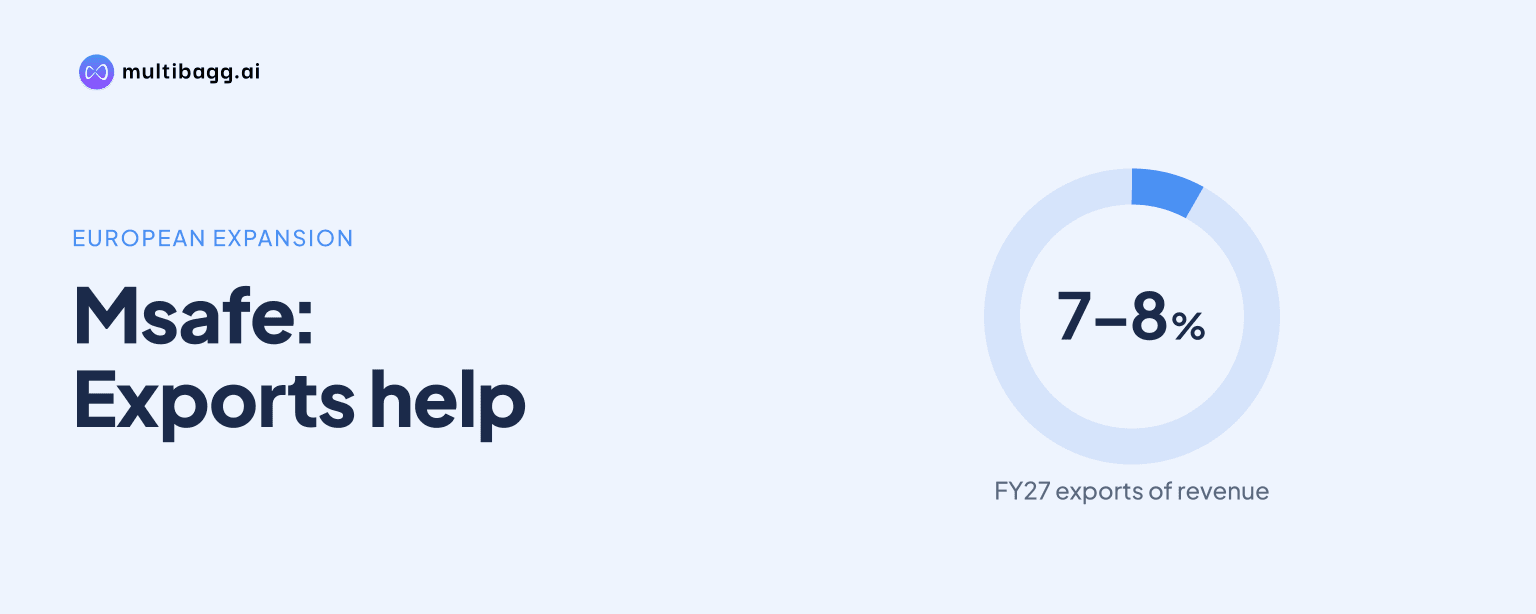
Msafe expects exports to contribute approximately 7%-8% of FY27 revenue after receiving orders from Middle Eastern countries, and plans to approach Europe next year. Management said Msafe already holds the required European approvals and intends to sell products overseas rather than use the domestic rental model.
Know Msafe Equipments inside out
Results, valuation, peers and who's buying, in one view.
What is Msafe’s FY27 export revenue target?
Msafe expects exports to account for approximately 7%-8% of total revenue in FY27. Management gave that estimate after saying it had recently received orders from Middle Eastern countries, where demand has been strong. The call did not disclose the value, volume or number of those export orders, making the percentage contribution the only stated measure of the overseas opportunity.
The target marks an expansion from a domestic business where demand has limited the time available for export development. Management said Indian demand has been sufficiently strong that Msafe has not focused extensively on overseas markets. Even so, the Middle East has become an additional product-sales opportunity, with management describing margins on those orders as reasonably good.
Msafe did not name the Middle Eastern countries it serves, citing commercial reasons and the risk of drawing competitors’ attention to those markets. It also did not provide customer names, order duration, shipment volumes or a country-level split of the expected 7%-8% contribution. The company has therefore disclosed active export orders but not a quantified order book behind the FY27 expectation.
When will Msafe enter Europe and Australia?
Msafe plans to approach Europe next year, followed by Australia after Europe. Management said Europe is the initial priority because Msafe has already obtained the required approvals there, whereas Australia has somewhat different requirements. No launch date, distributor arrangement, country list or separate revenue target was disclosed for either market.
Management said Msafe has manufactured its products to EN 1004, a European standard, from day one. That product standard and the stated European approvals are the specific reasons management gave for considering Europe before Australia. The company said its quality standards are aligned with the requirements of both markets, but provided no details on the approvals needed for Australia.
Europe remains at a planning stage rather than an announced order pipeline. Management said it was too early to comment on expected European orders, distinguishing that market from the Middle East, where exports have already begun. Investors have a disclosed sequence of Europe first and Australia later, but no confirmed European customer, order value or shipment timetable.
Will Msafe sell or rent products in export markets?
Msafe currently intends to sell products overseas rather than operate a rental business. Management said overseas rentals involve additional complexities, without identifying whether these relate to transport, servicing, asset recovery, local operations or contracts. The export model is therefore product sales, unlike the domestic business where rental equipment is deployed and redeployed.
The distinction is relevant because Msafe reported differing domestic rental yields by product. Management put MS scaffolding rental yields at approximately 32%-38%, compared with approximately 60%-66% for aluminium scaffolding. It also said an average aluminium scaffolding rental order lasts around four months, while the average MS scaffolding rental tenure is around one year.
The domestic equipment base also has different stated economic lives. Msafe estimates MS scaffolding can have an economic life of approximately 15-20 years, compared with around 5-7 years for aluminium scaffolding. By exporting through direct sales, Msafe can pursue overseas demand without disclosing plans to build, fund, service and retrieve rental assets outside India.
Got a follow-up? Ask IRIS
How does export expansion fit Msafe’s capacity build-out?
Msafe’s export plan comes alongside repeated MS scaffolding capacity additions in response to demand in both rental and sales. Capacity was approximately 3,200 tonnes per annum before the issue, rose to 6,285 tonnes in April, and has already reached the 9,000-tonne target that had been set for the next financial year. Management has now revised its capacity target to 15,000 tonnes.
Monthly MS scaffolding production exceeded 750 tonnes in the month before the call, and management said the company was operating at high utilisation. This is a change from the earlier 6,285-tonne capacity target, which Msafe achieved sooner than planned before increasing output again. Management linked the accelerated expansion to strong demand across both rental and product sales businesses.
Msafe identified several domestic drivers for aluminium scaffolding demand, including data centres, semiconductor plants, airports, malls, hotels and infrastructure projects. Management specifically named Navi Mumbai International Airport and Bhogapuram Airport, and said more than 100 large data centres and around 10 semiconductor plants were under construction over coming years. These domestic projects are the demand backdrop as Msafe adds overseas product sales.
What could affect Msafe’s export contribution?
The principal disclosed uncertainty is the early stage of the European plan. Management said it was too early to discuss prospective European orders, meaning the 7%-8% export expectation is supported by existing Middle East activity rather than a disclosed European order book. Msafe has not provided export selling prices, shipment volumes, customer concentration or the contribution expected from each region.
Product mix may also matter because management said sales of aluminium and steel products carry margins of approximately 5%-6%. It said increased sales of these products reduced reported earnings before interest, taxes, depreciation and amortisation, or EBITDA, margin to 38.65% from 39.67%. Management said Middle East order margins were reasonably good, but explicitly cautioned that they are not directly comparable with Indian margins.
Msafe also said its rental-heavy and asset-intensive business needs continuing investment in assets and inventory to support its broader 50%-70% top-line growth guidance. Management referred to current debt of approximately Rs 44 crore and a possible additional Rs 25 crore, while saying becoming debt-free in the near term may be difficult. The company did not disclose separate working-capital, inventory or funding requirements for the overseas sales business.
Conclusion
Msafe’s stated export strategy begins with current Middle East product sales and moves next toward Europe, where management says required approvals have already been obtained. The company expects exports to represent approximately 7%-8% of FY27 revenue, but has not quantified the underlying orders or disclosed a European customer pipeline. Its decision to sell products overseas, rather than rent them, differentiates the export model from its domestic operations.
The next disclosed milestones are Msafe’s planned approach to Europe next year and a subsequent approach to Australia, whose requirements management said differ from Europe’s. Investors can also watch progress toward the revised 15,000-tonne MS scaffolding capacity target after production exceeded 750 tonnes per month, and whether export revenue develops toward the stated 7%-8% FY27 contribution.