










MSAFE expects debt of Rs 65 crore to Rs 70 crore
Key highlights
- MSAFE discussed potential total debt of approximately Rs 65 crore to Rs 70 crore, compared with about Rs 44 crore of existing debt.
- Management cited an additional Rs 20 crore to Rs 25 crore requirement for factory completion and working capital.
- Rentals represented around 52% of MSAFE’s current-year business mix, compared with approximately 51% in the previous financial year.
- Steel scaffolding rental revenue was approximately Rs 10 crore in the first half, compared with approximately Rs 3.5 crore in the previous full financial year.
powered by IRIS
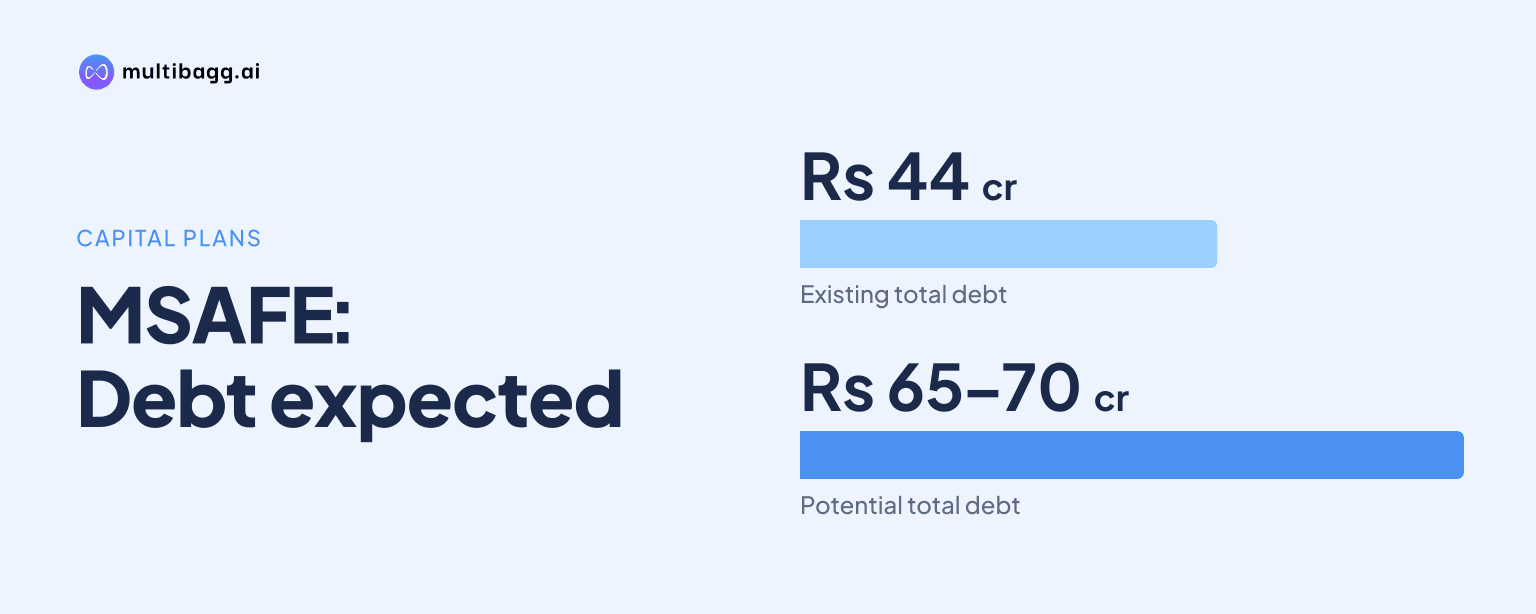
MSAFE said total debt could rise from approximately Rs 44 crore to Rs 65 crore to Rs 70 crore after an additional Rs 20 crore to Rs 25 crore requirement for factory completion and working capital. Management said its rental model requires investment in assets before those assets generate rental income.
Know Msafe Equipments inside out
Results, valuation, peers and who's buying, in one view.
Why could MSAFE’s debt reach Rs 65 crore to Rs 70 crore?
MSAFE said it is considering an additional debt requirement of approximately Rs 20 crore to Rs 25 crore, over and above existing short-term and long-term debt of about Rs 44 crore. When an analyst asked whether this could take total debt to approximately Rs 65 crore to Rs 70 crore, management confirmed that the proposed funding would be incremental to current borrowings.
Management identified factory completion and working-capital requirements as the stated uses for the additional funding. It did not provide a split between those two uses, a borrowing timetable or a date for any peak debt level, meaning the Rs 65 crore to Rs 70 crore range was discussed as a potential requirement rather than reported debt at the time of the call.
The potential increase reflects the funding structure of MSAFE’s rental business, under which the company first buys assets and subsequently earns rental income from them. This mechanism differs from a product sale, where the company converts inventory into revenue at the point of sale, and it links rental-led expansion to continuing capital deployment.
How important is the rental business to MSAFE’s growth?
MSAFE said rentals represented around 52% of the current-year business mix, compared with approximately 51% in the previous financial year, while sales accounted for about 48% versus 49%. Management said rental is its core focus because it considers the rental business more profitable, but it also plans to retain at least a 50% contribution from sales.
The movement from a 51% rental share in the previous financial year to around 52% in the current year was limited to one percentage point, but rental revenue has expanded in steel scaffolding. MSAFE said steel scaffolding rental revenue was approximately Rs 3.5 crore in the last financial year and approximately Rs 10 crore in the first half of the current financial year, although those periods are not directly comparable.
MSAFE reported rental yields of around 32% to 38% for mild-steel, or MS, scaffolding and 60% to 66% for aluminium scaffolding. Management said MS scaffolding has an estimated economic life of 15 to 20 years, compared with five to seven years for aluminium scaffolding, so the two yield ranges need to be considered alongside differing asset lives and rental durations.
Aluminium scaffolding was operating at nearly 80% utilisation, according to management, with an average rental order of about four months. MS scaffolding had an average rental tenure of approximately one year, while individual contracts could range from three months to two years, allowing assets to remain deployed for longer even though MS has the lower stated rental-yield range.
What capacity expansion is MSAFE undertaking?
MSAFE has raised its MS scaffolding capacity plans from approximately 3,200 tonnes per annum before the issue to a revised target of 15,000 tonnes per annum. Management said it had originally planned to reach 6,285 tonnes per annum by the end of the year, achieved that level in April, subsequently reached 9,000 tonnes per annum and then raised the target again.
The company said production capacity exceeded 750 tonnes per month in the month before the call and described MS scaffolding utilisation as high. Management cited demand in both the rental and sales businesses as the reason it had repeatedly increased capacity, but it did not disclose an exact MS scaffolding utilisation percentage.
MSAFE is also entering aluminium formwork with an initial planned production capacity of 500 tonnes annually at a rented facility. Trial runs have commenced, and management is targeting commercialisation in December 2026; it also said formwork would have capital intensity similar to aluminium scaffolding when operated on a rental basis.
Got a follow-up? Ask IRIS
Can operating cash flow limit MSAFE’s borrowing needs?
MSAFE said its objective is to remain cash-flow positive for the full financial year after an analyst stated that the company had generated positive operating cash flow in the first half. Management did not disclose an operating cash-flow amount, give a full-year forecast or make a firm commitment that positive operating cash flow would continue through year-end.
Management said it is cautious about debt and earnings, and that cash is important because accounting profit alone is insufficient. That position makes operating cash generation relevant to the company’s factory-completion and working-capital needs, although the call did not quantify how much of the Rs 20 crore to Rs 25 crore requirement could be funded internally.
MSAFE said aluminium scaffolding assets are returned, serviced where needed and redeployed after orders averaging about four months. For aluminium formwork, management estimated a useful life of approximately 150 to 200 cycles, with one cycle taking around 10 days at peak utilisation, making utilisation and redeployment central to the cash conversion of rental assets.
How does borrowing fit MSAFE’s FY27 plan?
MSAFE continues to target approximately 50% revenue growth in FY27, driven by capacity expansion, rental-business growth, improved operating leverage and gradual aluminium-formwork commercialisation. Management also reiterated guidance for annual top-line growth of 50% to 70% and bottom-line growth of 40% to 50%, which it expects to maintain for at least the next two years.
Management said aluminium formwork has not been factored in as a significant contributor in the current financial year because trial production has started and the period from enquiry to order conversion and execution is relatively long. From next year onwards, it expects aluminium formwork to contribute at least 15% of total business; it separately said formwork sales may account for 15% to 20% of total revenue.
The initially introduced formwork product is expected to comprise approximately 95% aluminium and 5% MS, according to management. MSAFE said formwork margins may differ from those of its existing business, while the level of rental contribution will influence whether it can maintain similar profit-after-tax margins.
Conclusion
MSAFE’s potential debt range of Rs 65 crore to Rs 70 crore follows its stated need for an additional Rs 20 crore to Rs 25 crore for factory completion and working capital. The company’s rental model explains why expansion requires upfront asset investment, while the revenue mix has remained near balance at around 52% rentals and 48% sales in the current year discussed on the call.
The next points to watch are progress towards the 15,000-tonne-per-annum MS scaffolding capacity target, the planned December 2026 commercialisation of 500 tonnes of annual aluminium formwork capacity and management’s objective of remaining cash-flow positive for the full financial year. Management expects aluminium formwork to contribute at least 15% of total business from next year onwards, but did not provide a timetable for reaching the potential debt range.