










Msafe expects aluminium formwork to add 15% business from FY28
Key highlights
- Msafe targets December 2026 commercialisation of aluminium formwork from initial annual capacity of 500 tonnes.
- Management expects aluminium formwork to contribute at least 15% of Msafe's total business from FY28.
- Msafe reported approximately Rs 72 crore of H1 FY27 revenue from operations, up 47% year on year.
- Rental represented around 52% of H1 FY27 revenue, compared with approximately 51% in the previous financial year.
powered by IRIS
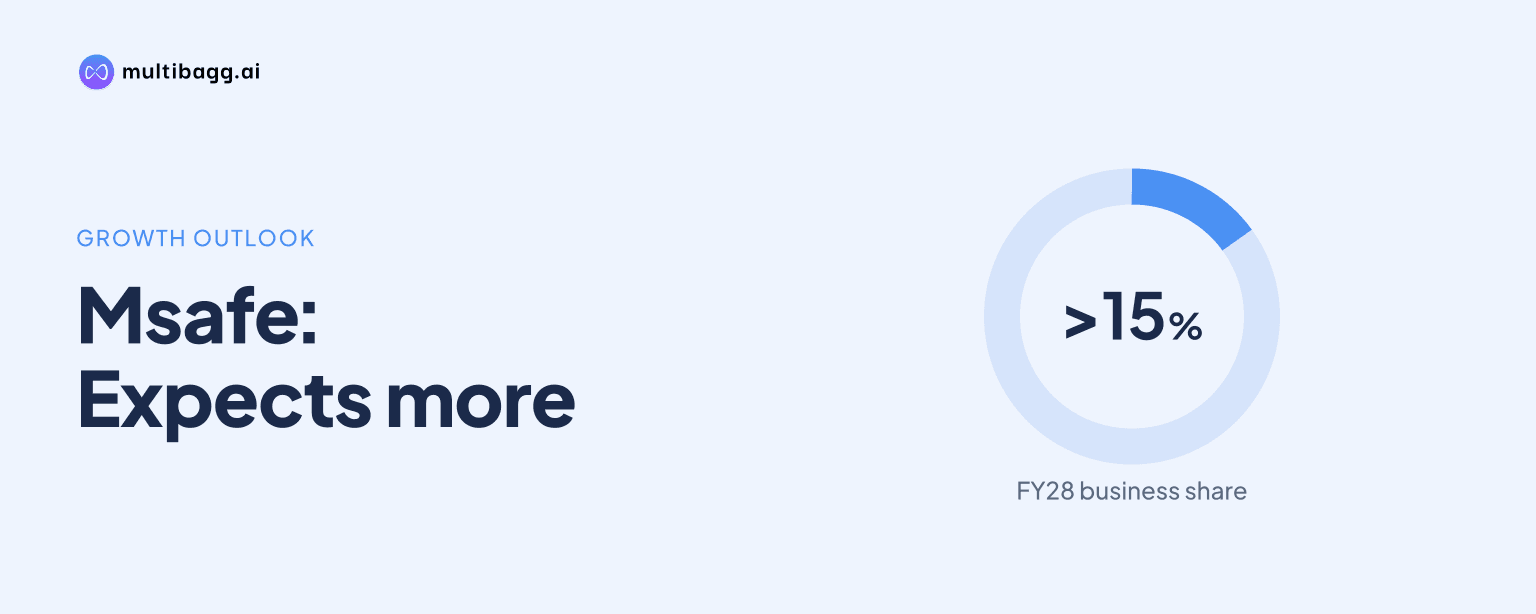
In FY28, Msafe Equipments Limited expects aluminium formwork to account for at least 15% of total business, after targeting December 2026 commercialisation from an initial 500-tonne annual capacity; management said FY27 contribution may be modest because conversion and execution cycles are relatively long.
Know Msafe Equipments inside out
Results, valuation, peers and who's buying, in one view.
When will Msafe commercialise aluminium formwork?
Msafe is targeting commercialisation of aluminium formwork in December 2026 after beginning trial runs at a rented facility with planned initial production capacity of 500 tonnes a year. The company is entering the segment with solutions intended for high-rise construction, mass housing and infrastructure projects, extending its existing portfolio of scaffolding and ladders.
Management said aluminium formwork has not been assumed to make a significant contribution during FY27. The stated reason is the relatively long cycle from enquiry through order conversion to project execution, even though trial production is under way. That timing is material because the company’s FY27 growth guidance of about 50% is instead supported by capacity expansion, rental growth, aluminium sales and other existing businesses.
The planned commercialisation comes before Msafe’s integrated manufacturing facility at Mathura is expected to start operations in May 2027. Management said the Mathura facility is intended to support broader expansion plans, while the 500-tonne formwork operation will initially run from rented premises. The transcript does not disclose a later formwork capacity target, capital cost or utilisation assumption for this new line.
How much business does Msafe expect from formwork in FY28?
Msafe expects aluminium formwork to contribute at least 15% of total business from FY28. In a separate response, management said formwork sales could account for 15% to 20% of total revenue from the next financial year, indicating a planned revenue-mix change rather than an FY27 earnings driver.
The outlook is management’s expectation, not reported revenue. Msafe said the FY27 contribution may be modest because the business is new and the execution cycle is long. The transcript does not provide a rupee revenue target for FY28 formwork, a customer order book, pricing information or an estimate of how much of the planned 500-tonne annual capacity will be sold or rented.
The planned FY28 contribution would be measured against a business currently balanced between sales and rental. For H1 FY27, management put sales at about 48% of revenue and rentals at about 52%, compared with approximately 49% sales and 51% rentals in the previous financial year. Management said its focus is to maintain at least 50% contribution from sales, while describing rental as its core focus because it is more profitable.
Got a follow-up? Ask IRIS
What demand case supports Msafe’s formwork entry?
Msafe’s demand case is based on growing high-rise construction, mass housing and infrastructure activity, where management said formwork can enable faster execution and reduce project costs. Management acknowledged that more than 10 to 15 new players are entering the market, but said it sees a significant demand opportunity rather than forecasting oversupply.
The current market is concentrated in about five major metropolitan areas, according to management. Its stated longer-term view is that demand could broaden to Tier 1 and Tier 2 cities and eventually more than 100 cities. That is a market assessment by management, and the call did not provide industry demand volumes, market-share targets or a timetable for Msafe’s geographic expansion in formwork.
Msafe plans to seek business from existing relationships, although management said only a small proportion of customers would overlap, particularly infrastructure and civil contractors. This limits the extent to which formwork can be treated as an automatic cross-sell to the company’s scaffolding base. The commercial outcome will therefore depend on converting new enquiries and executing orders after the December 2026 target launch.
How does formwork fit Msafe’s growth and profitability plans?
Msafe is adding formwork while expanding production capacity and its rental asset base, with management maintaining guidance for annual top-line growth of 50% to 70% and bottom-line growth of 40% to 50%. The company reported revenue from operations of approximately Rs 40 crore in Q2 FY27, up 53% year on year, and approximately Rs 72 crore in H1 FY27, up 47% year on year.
Rental activity remains a central part of the plan. Rental represented approximately 51.5% of Q2 FY27 revenue, while steel scaffolding rental revenue rose from approximately Rs 3.5 crore in the previous financial year to approximately Rs 10 crore in the first half of the current financial year. Management also reported rental yields of approximately 32% to 38% for MS scaffolding and 60% to 66% for aluminium scaffolding.
Management cautioned that formwork margins may differ from those of the existing business as formwork sales potentially reach 15% to 20% of revenue from FY28. In response to an analyst’s question on profit after tax, or PAT, margins, management said variation of around one percentage point was possible and linked maintaining similar margins to achieving a healthy rental contribution. Q2 FY27 earnings before interest, tax, depreciation and amortisation, or EBITDA, were Rs 15.61 crore, equal to a 38.65% margin.
Conclusion
Msafe’s stated plan makes aluminium formwork a FY28 growth component rather than a near-term FY27 revenue engine. It aims to commercialise a 500-tonne annual operation in December 2026 and expects at least 15% of total business from the segment in the following financial year. The new line sits alongside a rental-led model that produced approximately 52% of H1 FY27 revenue from rentals and reported approximately Rs 72 crore of H1 revenue.
The next disclosed milestones are December 2026 commercialisation and the expected May 2027 start of the Mathura integrated facility. The key matters to watch are whether trial production converts into orders despite the long execution cycle, whether formwork margins differ from the existing mix, and whether management maintains its 50% to 70% annual top-line growth guidance as the segment ramps up.