










MSAFE lifts MS scaffolding target to 15,000 tonnes early
Key highlights
- MSAFE reached 9,000 tonnes of MS scaffolding capacity ahead of its next-financial-year plan.
- MSAFE raised its MS scaffolding capacity target from 9,000 tonnes to 15,000 tonnes.
- Steel scaffolding rental revenue was approximately Rs 10 crore in the first half, compared with approximately Rs 3.5 crore in the previous full year.
- MSAFE disclosed an additional debt requirement of approximately Rs 20 crore to Rs 25 crore for factory completion and working capital.
powered by IRIS
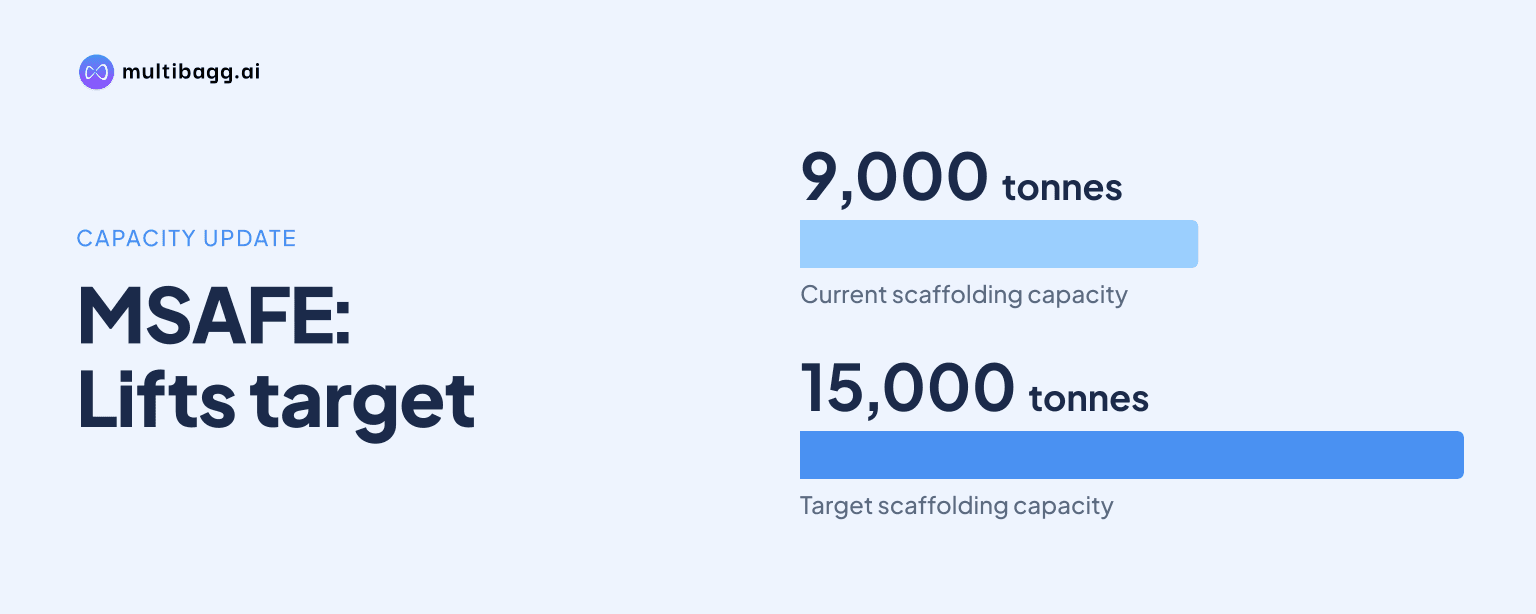
MSAFE has raised its MS scaffolding capacity target to 15,000 tonnes after reaching 9,000 tonnes ahead of its next-financial-year plan, with monthly production capacity exceeding 750 tonnes last month. Management attributed the accelerated expansion to high utilisation and strong demand in both rental and sales operations.
Know Msafe Equipments inside out
Results, valuation, peers and who's buying, in one view.
Why did MSAFE raise its MS scaffolding capacity target?
MSAFE raised its MS scaffolding capacity target to 15,000 tonnes because management said it is operating at high utilisation amid strong rental and sales demand. Before the issue, MS scaffolding capacity was approximately 3,200 tonnes per annum, and MSAFE had initially planned to raise it to 6,285 tonnes by the end of the year.
MSAFE achieved the 6,285-tonne level in April, earlier than its original year-end plan. Management then set a 9,000-tonne target for the next financial year, but said that level had already been reached. Last month, production capacity exceeded 750 tonnes per month, which is above a 9,000-tonne annualised pace if maintained for 12 months.
The move from approximately 3,200 tonnes before the issue to 9,000 tonnes represents an increase of 5,800 tonnes of annual MS scaffolding capacity. Management did not disclose a completion date, capital expenditure figure or revenue potential for the 15,000-tonne target, instead citing the need to add capacity repeatedly as utilisation remained high.
What demand is supporting MSAFE's added capacity?
MSAFE said strong rental and sales demand is supporting the expanded MS scaffolding capacity, with steel scaffolding rental revenue reaching approximately Rs 10 crore in the first half of the current financial year. That compares with approximately Rs 3.5 crore of steel scaffolding rental revenue in the whole previous financial year, although the periods are a half year and a full year respectively.
Management said its 50% growth outlook is based on new customer additions, aluminium sales, rental revenue and contributions from other businesses. It also identified data centres, semiconductor plants, Navi Mumbai International Airport, Bhogapuram Airport, malls, hotels and government and private infrastructure projects as sources of demand for aluminium scaffolding.
MSAFE management said more than 100 large data centres and around 10 semiconductor plants are under construction over coming years. These figures were cited as indicators of the wider demand environment rather than as confirmed MSAFE orders. Management also said the formwork market is currently concentrated in around five major metros but may extend into Tier 1 and Tier 2 cities and more than 100 cities over time.
The sales-rental mix has changed by only one percentage point despite the capacity build-out. Sales represented approximately 48% and rentals approximately 52% in the current year, versus around 49% sales and 51% rentals in the previous financial year. Management said rental remains its core focus because it is more profitable, while it aims to maintain at least 50% contribution from sales.
Got a follow-up? Ask IRIS
How do MSAFE's MS and aluminium scaffolding economics compare?
MSAFE said MS scaffolding earns rental yields of approximately 32% to 38%, compared with 60% to 66% for aluminium scaffolding. Management said MS scaffolding's lower yield is compensated by its longer useful life, longer rental duration and larger addressable market.
Management estimates an economic life of approximately 15 to 20 years for MS scaffolding, compared with approximately five to seven years for aluminium scaffolding. The average MS scaffolding rental tenure is around one year, with contracts ranging from three months to two years. Aluminium scaffolding rental orders average around four months, with individual orders ranging from one day to one or two years.
MSAFE said aluminium scaffolding utilisation is nearly 80%, while average rental orders are serviced and redeployed after their four-month duration when required. Management valued MS scaffolding at approximately Rs 65,000 to Rs 70,000 per tonne and aluminium scaffolding at approximately Rs 5 lakh to Rs 6 lakh per tonne.
Management cautioned that per-tonne values are not directly comparable because aluminium scaffolding weighs approximately one-third as much as MS scaffolding and serves different applications. It said the two businesses could generate broadly similar margins over a five-year period, although it had not conducted an exact calculation. Management also estimated scrap residual value of approximately 50% or more for both materials at the end of useful life.
What do formwork plans and funding needs mean for MSAFE?
MSAFE does not expect aluminium formwork to make a significant contribution in the current financial year, but management expects it to account for at least 15% of total business from next year onward. Trial production has started, although management said the cycle from enquiry and order conversion to execution is relatively long.
The initial aluminium formwork product will comprise approximately 95% aluminium and 5% MS, with MS used in certain support systems. Management said formwork capital intensity should be similar to aluminium scaffolding, and margins should be approximately similar if the business is operated on a rental basis. It estimated aluminium formwork life at approximately 150 to 200 usage cycles, with one cycle potentially taking around 10 days at peak utilisation.
MSAFE disclosed existing short-term and long-term debt of approximately Rs 44 crore and said it may require an additional Rs 20 crore to Rs 25 crore. Management confirmed that this debt would be in addition to current borrowings and would fund factory completion and working-capital requirements.
MSAFE generated positive operating cash flow in the first half, but management did not provide a full-year operating cash-flow forecast. It said the objective is to remain cash-flow positive and noted that the rental model requires investment in assets before those assets generate rental income. Management has also maintained guidance of 50% to 70% annual top-line growth and 40% to 50% annual bottom-line growth for at least the next two years.
Conclusion
MSAFE's revised 15,000-tonne MS scaffolding target follows capacity additions that moved faster than management's earlier plans, from approximately 3,200 tonnes before the issue to 6,285 tonnes in April and then 9,000 tonnes before the next-financial-year target. The stated basis for the expansion is high utilisation and strong demand across rental and sales, alongside approximately Rs 10 crore of first-half steel scaffolding rental revenue.
The next points to watch are the timing and funding of the 15,000-tonne target, as MSAFE has not disclosed either item, and whether operating cash flow remains positive for the full financial year. Management also expects aluminium formwork to contribute at least 15% of total business from next year, while disclosing an additional debt requirement of approximately Rs 20 crore to Rs 25 crore for factory completion and working capital.