










Novus Loyalty expects AutoPay PAT margin at 17%-20% long run
Key highlights
- AutoPay's PAT margin fell from about 21.9% to 13.8% in FY26, according to Novus management.
- AutoPay reported FY26 revenue of Rs 102 crore, EBITDA close to Rs 23 crore and PAT of more than Rs 14 crore.
- Novus expects AutoPay to maintain a 17%-20% PAT margin over the longer run.
- Novus plans to acquire about 80.87% of AutoPay, with Rs 40 crore to Rs 45 crore due in June 2027.
powered by IRIS
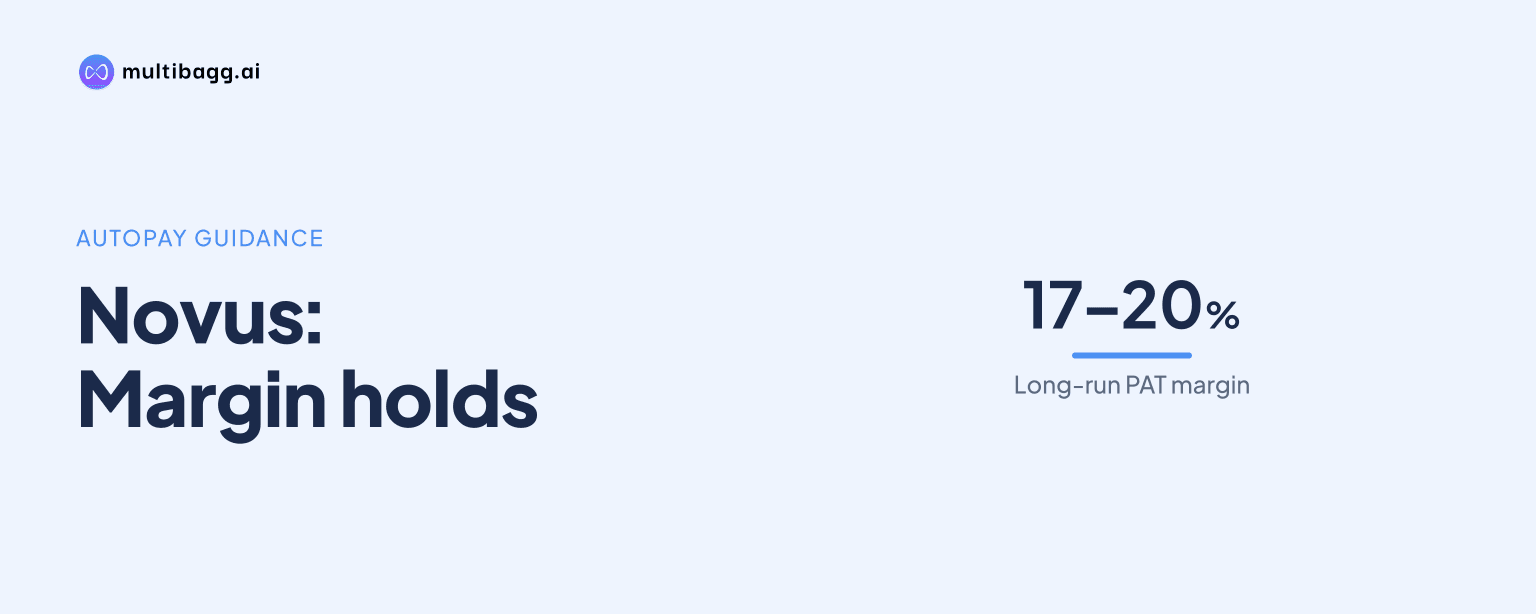
In FY26, AutoPay Payment Solution's profit after tax, or PAT, margin fell to 13.8% from about 21.9%, but Novus Loyalty expects the payments business to sustain a 17%-20% PAT margin over the longer run as Delhi Metro revenue offsets technology, research and development, and minimum-guarantee spending.
Know Novus Loyalty inside out
Results, valuation, peers and who's buying, in one view.
Why did AutoPay's PAT margin fall in FY26?
AutoPay's FY26 PAT margin declined because it invested in the Delhi Metro Rail Corporation, or DMRC, Saathi app business, according to Novus management. The margin moved from about 21.9% to 13.8%, a decline of about 8.1 percentage points, after AutoPay spent on technology development, research and development, and a new metro-linked revenue line whose revenue had not yet fully begun.
Management contrasted that spending with AutoPay's earlier concentration on Indian Railway Catering and Tourism Corporation, or IRCTC, payment operations, which it described as a high-margin activity. The DMRC rollout required AutoPay to build a virtual-card system, while a physical metro smart card costs Rs 80 to print and deliver, according to management. The virtual-card design is intended to let users transact through the Saathi app without inserting a physical card into a machine.
Management also cited minimum-guarantee amounts, or MMGs, payable to metro operators as a factor in FY26 profitability. It said AutoPay spent about Rs 1.5 crore on MMGs while related revenue had yet to fully kick in. Novus's explanation is therefore that revenue grew while the new metro business still needed bottom-line optimisation, rather than that the established IRCTC operation had stopped generating profit.
What PAT margin does Novus expect AutoPay to sustain?
Novus expects AutoPay's longer-run PAT margin to settle between 17% and 20%, rather than return to the roughly 22% level cited for the earlier period. Management gave that range after noting FY26 revenue of Rs 102 crore and PAT of more than Rs 14 crore, and said the newer metro revenue was beginning to flow.
The 17%-20% range is management's expectation, not a reported forecast for a specified fiscal year. It depends on AutoPay scaling the new DMRC line after its upfront development and MMG costs. Management said EBITDA was close to Rs 23 crore in FY26, indicating that its stated PAT-margin target is separate from the EBITDA measure.
Management also said it sees AutoPay growing by at least 15%-20% year on year while maintaining the 17%-20% margin range. That growth assumption includes expanding applications of its existing payment technology, rather than relying only on the IRCTC business that had been its principal customer for its first three to four years.
Got a follow-up? Ask IRIS
How could metro and transit products affect AutoPay's earnings mix?
AutoPay's earnings mix could shift toward transit-payment services if the Delhi Metro technology generates recurring usage after deployment. Novus said the business has built virtual cards for the Saathi app and continues to support physical-card top-ups, making the metro project a broader payment workflow than its established IRCTC activity.
Novus also said it and AutoPay submitted an expression of interest for an Indian Railways transit-loyalty system. Management described the opportunity as requiring capabilities in both transit payments and loyalty, which the two businesses would present together. No award, contract value or implementation date was disclosed, so the expression of interest remains a prospective opportunity rather than reported revenue.
The acquisition rationale also includes links to Novus's loyalty platform. Management said AutoPay could enable low-value, high-frequency reward redemptions for bank clients, while Novus's existing loyalty services can provide offers to merchants. It said AutoPay's payment technology could also shorten collection cycles by allowing Novus to collect payments from merchants rather than only supplying loyalty and offer solutions.
How will Novus fund and integrate the AutoPay acquisition?
Novus has signed an agreement to acquire about 80.87% of AutoPay and said the transaction was expected to complete within six months from the H1 FY27 call. Management said about 20% of the consideration would be funded through a share swap, around Rs 40 crore through internal accruals and potentially initial public offering proceeds, and a further Rs 40 crore to Rs 45 crore was due in June 2027.
For the June 2027 payment, management said Novus planned a preferential, or pref, funding round. It did not disclose a final funding amount, issue price, valuation multiple or whether the proposed pref round would be completed. An investor raised a proposed acquisition value of around Rs 130 crore, while management said a fair valuation exercise and discussions with selling shareholders informed the agreed figure.
Following completion, Novus plans to combine payment and loyalty offerings and apply for a prepaid payment instrument, or PPI, licence within the AutoPay structure. Management said a PPI licence could reduce third-party card-issuance fees and eventually support higher voucher margins through retained breakage, meaning the value of vouchers not used by customers. These are conditional benefits because the licence has not yet been obtained.
Conclusion
AutoPay's FY26 margin compression reflects a move from an established IRCTC-centred payment business into Delhi Metro technology and related minimum-guarantee commitments. Novus's central position is that the 13.8% FY26 PAT margin should move into a 17%-20% long-run range as revenue from the metro line develops, while growth is targeted at at least 15%-20% annually.
The next items to watch are the stated six-month timetable for completing the 80.87% AutoPay acquisition, the planned integration of payment and loyalty products, and the proposed pref round for Rs 40 crore to Rs 45 crore due in June 2027. Progress on the PPI licence and any result from the Indian Railways transit-loyalty expression of interest would also affect whether the expected synergies become operational.