










Novus Loyalty targets transit payments through AutoPay deal
Key highlights
- Novus Loyalty signed an agreement to acquire 80.87% of AutoPay, with completion expected within six months.
- Novus Loyalty reported about Rs 98 crore of H1 FY27 revenue, versus about Rs 71 crore in H1 FY26.
- Management said AutoPay generated about Rs 102 crore of FY26 revenue and more than Rs 14 crore of PAT.
- Management plans about 20% share-swap funding, around Rs 40 crore from internal sources and a Rs 40 crore to Rs 45 crore June 2027 payment.
powered by IRIS
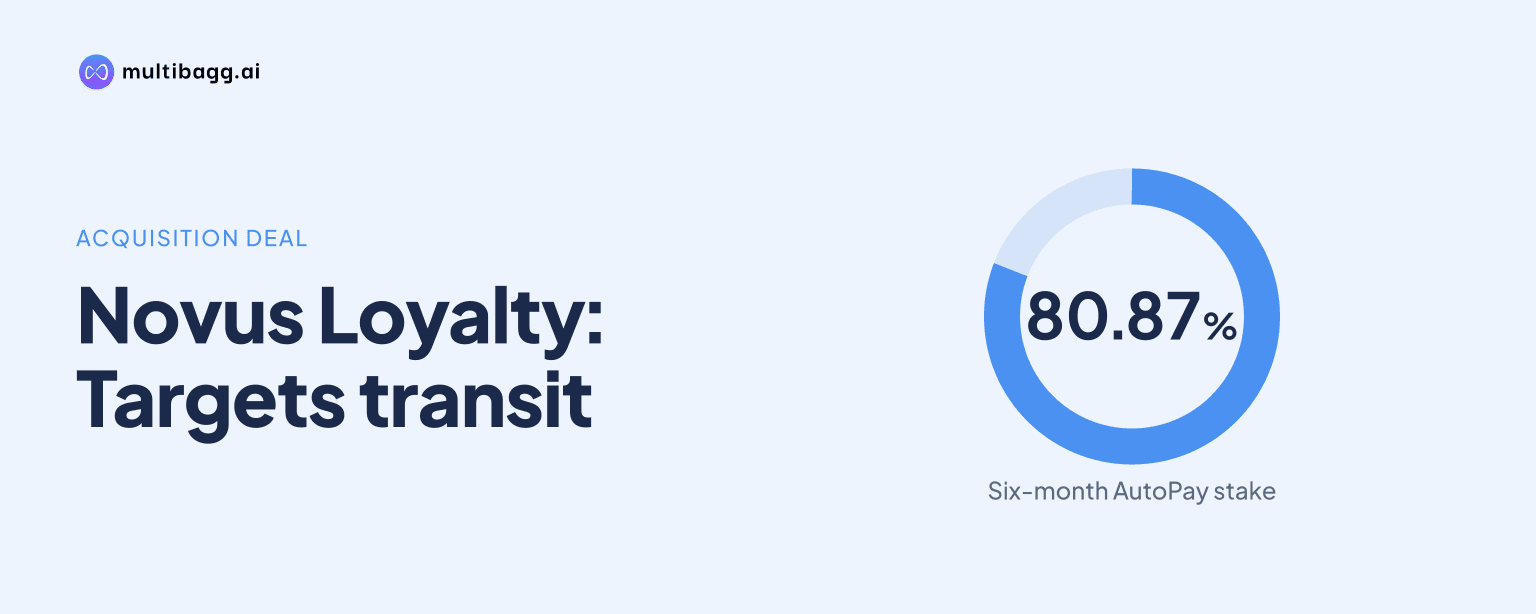
Novus Loyalty Limited signed an agreement in H1 FY27 to acquire 80.87% of AutoPay, seeking to add transit-payment capabilities to its loyalty platform and pursue a prepaid payment instrument, or PPI, licence. Management said AutoPay could enable low-value, high-frequency redemptions and merchant payment collection alongside Novus Loyalty’s existing enterprise products.
Know Novus Loyalty inside out
Results, valuation, peers and who's buying, in one view.
What does Novus Loyalty’s AutoPay agreement include?
Novus Loyalty has signed a Share Purchase Agreement, or SPA, to acquire an 80.87% stake in AutoPay, and management expects the transaction to be completed within the next six months. The company described AutoPay as a debt-free business that has generated profit year on year for the last four years, but did not disclose a closing date or final transaction terms during the H1 FY27 call.
An analyst referred to a proposed acquisition value of about Rs 130 crore, while management said the valuation followed a fair valuation exercise and negotiations with selling shareholders. Management’s rationale extended beyond AutoPay’s existing earnings: it said the combination could bring transit-payment technology into Novus Loyalty’s customer-engagement offering and accelerate its path towards a PPI licence.
The acquisition was outlined as Novus Loyalty reported about Rs 98 crore of revenue in H1 FY27, compared with about Rs 71 crore in H1 FY26. H1 means first half and FY means financial year. Management said revenue increased across technology, redemption, merchant-promotion and digital-voucher lines, while banking, financial services and insurance, or BFSI, represented 90% to 92% of its business.
How could AutoPay change Novus Loyalty’s loyalty platform?
Novus Loyalty says AutoPay can give bank clients lower-value and more frequently used redemption options through AutoPay’s transit-payment presence. Management cited AutoPay’s work with Indian Railway Catering and Tourism Corporation, or IRCTC, Delhi Metro Rail Corporation, or DMRC, and the Saathi app, as well as its presence on Mumbai’s airport metro line and at Delhi Metro stations.
This is intended to complement Novus Loyalty’s existing redemption engine rather than replace it. Management said bank loyalty programmes have traditionally used higher-value, lower-frequency redemption options, whereas transit use could create more regular redemption occasions. It cited the Central Bank of India programme, where points can be redeemed through IRCTC and the Saathi app, as an example of broadening redemption choices.
A second mechanism is merchant payment collection. Novus Loyalty said it supplies loyalty and offer solutions to merchants but does not collect their payments, which can lengthen collection cycles. Management said AutoPay’s payment technology could enable the combined business to collect payments as well as provide loyalty programmes and merchant offers, although it did not quantify the working-capital effect.
Management also plans to apply for a PPI licence in AutoPay. It said a successful licence would mean Novus Loyalty would not have to pay card-issuance fees to another provider. In discussing vouchers, management added that a PPI licence could potentially allow the group to retain unused-voucher breakage and create combined restaurant vouchers, but these were future possibilities rather than current revenue.
Got a follow-up? Ask IRIS
What are AutoPay’s margins and growth plans?
AutoPay’s profit after tax, or PAT, margin declined because it invested in DMRC-related technology and research and development, according to management. An analyst cited a decline to about 13.8% from about 21.9%. Management said AutoPay’s earlier IRCTC business carried high margins, while the newer DMRC and Saathi app operations required upfront expenditure before their revenue contribution had fully started.
Management said a physical smart card can cost Rs 80 to print and deliver, while AutoPay has developed a virtual-card system intended to work through the Saathi app without that offline process. It also said AutoPay spent about Rs 1.5 crore on minimum-guarantee commitments connected with metro operations before the related revenue had fully flowed. Those investments, management said, compressed profitability despite higher revenue.
For FY26, management said AutoPay recorded about Rs 102 crore of revenue, more than Rs 14 crore of PAT and close to Rs 23 crore of earnings before interest, tax, depreciation and amortisation, or EBITDA. Management said the business could sustain margins of 17% to 20% over the longer term, although it did not specify the exact profit measure for that range in its response.
Management expects AutoPay to grow at least 15% to 20% year on year by extending existing technology to more customers and use cases. It cited rail-ticketing refund processes as an opportunity, saying similar technology could potentially be offered to platforms such as ConfirmTkt and MakeMyTrip. Novus Loyalty and AutoPay also submitted an expression of interest for an Indian Railways transit-loyalty system, but did not disclose a timetable or outcome.
How will Novus Loyalty fund the AutoPay acquisition?
Novus Loyalty plans to fund about 20% of the AutoPay purchase through a share swap, according to management. It said around Rs 40 crore would come from internal accruals and potentially some initial public offering proceeds, while a further Rs 40 crore to Rs 45 crore would be payable in June 2027, depending on market conditions.
For that later payment, management said it was planning a preferential round. This remains a financing plan rather than completed funding. The call did not state the number of shares, issue price, investors, dilution effect or whether Novus Loyalty would use debt for any portion of the transaction.
The proposed funding accompanies Novus Loyalty’s stated mix of organic and inorganic growth. Management put organic growth in the base business at around 15%, while identifying payments, international expansion and artificial-intelligence-led products as priorities. It said AutoPay’s transit and payment capabilities were reasons for the deal, rather than presenting the acquisition solely as a means to add reported revenue.
Conclusion
Novus Loyalty’s AutoPay agreement represents a planned expansion from loyalty technology into payment-enabled customer engagement. The 80.87% acquisition is intended to add transit-linked redemption routes, merchant payment collection and a potential PPI licence pathway, while AutoPay brings an established IRCTC operation and newer DMRC technology that management said has temporarily reduced margins.
The next points to watch are the expected completion of the transaction within six months, the planned PPI licence application and management’s proposal to fund the June 2027 payment through a preferential round. Management also expects DMRC-related revenue to begin offsetting the stated Rs 1.5 crore of minimum-guarantee spending, while the Indian Railways transit-loyalty expression of interest remains unresolved.