










NRL first-half GRM rises to US$28.24 as utilisation reaches 106%
Key highlights
- NRL’s H1 FY 2026-27 GRM rose 265% to US$28.24 per barrel from US$7.73 per barrel.
- NRL processed 1,594 TMT of crude in H1 FY 2026-27, compared with 1,552 TMT a year earlier.
- NRL’s H1 FY 2026-27 capacity utilisation increased to 106.26% from 103.48%.
- NRL’s distillate yield improved to 87.15% from 86.64% in H1 FY 2025-26.
powered by IRIS
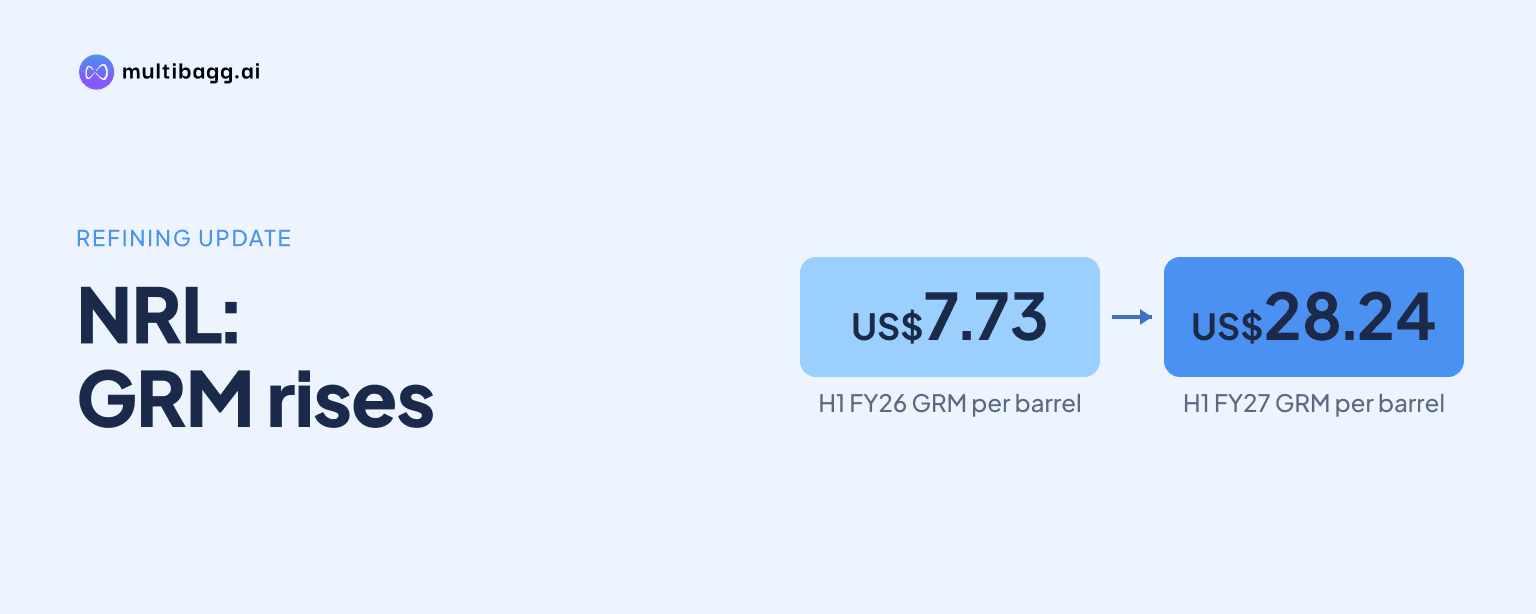
Oil India Limited’s material subsidiary NRL reported a US$28.24-a-barrel gross refining margin for the half year ended 30 September 2026, 265% above US$7.73 a year earlier, while capacity utilisation reached 106.26% and crude throughput rose to 1,594 thousand metric tonnes.
Know Oil India inside out
Results, valuation, peers and who's buying, in one view.
What was NRL’s first-half refining margin?
NRL reported a gross refining margin (GRM) of US$28.24 per barrel for the half year ended 30 September 2026, compared with US$7.73 per barrel for the half year ended 30 September 2025. Oil India stated that the year-on-year increase was 265%. The absolute difference between the two reported half-year margins was US$20.51 per barrel.
The US$28.24-per-barrel measure applies to the half year, not to Q2 FY27 alone. Oil India disclosed both Q2 FY27 and H1 FY 2026-27 crude-throughput figures, but it provided GRM only for the half year ended 30 September 2026 and the corresponding half year ended 30 September 2025. The US$7.73-per-barrel prior-period figure is therefore the direct comparator for the reported 265% increase.
Oil India linked NRL’s operating performance to sustained operational efficiency and effective refinery management. The announcement also reported higher capacity utilisation, crude throughput and distillate yield in H1 FY 2026-27, alongside the US$28.24-per-barrel GRM. It did not provide product-wise selling prices, crude procurement costs, inventory effects, product cracks or a quarterly GRM.
How much crude did NRL process in the first half?
NRL processed 1,594 thousand metric tonnes (TMT) of crude in H1 FY 2026-27, compared with 1,552 TMT in H1 FY 2025-26. The reported first-half increase was 42 TMT. This volume increase was accompanied by a rise in capacity utilisation to 106.26% from 103.48% over the same periods.
The H1 FY 2026-27 throughput figure includes NRL’s Q2 FY27 crude processing of 803 TMT. Oil India reported Q2 FY27 throughput of 753 TMT in the corresponding quarter of the previous year, making the quarterly increase 50 TMT. The Q2 rise was larger than the 42 TMT first-half rise because the first-half comparison also incorporates the respective first-quarter figures, which the announcement did not disclose.
NRL’s 1,594 TMT of H1 FY 2026-27 throughput was reported together with a US$28.24-per-barrel GRM, rather than as an explanation of the margin movement. Oil India did not disclose the refinery’s nameplate capacity, any capacity change, crude mix or maintenance activity. Those omissions mean the release does not quantify how much of the margin improvement was associated with the 42 TMT throughput increase.
Got a follow-up? Ask IRIS
How did NRL’s refinery utilisation and distillate yield change?
NRL’s capacity utilisation was 106.26% in H1 FY 2026-27, up from 103.48% in H1 FY 2025-26. The year-on-year increase was 2.78 percentage points. Oil India said NRL maintained capacity utilisation above 100% in the period, during which crude throughput reached 1,594 TMT.
NRL’s distillate yield rose to 87.15% in H1 FY 2026-27 from 86.64% in H1 FY 2025-26. That was an increase of 0.51 percentage points, smaller than the 2.78-percentage-point improvement in capacity utilisation. Oil India attributed the higher distillate yield to sustained focus on operational efficiency and product optimisation.
The reported operating measures moved in the same direction: throughput increased from 1,552 TMT to 1,594 TMT, utilisation rose from 103.48% to 106.26%, and distillate yield increased from 86.64% to 87.15%. The announcement did not define the products included in distillates or provide yields for other product categories. It also did not state whether the 87.15% yield reflected any change in crude quality or refinery configuration.
What does NRL’s Q2 throughput result show?
NRL processed 803 TMT of crude in Q2 FY27, against 753 TMT in the corresponding quarter of the previous year. The 50 TMT increase occurred in the quarter ended 30 September 2026, when Oil India also reported its financial results on 12 November 2026. The release did not disclose NRL’s Q2 GRM, Q2 utilisation or Q2 distillate yield.
The Q2 FY27 throughput of 803 TMT represented just over half of NRL’s reported H1 FY 2026-27 throughput of 1,594 TMT. By comparison, the 753 TMT reported for the corresponding prior-year quarter was below half of the 1,552 TMT reported for H1 FY 2025-26. These figures show a higher second-quarter throughput contribution in FY 2026-27, although Oil India did not publish the individual first-quarter throughput figures.
Oil India described NRL as a material subsidiary and reported its refinery metrics separately from the parent company’s upstream production figures. In the same release, Oil India said it drilled 42 wells during the first half of the year and produced 1.021 million metric tonnes of crude oil in Q2 FY27. The announcement did not provide NRL revenue, profit after tax, refining operating costs or its contribution to Oil India’s consolidated profit after tax of Rs 6,548 crore for the half year ended 30 September 2026.
Conclusion
NRL’s first-half results showed a US$20.51-per-barrel increase in reported GRM to US$28.24 per barrel in the half year ended 30 September 2026, from US$7.73 a year earlier. The margin movement coincided with 1,594 TMT of crude throughput, 106.26% capacity utilisation and an 87.15% distillate yield, compared with 1,552 TMT, 103.48% and 86.64%, respectively, in H1 FY 2025-26.
The next operating comparison remains unresolved because Oil India disclosed no forward GRM target, throughput target, refinery-expansion plan or quarterly utilisation guidance for NRL in its 12 November 2026 release. Future disclosures would clarify whether the 803 TMT of Q2 FY27 throughput, 106.26% first-half utilisation and US$28.24-per-barrel first-half GRM are sustained, but the current announcement provides no forecast for those measures.