










Oil India royalty tax provision reaches Rs 5,283.85 crore
Key highlights
- Oil India’s cumulative royalty service-tax and GST provision was Rs 5,283.85 crore at September 30, 2026.
- Oil India deposited Rs 4,857.55 crore under protest, including Rs 770.00 crore of interest.
- The September 2026 quarter provision was Rs 240.52 crore, including Rs 53.23 crore of interest.
- The half-year provision was Rs 530.08 crore, including Rs 157.00 crore of interest.
powered by IRIS
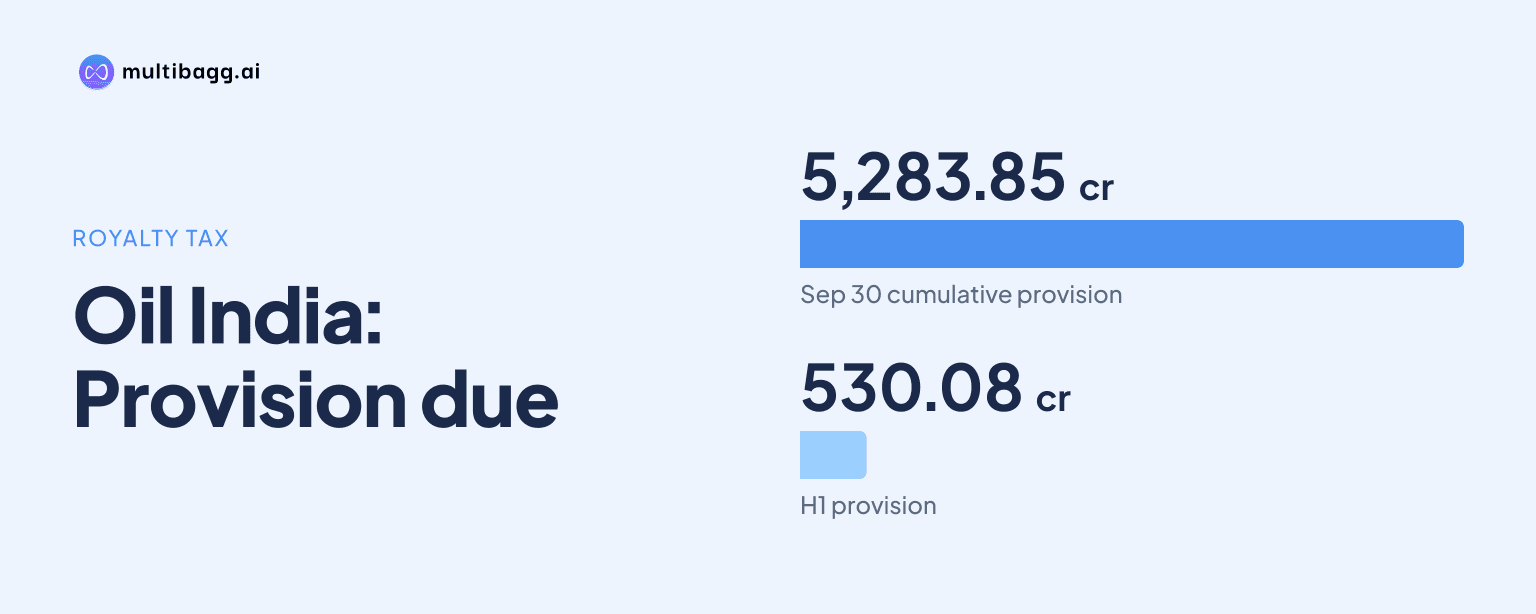
Oil India Limited had recognised a cumulative Rs 5,283.85 crore provision, including Rs 1,038.30 crore of interest, by September 30, 2026 for disputed service tax and GST on oil and natural-gas royalty, and had deposited Rs 4,857.55 crore under protest while proceedings remained pending.
Know Oil India inside out
Results, valuation, peers and who's buying, in one view.
What has Oil India provided for the royalty tax dispute?
Oil India has provided Rs 5,283.85 crore cumulatively as at September 30, 2026 for disputed service tax and Goods and Services Tax, or GST, on royalty paid for crude oil and natural gas in Assam, Arunachal Pradesh and Rajasthan. The amount includes Rs 1,038.30 crore of interest, covering both the levy and interest recognised in the standalone results.
The provision recorded for the quarter ended September 30, 2026 was Rs 240.52 crore, including Rs 53.23 crore of interest. For the half year ended September 30, 2026, Oil India disclosed a Rs 530.08 crore provision, including Rs 157.00 crore of interest, showing that the recognised charge increased during the six-month period.
Oil India’s standalone cash-flow statement shows a Rs 470.44 crore line item for provision towards service tax and GST on royalty for the half year ended September 30, 2026, against Rs 530.08 crore for the corresponding half year ended September 30, 2025. The financial-results note separately identifies the Rs 530.08 crore provision for the 2026 half year, while the cash-flow statement presents a royalty-provision adjustment in the operating-cash-flow reconciliation.
How much has Oil India deposited under protest?
Oil India had deposited Rs 4,857.55 crore under protest by September 30, 2026 against service tax and GST on royalty. This sum includes Rs 770.00 crore of interest and is subject to the final outcome of the pending proceedings, according to the company’s disclosure.
The service-tax demand covered March 2016 to June 2017 and sought to levy tax on royalty paid under the Oil Fields (Regulation and Development) Act, 1948. Oil India said it deposited the entire Rs 257.13 crore service-tax demand under protest while challenging the levy through writ petitions before different High Courts for Assam, Arunachal Pradesh and Rajasthan.
GST was implemented from July 1, 2017. Oil India said FAQs on government services issued by the Central Board of Indirect Taxes and Customs stated that GST was payable on royalty for assigning the right to use natural resources, while the company has challenged the application of that levy to royalty payable or paid under the Oil Fields (Regulation and Development) Act, 1948.
Oil India said future liabilities would also be deposited under protest as and when they accrue. It also disclosed that service tax and GST paid under protest have been, or are being, claimed as an allowable deduction under the Income Tax Act, 2025; the filing does not state a final outcome for those deduction claims.
Got a follow-up? Ask IRIS
Why is Oil India challenging service tax and GST on royalty?
Oil India is challenging whether service tax and GST apply to royalty paid under the Oil Fields (Regulation and Development) Act, 1948. Its petitions concern both the service-tax demand for March 2016 to June 2017 and the GST levy that began after July 1, 2017.
Pending matters before the Gauhati High Court and Rajasthan High Court were transferred to the Supreme Court for hearing by a nine-judge Constitution Bench. The Supreme Court de-tagged the cases from Civil Appeals Nos. 4056-4064 of 1999 through its March 14, 2024 order, leaving the royalty issue under the oilfields law to be considered separately.
In its July 25, 2024 judgment in Mineral Area Development Authority versus Steel Authority of India Limited, the Supreme Court held that royalty under the Mines and Minerals (Development and Regulation) Act was not a tax. Oil India’s filing states that the nature of royalty under the Oilfields (Regulation and Development) Act requires a separate decision because it involves a distinct constitutional provision.
On July 29, 2026, the Supreme Court tagged Transfer Petition (Civil) Nos. 300-304 of 2024 with Civil Appeal No. 10560 of 2025, Udaipur Chamber of Commerce and Industry versus Union of India. The court took note of a submission made on Oil India’s behalf that GST would be deposited in accordance with law within six weeks, subject to the final result of the proceedings.
How does the royalty provision compare with Oil India’s latest results?
Oil India’s Rs 530.08 crore royalty-related provision for the half year ended September 30, 2026 was reported alongside Rs 6,608.96 crore of profit before tax. Profit before tax was Rs 2,415.14 crore in the half year ended September 30, 2025, while the ultimate legal position on the royalty levy remained unresolved.
Net profit after tax rose to Rs 5,129.63 crore for the half year ended September 30, 2026 from Rs 1,857.50 crore a year earlier. Net profit margin was 32.00% in the 2026 half year, compared with 17.74% in the corresponding 2025 half year, while the disputed royalty payments continued to be treated as deposits under protest.
The joint statutory auditors highlighted the matter in their limited-review report, citing the Rs 5,283.85 crore cumulative provision and Rs 4,857.55 crore deposited under protest at September 30, 2026. Their conclusion was not modified in respect of the royalty matter, although the report drew attention to the provision and the pending litigation.
Oil India also disclosed a separate Rs 2,484.81 crore demand from the Assam government under the Assam Taxation (on Specified Lands) Act, 1990, as amended in 2004, for calendar years 2005 to 2024. The company has challenged that demand and continues to disclose it as a contingent liability until the Amendment Act is repealed by the state government.
Conclusion
Oil India’s September 30, 2026 results quantify a recognised royalty-related indirect-tax exposure of Rs 5,283.85 crore, including Rs 1,038.30 crore of interest. With Rs 4,857.55 crore already deposited under protest, the disclosure shows that most of the cumulative provision has been paid while the company continues to contest whether the levies apply.
The next development to watch is the outcome of proceedings following the Supreme Court’s July 29, 2026 tagging order and a separate judicial determination on royalty under the Oilfields (Regulation and Development) Act. Oil India has said it will deposit future royalty-related liabilities under protest as they accrue, which could result in further provisions or deposits before a final ruling.