










Oil India Limited reports decade-high daily crude output
Key highlights
- OIL produced 1.021 MMT of crude oil in Q2 FY27, up 20% from 0.848 MMT in Q2 FY26.
- OIL recorded daily crude production of 11,300 MT, or 87,051 barrels, on September 29, 2026.
- OIL drilled a record 42 wells during the first half of FY27.
- NRL's H1 FY 2026-27 GRM was US$28.24 per barrel, compared with US$7.73 per barrel a year earlier.
powered by IRIS
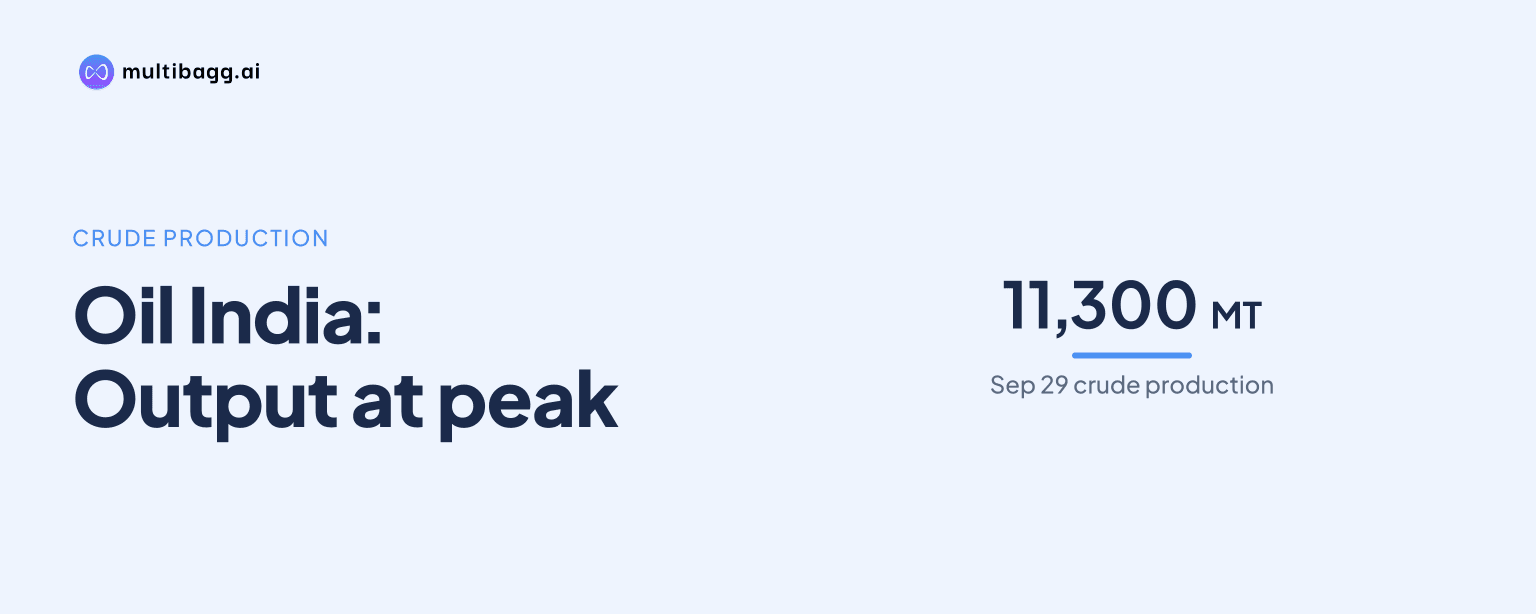
OIL recorded 11,300 metric tonnes (MT) of crude output on September 29, 2026, its highest daily rate in a decade, while Q2 FY27 production from mature and old oilfields reached 1.021 million metric tonnes (MMT). The quarterly volume was 20% above the 0.848 MMT reported in Q2 FY26.
Know Oil India inside out
Results, valuation, peers and who's buying, in one view.
How much crude did OIL produce in Q2 FY27?
OIL produced 1.021 MMT of crude oil from its mature and old oilfields in Q2 FY27, compared with 0.848 MMT in Q2 FY26, representing reported growth of 20%. The increase between the two quarterly volumes was 0.173 MMT. OIL disclosed the production figures in its November 12, 2026 press release accompanying its Q2 FY27 results.
The Q2 FY27 volume was reported alongside a 116% increase in standalone profit after tax (PAT) to Rs 2,259 crore from Rs 1,044 crore in Q2 FY26. OIL attributed the PAT increase to the 20% growth in crude production and a 35% rise in crude price realisation, to US$92.24 per barrel from US$68.19 per barrel.
When did OIL reach its decade-high daily crude output?
OIL reached its highest daily crude production in a decade on September 29, 2026, when output reached 11,300 MT, equivalent to 87,051 barrels. The company placed the daily record within Q2 FY27, when total production from mature and old oilfields was 1.021 MMT.
The September 29 figure is a one-day production measure, whereas the 1.021 MMT volume covers the full Q2 FY27 period. OIL compared the quarterly volume with 0.848 MMT in Q2 FY26, but described the 11,300 MT daily result against its production performance over the previous decade. The release did not identify the field, well or operating action behind that day’s output.
How many wells did OIL drill in the first half of FY27?
OIL drilled 42 wells during the first half (H1) of FY27, its highest-ever half-year drilling performance. The company said the 42-well result set a new benchmark in its operational achievements, while its Q2 FY27 crude production was 1.021 MMT.
The release does not provide an H1 FY26 drilling count, so it does not support a year-on-year comparison for the 42 wells. It also does not allocate the Q2 FY27 increase of 0.173 MMT in crude output to individual wells, a drilling campaign, a discovery or a reservoir intervention. The disclosed results therefore show record H1 drilling alongside higher quarterly production without specifying a direct operational link.
Got a follow-up? Ask IRIS
What was NRL's crude throughput in Q2 FY27?
OIL’s material subsidiary NRL processed 803 thousand metric tonnes (TMT) of crude in Q2 FY27, compared with 753 TMT in Q2 FY26. The 50 TMT increase came in the same quarter in which OIL’s upstream crude production rose by 0.173 MMT from the prior-year period.
For H1 FY 2026-27, NRL’s crude throughput was 1,594 TMT, against 1,552 TMT in H1 FY 2025-26, an increase of 42 TMT. OIL said NRL’s operating performance was supported by sustained operational efficiency and effective refinery management. The announcement did not disclose the refinery’s nameplate capacity, product volumes or crude sourcing.
How did NRL's utilisation and refining margin change?
NRL reported capacity utilisation of 106.26% in H1 FY 2026-27, up from 103.48% in H1 FY 2025-26. Distillate yield increased to 87.15% from 86.64% over the same periods. OIL said the refinery maintained utilisation above 100% and attributed the yield improvement to operational efficiency and product optimisation.
NRL’s gross refining margin (GRM) was US$28.24 per barrel for the half year ended September 30, 2026, compared with US$7.73 per barrel for the half year ended September 30, 2025. OIL reported the change as 265% growth. The release did not break down the contribution to GRM from product prices, feedstock costs, inventory effects or other margin factors.
What were OIL's Q2 FY27 profit and dividend disclosures?
OIL reported consolidated PAT of Rs 2,521 crore in Q2 FY27, up 53% from Rs 1,644 crore in Q2 FY26. For the half year ended September 30, 2026, consolidated PAT was Rs 6,548 crore, compared with Rs 3,690 crore in the corresponding previous half year, a reported increase of 77%.
Standalone PAT for the half year ended September 30, 2026 was Rs 5,130 crore, compared with Rs 1,857 crore in the corresponding previous half year, which OIL reported as 176% growth. The board recommended an interim dividend of Rs 7 per fully paid equity share with a face value of Rs 10. The board considered the Q2 FY27 financial results at its 586th meeting on November 12, 2026.
Conclusion
OIL’s Q2 FY27 disclosure combined higher crude production from mature and old oilfields with a decade-high daily output record. Quarterly production increased 20% to 1.021 MMT, daily output reached 11,300 MT on September 29, 2026, and H1 FY27 drilling reached a record 42 wells. NRL also reported higher throughput of 1,594 TMT in H1 FY 2026-27 and GRM of US$28.24 per barrel.
The next disclosures to watch are whether OIL provides a field-level explanation for the September 29 daily record and links future production to the 42 wells drilled in H1 FY27. The release does not disclose a prior-year drilling count, individual well contributions or a forward production target, leaving those operating details unresolved.