










Oil India Q2 profit rises 53% to Rs 2,520 crore
Key highlights
- Oil India reported Q2 profit after tax of Rs 2,520.47 crore, up 53% year on year.
- Oil India’s Q2 profit fell 37% from Rs 4,026.83 crore in the June 2026 quarter.
- Refinery-products segment profit fell to Rs 861.78 crore from Rs 1,640.16 crore sequentially.
- Oil India declared an interim dividend of Rs 7 per equity share on 12 November 2026.
powered by IRIS
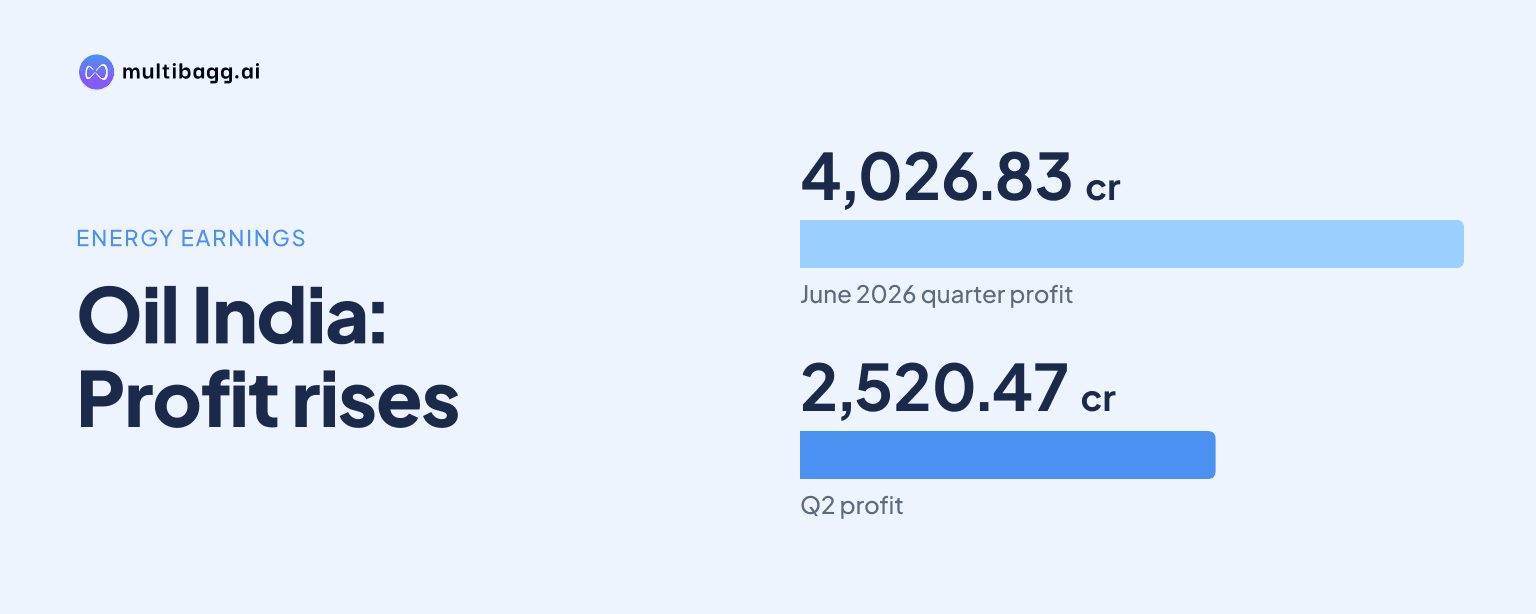
Oil India Limited reported consolidated profit after tax of Rs 2,520.47 crore for the quarter ended 30 September 2026, up 53% from Rs 1,643.81 crore a year earlier but down 37% from Rs 4,026.83 crore in the preceding quarter. Higher year-on-year revenue and crude-oil profit supported the annual comparison, while lower quarterly segment earnings and higher expenses affected the sequential result.
Know Oil India inside out
Results, valuation, peers and who's buying, in one view.
How did Oil India perform in Q2 2026?
Oil India recorded consolidated profit after tax of Rs 2,520.47 crore in the quarter ended 30 September 2026, against Rs 1,643.81 crore in the quarter ended 30 September 2025 and Rs 4,026.83 crore in the quarter ended 30 June 2026. Earnings per share from continuing operations were Rs 14.19, compared with Rs 8.78 a year earlier and Rs 22.32 in the June quarter. Oil India said quarterly earnings per share are not annualised.
Revenue from operations was Rs 11,914.80 crore in the September quarter, 22% above Rs 9,775.47 crore a year earlier, but below Rs 12,886.27 crore in the preceding quarter. Other income, mainly interest and dividend from deposits and investments, was Rs 388.91 crore. Total income was Rs 12,303.71 crore, while total expenses were Rs 9,056.57 crore.
Oil India reported profit before tax of Rs 3,433.99 crore, compared with Rs 2,047.73 crore a year earlier and Rs 5,322.17 crore in June 2026. The group received Rs 186.85 crore as its share of profit from associates and joint ventures, versus Rs 203.56 crore in the year-earlier quarter. Tax expense was Rs 913.12 crore, compared with Rs 403.92 crore in the June quarter.
For the half year ended 30 September 2026, Oil India reported profit after tax of Rs 6,547.70 crore, up from Rs 3,690.32 crore in the corresponding prior-year period. Revenue from operations for the six months rose to Rs 24,801.07 crore from Rs 17,925.35 crore. Total comprehensive income was Rs 6,759.42 crore, compared with Rs 7,101.22 crore in the previous corresponding half year.
Which Oil India segments changed most during the quarter?
Oil India’s crude-oil segment, including condensate, was the largest contributor to segment profit before tax and interest in the September quarter at Rs 2,465.29 crore. That was substantially above Rs 902.59 crore a year earlier, but below Rs 2,997.17 crore in the June 2026 quarter. Crude-oil segment revenue was Rs 6,146.08 crore, compared with Rs 3,512.25 crore a year earlier and Rs 6,120.84 crore in June.
Refinery products generated segment profit before tax and interest of Rs 861.78 crore, marginally above Rs 839.47 crore a year earlier but down from Rs 1,640.16 crore in the preceding quarter. Refinery-products revenue decreased sequentially to Rs 7,990.85 crore from Rs 9,147.62 crore. Natural-gas segment profit was Rs 304.66 crore, against Rs 318.88 crore a year earlier and Rs 647.93 crore in June.
Total segment profit before tax and interest fell to Rs 3,723.05 crore from Rs 5,423.01 crore in June, while it rose from Rs 2,417.86 crore a year earlier. Pipeline transportation reported Rs 41.09 crore of segment profit, down from Rs 311.61 crore in the September 2025 quarter. Liquefied petroleum gas, or LPG, contributed Rs 33.11 crore, compared with Rs 62.94 crore in June.
Got a follow-up? Ask IRIS
What happened to Oil India’s expenses and margins?
Oil India’s operating margin was 26.93% in the September 2026 quarter, compared with 39.54% in June 2026 and 17.79% a year earlier. Net profit margin was 27.76%, against 31.25% in the prior quarter and 17.92% in the year-earlier quarter. The sequential movement reflected a Rs 971.47 crore reduction in revenue from operations alongside a Rs 1,208.16 crore increase in total expenses.
Cost of materials consumed increased to Rs 2,155.91 crore from Rs 1,364.58 crore in the June quarter. Other statutory levies, which include royalty, cess and National Calamity Contingent Duty, or NCCD, rose to Rs 1,953.80 crore from Rs 1,270.96 crore. Other expenses increased to Rs 2,300.09 crore from Rs 1,953.11 crore.
Finance costs were Rs 350.99 crore, compared with Rs 305.24 crore in June and Rs 302.13 crore a year earlier. Depreciation, depletion and amortisation rose to Rs 767.70 crore from Rs 671.24 crore in the June quarter. Employee benefits expense was Rs 687.53 crore, compared with Rs 643.49 crore sequentially.
Oil India reported a debt-equity ratio of 0.57:1 at 30 September 2026, compared with 0.55:1 at 30 June 2026 and 0.56:1 a year earlier. Its current ratio was 1.12 times, against 1.22 times in June and 1.09 times at 31 March 2026. Cash and cash equivalents were Rs 422.28 crore at 30 September 2026, down from Rs 1,323.36 crore at 31 March 2026.
What dividend, audit and tax disclosures did Oil India make?
Oil India’s board declared an interim dividend of Rs 7 per equity share with a face value of Rs 10 on 12 November 2026, when it approved the unaudited consolidated results. The filing also stated that there was no outstanding default on loans and debt securities. The joint statutory auditors issued an unmodified conclusion on the consolidated financial results while reporting other matters.
The auditors said the parent company did not have the required number of independent directors to validly constitute its audit committee for the relevant period. They also said the parent did not have a woman director as required by the Companies Act, 2013. The auditors relied on management-certified information for 105 joint operations, including 49 relinquished blocks, which reported revenue of Rs 87.32 crore and a net loss including other comprehensive income of Rs 1,423.17 crore in the September quarter.
Oil India disclosed deposits of goods and services tax, or GST, on royalty following a Supreme Court order dated 29 July 2026. The parent company deposited Rs 2,562.13 crore in Assam and Rs 23.88 crore in Arunachal Pradesh. Against Assam’s interest demand of Rs 1,024.05 crore, it paid Rs 770 crore through September 2026 and the remaining Rs 254.05 crore on 9 October 2026.
A Rs 2,484.81 crore Assam demand under the amended Assam Taxation on Specified Lands Act remains a contingent liability. Oil India said it would retain the disclosure until the state repeals the amendment, despite the Supreme Court recording Assam’s submission that it would withdraw the specific-land tax through an appropriate bill. The carrying value of Oil India’s investment and loan in Suntera Nigeria 205 Limited was nil at 30 September 2026.
Conclusion
Oil India’s September-quarter performance showed a clear year-on-year recovery, with profit after tax rising to Rs 2,520.47 crore as revenue from operations increased and crude-oil segment profit reached Rs 2,465.29 crore. However, the 37% sequential reduction in profit coincided with lower crude-oil, natural-gas and refinery-products segment profit, higher expenses and a lower operating margin than in June.
The next disclosed matters to watch are the pending GST-on-royalty proceedings and the Rs 2,484.81 crore Assam specific-land-tax contingent liability, which Oil India plans to retain until the relevant amendment is repealed. Oil India has also declared an interim dividend of Rs 7 per share, while the final outcome of the royalty-related litigation remains unresolved.