










Oil India Limited board considers Q2 results and interim dividend
Key highlights
- Oil India’s board meets on November 12, 2026, to consider Q2 and H1 FY27 unaudited results.
- Oil India reported Q1 FY27 consolidated revenue from operations of ₹12,886.27 crore.
- Q1 FY27 consolidated net profit was ₹4,026.83 crore, with basic EPS of ₹22.32.
- The board will also consider an interim dividend for FY27, but no amount has been disclosed.
powered by IRIS
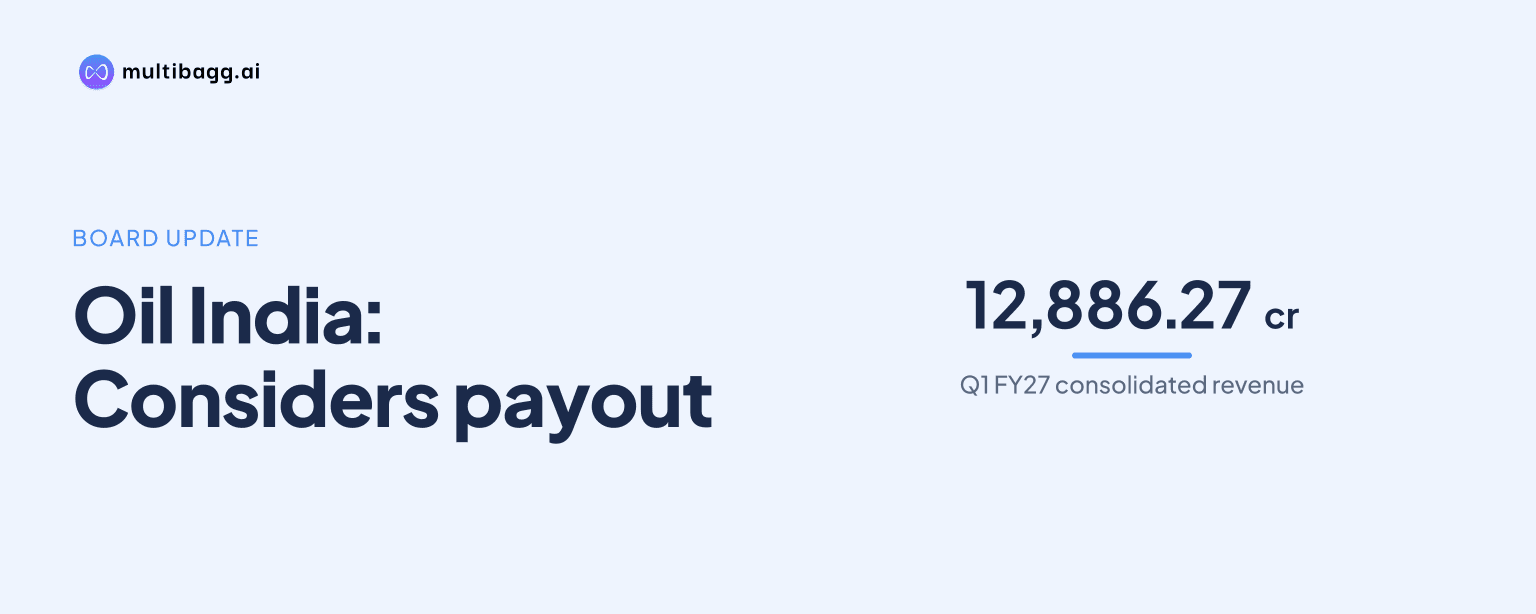
Oil India Limited’s board is scheduled to consider Q2 FY27 unaudited results and a possible interim dividend on November 12, 2026, following consolidated Q1 FY27 revenue of ₹12,886.27 crore and net profit of ₹4,026.83 crore. The pending disclosure will provide the confirmed financial performance for the quarter ended September 30, 2026.
Know Oil India inside out
Results, valuation, peers and who's buying, in one view.
When will Oil India announce its Q2 FY27 results?
Oil India is scheduled to consider and approve its unaudited standalone and consolidated financial results for Q2 and H1 FY27 at its board meeting on Thursday, November 12, 2026. The period under review covers the three and six months ended September 30, 2026.
The company’s filing states that the board agenda also includes consideration of an interim dividend for FY27. The notice does not specify a proposed dividend amount. Any payout will depend on the board’s decision and the applicable corporate and regulatory requirements.
Oil India has also notified investors of a conference call related to its Q2 FY27 financial results. The earnings release and exchange filing will establish the reported revenue, profitability, production-related disclosures and other financial metrics for the September quarter.
At the time of the meeting, Q2 FY27 figures had not been filed. As a result, revenue, profit, dividend amount and other September-quarter metrics should not be treated as confirmed until Oil India releases its official outcome to the stock exchanges.
What were Oil India’s latest reported financial numbers?
Oil India last reported consolidated Q1 FY27 revenue from operations of ₹12,886.27 crore and net profit of ₹4,026.83 crore. Basic earnings per share for the April-June 2026 quarter stood at ₹22.32.
The Q1 FY27 performance was higher than the preceding Q4 FY26 on the figures provided in the company’s quarterly results table. Revenue from operations was ₹10,012.77 crore in Q4 FY26, while net profit was ₹2,424.46 crore and basic EPS was ₹12.91.
The supplied market snapshot described the latest quarter as showing sales growth of 47.3% and profit growth of 96.8%. However, investors should rely on Oil India’s filed standalone and consolidated statements for the comparison basis, accounting scope and detailed explanations behind these changes.
Got a follow-up? Ask IRIS
Which factors will investors watch in Oil India’s Q2 FY27 filing?
Investors will watch Oil India’s disclosures on crude oil production, natural gas output, price realisations, exploration activity and operating profitability. These factors are directly relevant to the financial performance of a state-owned upstream oil and gas producer.
The Q2 filing will include both standalone and consolidated results. Standalone Q1 FY27 revenue was stated at ₹7,958.14 crore and standalone profit after tax at ₹2,870.21 crore, while the consolidated figures were higher at ₹12,886.27 crore of revenue and ₹4,026.83 crore of net profit.
The difference matters because consolidated accounts include the financial contribution of subsidiaries and other entities within the group, whereas standalone accounts reflect the parent company. Investors assessing operational performance will need to distinguish between these two reporting bases when the September-quarter results are released.
The interim dividend decision is another immediate focus. Oil India paid an interim dividend of ₹3.50 per share with the corresponding results period a year earlier, according to the supplied information. That past distribution does not confirm an equivalent or higher FY27 payout, as the current amount has not been announced.
Why does the board meeting matter for shareholders and the energy sector?
The meeting matters because it will provide an updated measure of Oil India’s earnings and potential shareholder distribution for the first half of FY27. Oil India’s market value was indicated at more than ₹72,514 crore, making the result and dividend decision relevant to a broad base of public-market investors.
For shareholders, an interim dividend can translate into a cash return if the board approves one. But the financial impact cannot be calculated until Oil India discloses the dividend per share, record date and other terms. The board notice only confirms that the matter will be considered.
For the energy sector, Oil India’s reporting offers a current data point on domestic upstream operations. Crude production, natural gas output, exploration progress and realisations can affect the company’s revenue and margins, though Q2 FY27 outcomes remain unavailable pending the official filing.
The earlier quarter provides context rather than a forecast. Q1 FY27 consolidated net profit of ₹4,026.83 crore was substantially above the ₹1,643.81 crore reported in Q2 FY26, but Oil India has not released the September-quarter numbers needed to determine whether that trend continued.
Conclusion
Oil India’s November 12 board meeting is focused on two linked matters: approval of Q2 and H1 FY27 unaudited results and consideration of an interim dividend. The latest confirmed consolidated benchmark is Q1 FY27 revenue from operations of ₹12,886.27 crore, net profit of ₹4,026.83 crore and EPS of ₹22.32.
Investors should watch for the exchange filing containing standalone and consolidated results, production and realisation commentary, and the final dividend decision. The company’s planned investor conference call may provide additional management context after the official financial release.