








Om Infra Limited targets Rs 400 crore H2 FY27 top line after monsoon
Max Plan at ₹4,999/yr₹8,999

Find your next multibaggerBe a Pro Investor
Research stocks and track your picks on the go. Download the app.
Key highlights
- Om Infra reported H1 FY27 revenue of Rs 270 crore, up 15.29% from Rs 234 crore in H1 FY26.
- H1 FY27 EBITDA increased 72.33% to Rs 21.99 crore and EBITDA margin rose to 8.12% from 5.43%.
- H1 FY27 PAT fell 89% to Rs 60.38 lakh from Rs 6.02 crore a year earlier.
- Management targets approximately Rs 400 crore of top line from October 2026 to March 2027.
powered by IRIS
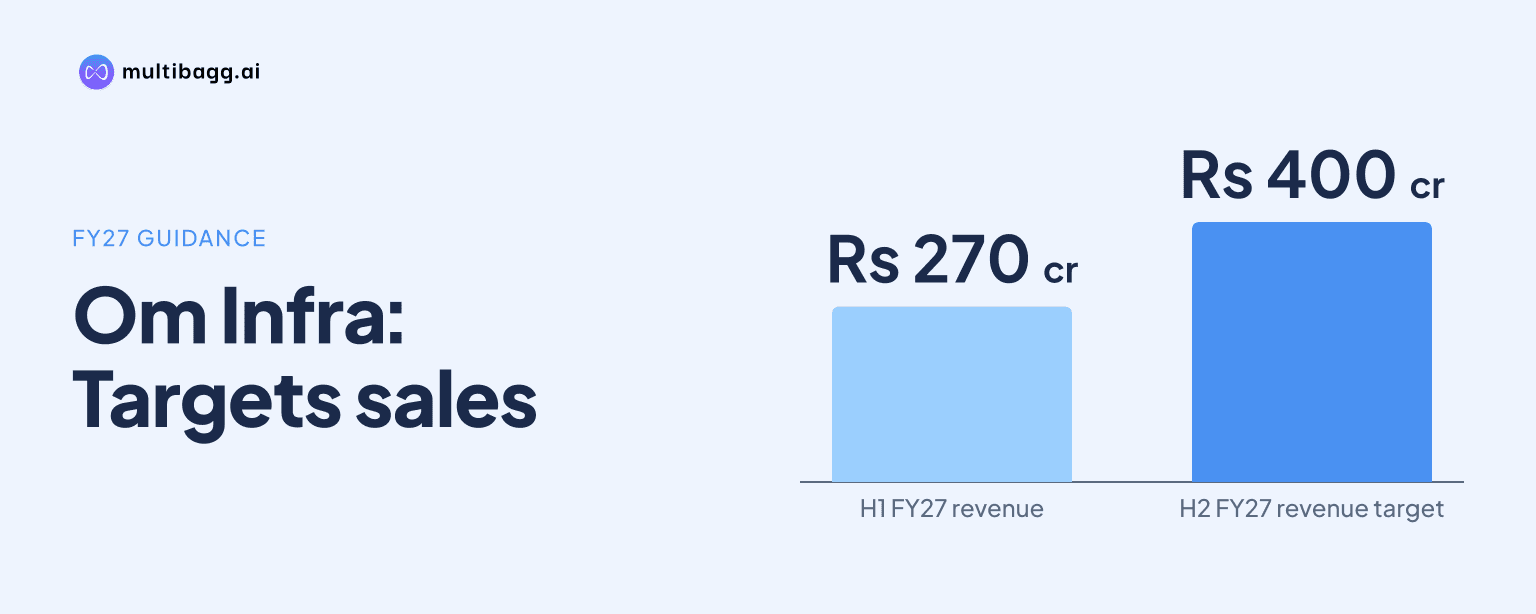
For October 2026 to March 2027, Om Infra Limited is targeting approximately Rs 400 crore in top line after H1 FY27 revenue rose 15.29% to Rs 270 crore, although profit after tax fell 89% to Rs 60.38 lakh. Management cited improved post-monsoon execution conditions and recently added quicker-turnaround projects as support for the target.
Know Om Infra inside out
Results, valuation, peers and who's buying, in one view.
What were Om Infra's H1 FY27 results?
Om Infra reported higher revenue and operating profit in the half year ended September 30, 2026, but materially lower net profit. Revenue increased to Rs 270 crore from Rs 234 crore in H1 FY26, while earnings before interest, tax, depreciation and amortisation, or EBITDA, increased 72.33% to Rs 21.99 crore from Rs 12.76 crore.
Om Infra's EBITDA margin expanded to 8.12% in H1 FY27 from 5.43% a year earlier, a 2.69-percentage-point increase. This operating improvement contrasted with profit after tax, or PAT, of Rs 60.38 lakh, down from Rs 6.02 crore in H1 FY26, with PAT margin declining to 0.22% from 2.56%.
Management said tax provisions made under Income Computation and Disclosure Standards, or ICDS, could change at year-end after Budget 2027. It also identified the April-to-September monsoon period and property-related developments as factors behind the lower reported profitability, despite the Rs 9.23 crore increase in EBITDA.
Why did Om Infra's PAT fall despite EBITDA growth?
Om Infra attributed the difference between EBITDA growth and the 89% PAT decline partly to the seasonal nature of infrastructure execution from April to September. Management said heavy rainfall and unfavourable site conditions slow construction work, resource mobilisation and project execution, while October to March generally offers more favourable conditions.
The company also cited registration-related processes for certain flats booked in 2011-12 in its real-estate portfolio. Some unsold inventory is being furnished to produce rental income, and management said these property-related developments were among the H1 FY27 profitability factors expected to neutralise going forward.
Jal Jeevan Mission, or JJM, contributed approximately Rs 12 crore in the last quarter discussed on the November 20, 2026 earnings call. Management said non-JJM projects accounted for most H1 total income and expected that broad mix to continue, with JJM adding to future top line.
Which projects could support Om Infra's second-half execution?
Om Infra disclosed two recent orders and one joint-venture L1 position with stated values totalling approximately Rs 108 crore. In August 2026, it received a supplementary order worth about Rs 29 crore from UP Jal Nigam for repair work and three years of operations and maintenance for drinking-water schemes in Indore.
MCC-Om, a joint venture involving Om Infra, was L1 for an approximately Rs 32 crore Vidarbha Irrigation Development Corporation contract for lift-irrigation schemes under Maharashtra's Gosikhurd Project. L1 denotes the lowest-ranked bidder, so management did not describe this position as an awarded contract on the call.
Before that, Om Infra received a Rs 47 crore Isarda order, described as an expansion or extension of a completed hydromechanical project. Management said the Isarda work was also part of river-interlinking activity, while the Rs 29 crore Indore work covered drinking-water schemes and operations and maintenance.
Management described the recent smaller projects as having higher double-digit margins and quicker execution cycles, which it said should enable faster revenue recognition. Om Infra is also pursuing rural-infrastructure opportunities through its wholly owned subsidiary in Goa, Maharashtra and the National Capital Region, though it gave no order value or revenue forecast for that business.
Got a follow-up? Ask IRIS
How does Om Infra plan to reach Rs 400 crore in H2 FY27?
Om Infra is targeting approximately Rs 400 crore of top line between October 2026 and March 2027, subject to project execution, business conditions and other relevant factors. The target is Rs 130 crore, or about 48.15%, above the Rs 270 crore reported during the full first half of FY27.
Management's stated priorities for the six-month period include progressing ongoing JJM projects, executing awarded contracts, pursuing infrastructure opportunities and improving financial performance. It said improved site accessibility after the monsoon should accelerate construction activity and help translate the H1 EBITDA margin improvement to 8.12% into better bottom-line performance.
In response to an analyst on November 20, 2026, management said it was confident of achieving the Rs 400 crore target but made that assessment conditional on government fund allocation. It said central-government projects had no funding issue, whereas financial constraints in some states can delay revenue recognition even if the underlying project remains in place.
The company is also participating in pump-storage projects and said it prefers government-sector opportunities, particularly those associated with central entities such as NHPC, NTPC and SJVN. Management said it was preserving capacity for such government projects, but disclosed no bid value, award timeline or H2 FY27 revenue contribution from pump storage.
Conclusion
Om Infra's H1 FY27 performance combined 15.29% revenue growth to Rs 270 crore and 72.33% EBITDA growth to Rs 21.99 crore with an 89% decline in PAT to Rs 60.38 lakh. Management's approximately Rs 400 crore H2 top-line objective depends on the seasonal return of more workable conditions, ongoing JJM activity and execution of drinking-water, irrigation and hydromechanical work.
The next measure to watch is revenue recognition between October 2026 and March 2027 against the Rs 400 crore target, including progress on the Rs 29 crore Indore and Rs 47 crore Isarda orders. State-government funding availability remains an unresolved factor identified by management, while the approximately Rs 32 crore Gosikhurd position remains an L1 bid rather than a disclosed award.

