










OM Infra Ltd JJM book forms 58% of its total order backlog
Key highlights
- Om Infra reports Rs 1,546 crore of JJM orders, representing 58% of its total order book.
- Om Infra plans to bid for Rs 1,000 crore of JJM work in FY26.
- The presentation cites Rs 67,000 crore of JJM funding in the Union Budget 2025-26.
- Om Infra says approximately 16.1 crore households still lack tap-water connections.
powered by IRIS
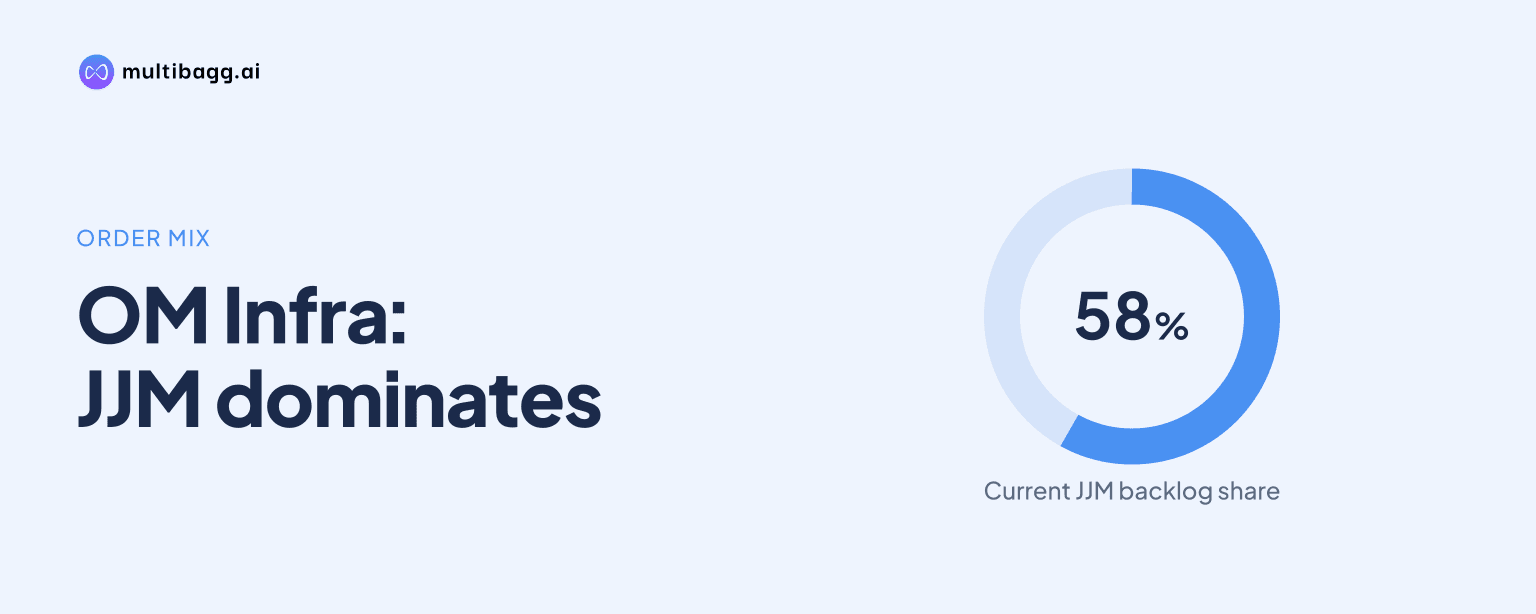
OM Infra Ltd reports that its Jal Jeevan Mission, or JJM, order book stands at Rs 1,546 crore and represents 58% of total orders, while Om Infra plans to bid for Rs 1,000 crore of JJM work in FY26. The disclosed concentration places tap-water infrastructure at the centre of the company’s current backlog and stated bidding agenda.
Know Om Infra inside out
Results, valuation, peers and who's buying, in one view.
How much of Om Infra’s order book is JJM work?
Om Infra’s JJM order book is Rs 1,546 crore, equal to 58% of its total order book. The presentation presents this as contracted order-book value rather than revenue, profit, cash collection or annual execution guidance. It therefore establishes that JJM accounts for more than half of the work backlog disclosed on the page, but does not specify the pace at which this work will be completed.
Om Infra describes its capability in this area as providing end-to-end water-infrastructure solutions, particularly in Uttar Pradesh and Rajasthan. The presentation does not disclose the number of JJM contracts within the Rs 1,546 crore book, their individual values, start or completion dates, or the allocation between the two named states. It also gives no segment-wise split for the other 42% of the total order book.
What does Om Infra plan to bid for under JJM?
Om Infra plans to bid for Rs 1,000 crore of JJM work in FY26. This is a stated bidding plan, not an awarded order, revenue forecast or order-book addition. The company does not disclose how much of the Rs 1,000 crore opportunity has already been tendered for, the expected size of individual bids or any expected conversion rate into contracts.
The planned Rs 1,000 crore bidding effort is separate from the existing Rs 1,546 crore JJM order book. It indicates that Om Infra intends to pursue further work in the same water-infrastructure category that accounts for 58% of backlog, but the presentation provides no tender calendar, margin expectation, consortium details or state-wise bidding targets. Contract awards, if any, would determine whether the plan becomes additional backlog.
Why does Om Infra identify JJM as a water-infrastructure opportunity?
Om Infra identifies JJM as an opportunity because the presentation cites a Rs 67,000 crore Government of India allocation for the mission in the Union Budget 2025-26 and says approximately 16.1 crore households still lack tap-water connections. The budget figure is programme-level funding rather than an allocation to Om Infra, while the household figure is presented as an opportunity driver rather than a forecast of contracts for the company.
The presentation names Uttar Pradesh and Rajasthan as major states that still lag in tap connections, and identifies both as key states for Om Infra’s end-to-end water solutions. This links the company’s cited capabilities to the stated connection gap, but it does not establish that its Rs 1,546 crore JJM book is concentrated in either state. No state-level contract value or project location is provided for the existing orders.
Got a follow-up? Ask IRIS
How does the water market outlook compare with JJM funding?
The presentation says the water segment is expected to grow at a compound annual growth rate, or CAGR, of 9.5% from 2025 to 2030, compared with a 6.1% CAGR for the overall Indian water market through 2030. This is a comparison of market-growth expectations, not a projection for Om Infra’s order intake or revenue. The presentation does not quantify what share of either market is addressable by JJM contractors.
For 2030, the presentation shows water demand of 1,498 billion cubic metres against supply of 744 billion cubic metres, a gap of 754 billion cubic metres. It identifies population growth, urbanisation, climate change, industrialisation, agricultural needs, resource mismanagement and declining water quality as sector drivers. These market indicators provide the context for water infrastructure demand, but do not assign a specific addressable opportunity to Om Infra.
How does JJM compare with other water programmes cited by Om Infra?
JJM’s Rs 67,000 crore allocation for 2025-26 is lower than the Rs 2.99 lakh crore allocation cited for AMRUT 2.0 over five years, although the two figures use different time periods and cannot be compared as annual spending. The presentation also cites Rs 45,600 crore for the Ken-Betwa Interlinking River Project and Rs 15,000 crore for the Kishau Multipurpose Project. It does not say that Om Infra will bid for work under those programmes.
Om Infra separately says it plans to bid for up to Rs 600 crore in the Eastern Rajasthan Canal Project, compared with its Rs 1,000 crore FY26 JJM bidding plan. The JJM plan is therefore Rs 400 crore higher than the disclosed Eastern Rajasthan Canal Project bid plan, but the opportunities cover different water-infrastructure work. The presentation does not treat either bidding plan as a secured order forecast.
Conclusion
Om Infra’s Rs 1,546 crore JJM order book, equivalent to 58% of total orders, identifies tap-water infrastructure as its most clearly quantified current backlog concentration. The company links this position to end-to-end water solutions in Uttar Pradesh and Rajasthan, a cited 16.1 crore household tap-connection gap and Rs 67,000 crore of JJM funding for 2025-26.
The next disclosure to watch is progress against Om Infra’s Rs 1,000 crore FY26 JJM bidding plan. The presentation leaves unresolved the timing of tenders, awards, conversion into new orders and execution timing for the existing Rs 1,546 crore book, making future updates on bid wins and project delivery the relevant measures of progress.