








Om Infra margins squeezed by JJM delays, targets upper teens
Max Plan at ₹4,999/yr₹8,999

Find your next multibaggerBe a Pro Investor
Research stocks and track your picks on the go. Download the app.
Key highlights
- Om Infra said Jal Jeevan Mission delays lasting more than two years increased costs and reduced margins.
- Management said new bids are targeting double-digit margins in the upper teens.
- Om Infra is awaiting letters of intent for two L1 projects worth about Rs 1,000 crore to Rs 1,100 crore.
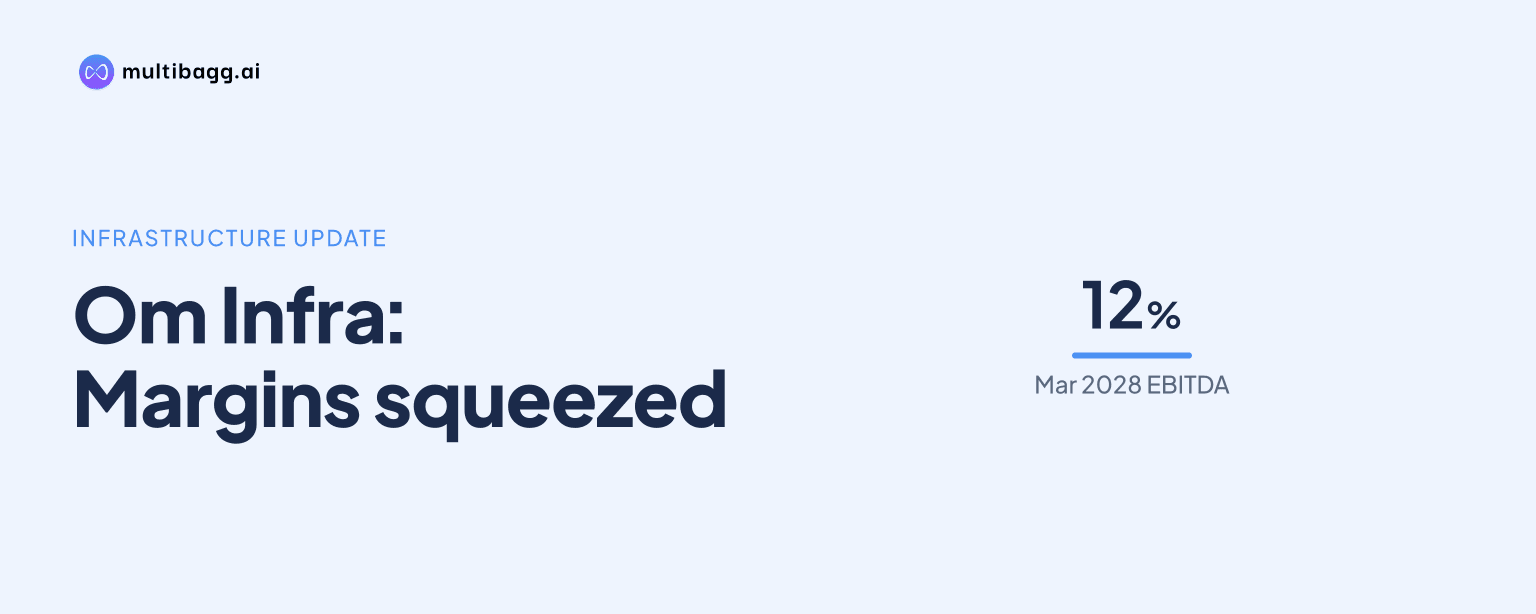
- Management indicated approximate EBITDA of 12% for March 2028.
powered by IRIS
Om Infra Limited said more than two years of delays in Jal Jeevan Mission execution compressed project margins after central funding to states stopped, while its targeted new drinking-water and reservoir orders are being bid for double-digit, upper-teen margins. Management said the funding trend has begun to return slowly.
Know Om Infra inside out
Results, valuation, peers and who's buying, in one view.
Why did Jal Jeevan Mission delays reduce Om Infra's margins?
Jal Jeevan Mission delays reduced Om Infra's margins because costs continued for more than two years while execution and revenue recognition slowed. Management said the programme initially delivered good margins and an extraordinary revenue increase during its first two years, when central government funding to states was available. It said a subsequent stop in central funding produced a significant revenue-recognition decline across states and projects.
The cost impact arose because project costings still had to be incurred during the extended delay, according to management. Om Infra said the delayed work may result in claims, but management’s immediate priority was completing jobs and moving contracts forward rather than relying on claims. It described the disruption as external to the company and linked it to the funding flow for Jal Jeevan Mission projects.
Management also said funding has started to return, although not at the pace seen in the programme’s initial phase. This was its basis for saying the operating cycle is reversing after the past three to four years. The statement does not quantify the reported margin decline or specify the value of potential claims, so the call does not establish how much of the lost margin could ultimately be recovered.
How did turnkey contracts change Om Infra's margin profile?
Om Infra said its move from hydro-mechanical work into complete turnkey contracts diluted its core margin profile because turnkey work includes civil construction. Management described hydro-mechanical projects as a specialised, double-digit-margin business, but said the shrinking size of that industry and the emergence of more projects led it to expand through backward and forward integration into civil works.
The trade-off is a larger addressable market but more competition and lower core margins, according to management. It contrasted its sector with roads and highways, where it said a bid can draw 20 bidders, while its own projects generally have no more than three or four competing bidders. That comparison was management’s explanation of why competition remains more limited in its water and related infrastructure categories despite the shift to broader turnkey execution.
Jal Jeevan Mission was the sharper source of recent pressure, management said, rather than turnkey diversification alone. It said the programme’s initial two years combined good awarded margins with strong funding, whereas the subsequent execution delay raised the cost burden over a period exceeding two years. Therefore, the margin issue described on the call combines contract mix, delayed execution and state-level funding disruption.
Got a follow-up? Ask IRIS
What margins is Om Infra targeting on new water orders?
Om Infra said it is targeting double-digit margins in the upper teens when bidding for projects now. Management made that statement in response to a question on the normal margin sought for new bids, after explaining that delayed Jal Jeevan Mission work had affected existing project economics. It did not provide a single percentage, project-level target or a forecast of the group’s future reported operating margin.
Management said the new order book is being built selectively, primarily around drinking-water supply projects. It also cited a recently received Raipur reservoir-creation project serving a large thermal power project being built by Adani. According to management, the thermal project is already at an advanced construction stage, so the reservoir contract carries an aggressive completion timetable because water availability is necessary for electricity generation.
This targeted approach differs from indiscriminately pursuing volume, management said in a later discussion on capacity. It stated that Om Infra’s long operating history has been based on avoiding low-profit orders and working-capital strain. The call does not disclose the size, expected margin or completion date of the Raipur reservoir order, but it identifies the project type and time-sensitive delivery mechanism behind management’s selection rationale.
What could support Om Infra's revenue recovery and order book?
Om Infra said a gradual return of Jal Jeevan Mission funding could support revenue recovery because revenue recognition had fallen significantly after central funding to states stopped. Management said the improvement is not occurring in the same manner as the programme’s initial rollout, but it sees the trend reversing. Its expectation of better revenue growth is therefore conditional on smoother execution and the completion of delayed water contracts.
Separately, management said it had become lowest bidder, or L1, for two projects worth about Rs 1,000 crore to Rs 1,100 crore and was awaiting letters of intent. It attributed the delay partly to municipal elections in Rajasthan, saying a code of conduct can prevent contract awards during that period. These projects were not yet announced as awarded on the call, so they should not be treated as confirmed additions to the order book.
Management also said Om Infra could scale civil-work execution if opportunities arise, including annual execution of Rs 1,500 crore to Rs 2,000 crore. That was a capacity statement rather than a revenue target or guidance. When asked about earnings before interest, tax, depreciation and amortisation, or EBITDA, for March 2028, management gave an approximate 12% figure, which is distinct from its upper-teen margin target on new bids.
Conclusion
Om Infra’s account of margin pressure centres on Jal Jeevan Mission: good funding and margins in the first two years gave way to more than two years of delayed execution, ongoing costs and lower revenue recognition. Its broader move into turnkey civil work also reduced the relative weight of specialised hydro-mechanical activity, while management said new water-focused bids are being targeted at double-digit, upper-teen margins.
The next items to watch are whether funding to states continues to normalise, whether delayed Jal Jeevan Mission jobs are completed, and whether the Rs 1,000 crore to Rs 1,100 crore L1 opportunities receive letters of intent. Management’s approximate March 2028 EBITDA expectation of 12% and its stated Rs 1,500 crore to Rs 2,000 crore execution capacity provide further benchmarks for subsequent disclosures.

