








Om Infra Limited Files Q2 FY27 Earnings Call Transcript
Max Plan at ₹4,999/yr₹8,999

Find your next multibaggerBe a Pro Investor
Research stocks and track your picks on the go. Download the app.
Key highlights
- Om Infra Limited filed the transcript of its Q2 FY27 earnings call held on 20 November 2026.
- H1 FY27 topline grew 15.29% year on year, according to the call-related material.
- PAT cited in the management speech was ₹60.38 lakh, compared with ₹602.15 lakh a year earlier.
- Q2 FY27 consolidated revenue was ₹139.94 crore and the company reported a net loss of ₹10.85 crore.
powered by IRIS
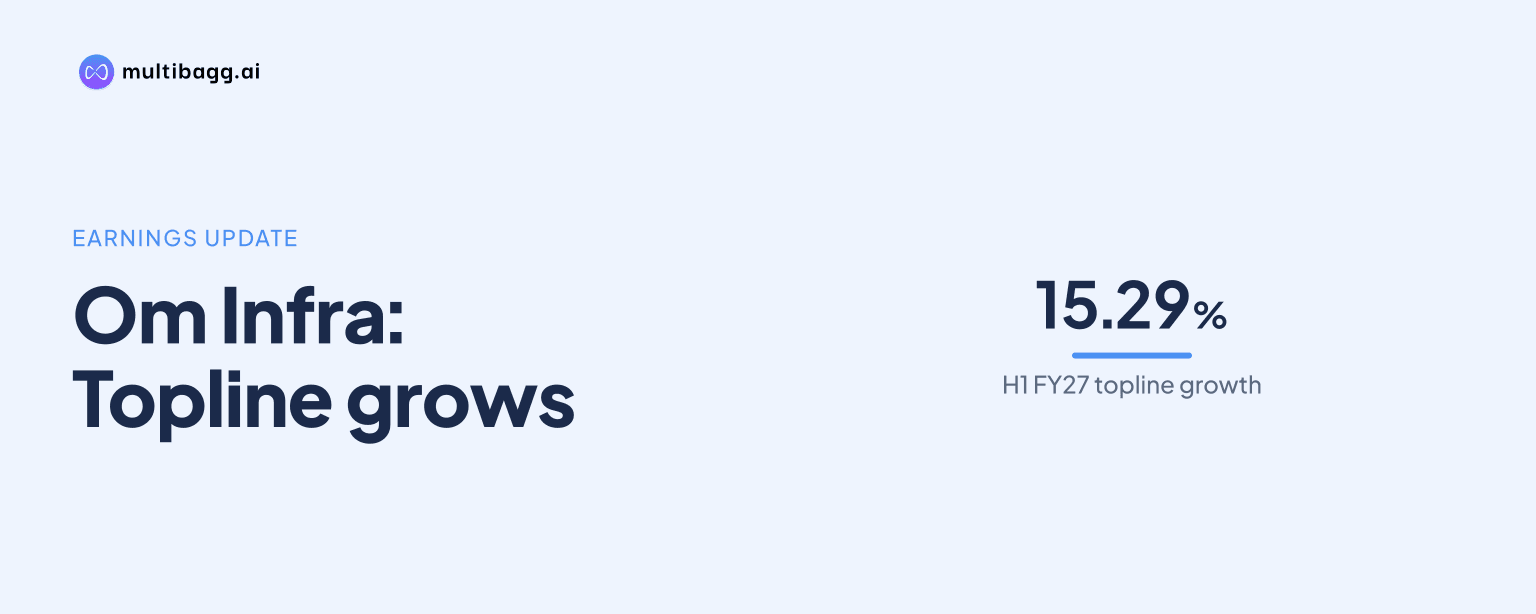
Om Infra Limited filed the transcript of its 20 November 2026 Q2 FY27 earnings conference call, which discussed half-year revenue growth of 15.29% while profit after tax fell to ₹60.38 lakh from ₹602.15 lakh a year earlier. The filing gives investors an official record of management's discussion after the September-quarter results.
Know Om Infra inside out
Results, valuation, peers and who's buying, in one view.
What did Om Infra Limited file with the exchanges?
Om Infra Limited filed the transcript of its earnings conference call held on 20 November 2026 with analysts and institutional investors. The call covered the company's financial results for the quarter and half-year ended 30 September 2026, corresponding to Q2 FY27 and H1 FY27.
The transcript follows the earlier release of the call's audio recording on the company's investor-relations website. The company had informed exchanges that the recording of the call was available after the event. The 26 November filing provides the written record of the discussions held during the conference call.
For investors, a transcript is a disclosure document rather than a new set of financial results. It records management's presentation and its responses to participants, allowing shareholders to review the discussion without relying solely on the audio recording.
What financial performance was discussed in the Q2 FY27 call?
Om Infra reported that H1 FY27 topline increased 15.29% year on year, while profitability showed a sharp decline based on the figures cited during the call. The call material indicated EBITDA of ₹26.66 crore and an EBITDA margin of 8.12% for the first half.
The filing's stated profit-after-tax figure was ₹60.38 lakh, compared with ₹602.15 lakh in the corresponding earlier period. This represents an approximately 89% decline in PAT, despite the reported growth in topline and improvement in operating profitability indicators.
The previously reported Q2 FY27 financial results provide further context for the discussion. For the quarter ended 30 September 2026, Om Infra reported consolidated revenue from operations of ₹139.94 crore, up 13.0% year on year, and a net loss of ₹10.85 crore.
Why do the profit figures require careful reading?
Om Infra's call-related material contains a difference in the reported H1 FY27 PAT figures that investors should note. The presentation summary referred to PAT of ₹13.90 crore on a slide, whereas the management speech cited PAT of ₹60.38 lakh. The transcript filing is relevant because it preserves the figure stated in the call.
The available material does not explain the reason for this difference. Investors therefore cannot treat the two amounts as directly comparable without clarification from the company or reconciliation with the detailed financial statements and notes filed for the period.
The quarterly result itself was loss-making, with a consolidated net loss of ₹10.85 crore in Q2 FY27. That result differs from a half-year profit figure because H1 FY27 includes both the June and September quarters. The available data shows that Om Infra reported a Q1 FY27 net profit of ₹11.45 crore before the Q2 loss.
Got a follow-up? Ask IRIS
How does the transcript filing matter to shareholders?
The transcript filing matters because it makes Om Infra's management commentary on the September-quarter results accessible in a formal written format. Shareholders can use it alongside the 14 November results filing, the investor presentation and the 20 November call recording to review management's discussion of performance.
The reported numbers show two contrasting trends. H1 revenue grew 15.29% and the call summary cited EBITDA growth of 72.33%, with margin expansion of 269 basis points. At the same time, the PAT figure stated during the call was substantially below the comparable prior-year amount, while Q2 ended with a consolidated loss.
For the market, the filing does not alter the previously disclosed Q2 revenue or net-loss figures. Its value is informational: it documents what was discussed after the results and highlights the need to distinguish between operating metrics, quarterly performance and the differing H1 PAT amounts appearing in available call materials.
What should investors compare in Om Infra's disclosures?
Investors reviewing Om Infra's disclosures should compare the official Q2 FY27 financial results with the investor presentation and the earnings-call transcript. The results filing reported ₹139.94 crore of consolidated quarterly revenue and a ₹10.85 crore net loss, while the call discussion focused on H1 revenue growth, EBITDA and PAT.
A careful comparison is especially important given the difference between the ₹13.90 crore PAT shown in call-related slide material and the ₹60.38 lakh figure stated in the management speech. Until Om Infra provides a reconciliation or clarification, the figures should be read in the context in which each was disclosed rather than combined.
Conclusion
Om Infra's 26 November filing formally placed the Q2 FY27 earnings-call discussion on record after the company reported revenue growth but a weaker profit outcome. The transcript states that H1 FY27 topline rose 15.29%, while PAT cited in the management speech fell to ₹60.38 lakh from ₹602.15 lakh, and Q2 FY27 closed with a consolidated loss of ₹10.85 crore.
The key point to watch is whether Om Infra clarifies the difference between the PAT amount cited in the call speech and the ₹13.90 crore amount referenced in slide material. Investors can also monitor subsequent financial disclosures for changes in revenue growth, EBITDA margin and profitability after the September-quarter result.

