










Orient Bell Q2 revenue rises 38.8% to ₹227.6 crore, margin at 9.8%
Key highlights
- Orient Bell reported Q2 FY27 consolidated revenue of ₹227.6 crore, up 38.8% year-on-year.
- Q2 FY27 EBITDA was ₹22.4 crore and EBITDA margin improved 300 basis points to 9.8%.
- Q2 FY27 profit before tax rose 326% year-on-year to ₹16.4 crore.
- Working-capital days improved to 18 from 20 in March 2026, while DSO declined to 43 from 48 days.
powered by IRIS
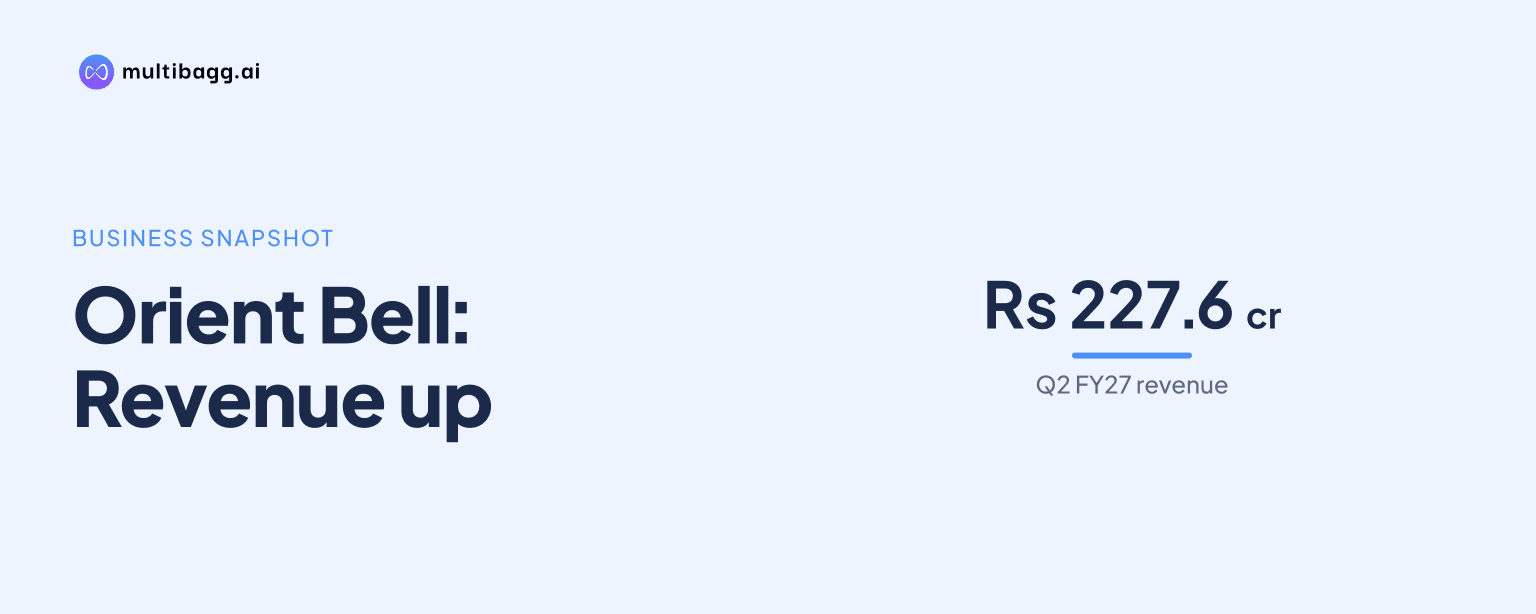
Orient Bell Limited reported consolidated Q2 FY27 revenue of ₹227.6 crore, up 38.8% year-on-year, while EBITDA margin expanded by 300 basis points to 9.8%. The tile maker also reported 14.6% volume growth and a 326% increase in profit before tax to ₹16.4 crore for the quarter ended September 30, 2026.
Know Orient Bell inside out
Results, valuation, peers and who's buying, in one view.
What did Orient Bell report for Q2 FY27?
Orient Bell reported broad-based growth in revenue, volumes and profitability during Q2 FY27. Management said consolidated revenue was ₹227.6 crore, compared with the corresponding quarter a year earlier, and volume growth was 14.6%. For the first half of FY27, revenue reached ₹430.5 crore, up 40.6% year-on-year, while volumes grew 18.1%.
The company also disclosed a separate investor-presentation figure of ₹229 crore for Q2 revenue from operations, up 38.7% year-on-year. The earnings-call commentary cited ₹227.6 crore as consolidated revenue. Both disclosures point to similar quarterly growth, though investors should distinguish between the reported measures when comparing figures.
EBITDA for the September quarter was ₹22.4 crore, producing a 9.8% margin. This was 300 basis points higher year-on-year. Profit before tax rose 326% year-on-year to ₹16.4 crore. The investor presentation reported net profit of ₹12.4 crore, compared with ₹3.2 crore in Q2 FY26, representing growth of 287.5%.
What drove Orient Bell's revenue and profit growth?
Orient Bell attributed its performance to its focus on secondary sales through dealers, supported by digital sales and market-coverage tools. Chief Executive Officer Aditya Gupta said the company has adopted an FMCG-style approach to secondary sales rather than relying on the sector's conventional focus on credit and discounts.
Management identified several initiatives behind this approach, including 24/7 TV, tile visualisation tools, direct-to-consumer lead generation, learning and development programmes, AI-led sales-team support and digital tracking of market coverage. These initiatives are intended to strengthen dealer-led demand generation and improve execution in local markets.
The profit improvement reflected operating leverage, improved realisations, premiumisation and manufacturing efficiencies, according to Chief Financial Officer Anuj Arora. Revenue grew faster than volumes during the quarter, while management also highlighted improved realisations as a contributor to profitability.
How did working capital and regional sales perform?
Orient Bell said it maintained a focus on cash generation and working-capital discipline alongside revenue growth. Its working-capital cycle improved to 18 days from 20 days in March 2026. Days sales outstanding declined to 43 days from 48 days in Q4 FY26.
These measures are relevant because a growing dealer-led business can require tighter management of receivables and inventory. The disclosed reduction in both working-capital days and DSO indicates a shorter cash-conversion cycle compared with the earlier periods cited by management.
In its analyst interaction, the company gave an approximate regional sales mix of 49% for north and central India, 24% for east India, 19% for south India and 7% for west India. Management described its South India performance as mixed, while indicating that the region remained important for future branding and display expansion.
Got a follow-up? Ask IRIS
What is Orient Bell's outlook for the second half?
Orient Bell did not provide numerical revenue or earnings guidance for FY27. Management said it expects good performance in the second half and aims for a double-digit EBITDA margin in H2 FY27, subject to the operating environment.
The company indicated planned capital expenditure of about ₹20 crore for FY27. It also flagged caution on gas costs and pricing in Morbi, a major tile-manufacturing cluster. These factors can affect industry pricing, input costs and margins, making them relevant to the company's stated profitability target.
The Q2 outcome shows a significant improvement in operating performance, but the company has not offered a quantified revenue target for the rest of the year. Its H2 commentary is therefore centred on margin aspirations, planned capital spending and continued execution through dealer networks rather than a formal financial forecast.
Why do these results matter for investors and the tile industry?
Orient Bell's 38.8% revenue growth and 14.6% volume growth indicate that both sales volumes and realisations contributed to quarterly expansion. The 300-basis-point EBITDA-margin improvement shows that the higher revenue translated into stronger operating profitability during the period.
For investors, the key data points are the ₹22.4 crore EBITDA, ₹16.4 crore profit before tax, ₹12.4 crore net profit and improvement in working-capital metrics. The company also maintained a net cash position, according to its investor presentation. These disclosures provide context for assessing whether earnings growth has been accompanied by financial discipline.
For the wider tile sector, management's comments on gas costs and Morbi pricing underline the importance of input-cost and competitive-price conditions. Orient Bell's approach of using digital tools and dealer-focused secondary sales differs from a strategy centred primarily on credit and discounts, though the company did not provide quantified details of the financial contribution from each initiative.
Conclusion
Orient Bell's Q2 FY27 performance combined 38.8% consolidated revenue growth with 14.6% volume growth and a 300-basis-point improvement in EBITDA margin to 9.8%. Higher realisations, premiumisation, manufacturing efficiencies and operating leverage were identified by management as the main drivers of the improvement in profitability.
The next points to watch are the company's ability to deliver a double-digit EBITDA margin in H2 FY27, the planned ₹20 crore FY27 capital expenditure and developments in gas costs and Morbi pricing. Management has not issued numerical guidance, leaving subsequent quarterly disclosures important for measuring progress against its stated priorities.