










Orient Bell plans South expansion after outlet churn reset
Key highlights
- South India contributed about 19% of Orient Bell sales, compared with 49% for North and Central.
- Orient Bell had 238 active exclusive outlets and about 200 shop-in-shop installations in November 2026.
- Management expects exclusive-showroom additions to resume in H2 FY27 after a four-quarter slowdown.
- Orient Bell reported H1 FY27 revenue of Rs 430.5 crore, up 40.6% year on year.
powered by IRIS
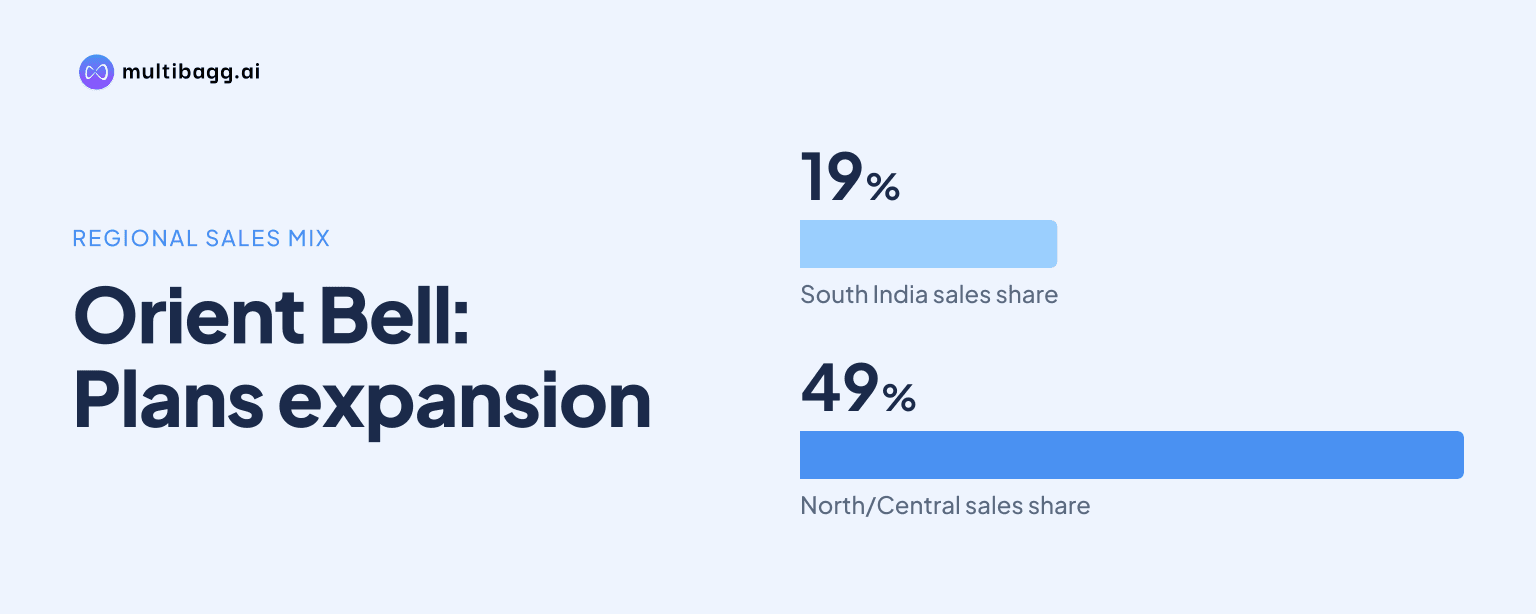
Orient Bell Limited plans to resume exclusive-showroom additions in H2 FY27 after addressing outlet churn, while building its South presence through regional television advertising, dealer displays and shop-in-shops. South accounted for about 19% of sales, and Orient Bell had 238 active exclusive outlets plus about 200 shop-in-shop installations at the November 13, 2026 call.
Know Orient Bell inside out
Results, valuation, peers and who's buying, in one view.
Why is Orient Bell expanding its South presence?
Orient Bell is expanding in South India because the region accounted for about 19% of sales and management said it is underrepresented there. The geographical mix disclosed for the period ended September 30, 2026 was 49% for North and Central, 24% for East, 19% for South and 7% for West.
Management said growth was broadly similar across the country, so the South has not yet increased its share of sales. Its stated approach is to build brand awareness and physical coverage through more displays and outlets, rather than pursue a separately disclosed South revenue or volume target.
The South initiative comes as Orient Bell reported H1 FY27 revenue of Rs 430.5 crore, up 40.6% year on year, with volume growth of 18.1%. Management attributed the broader performance to its secondary-sales focus, digital tracking of market coverage, direct-to-consumer lead generation and sales-team tools, without providing a separate South sales figure.
How is Orient Bell building awareness and distribution in South India?
Orient Bell has started advertising on two Tamil television channels and one Kannada television channel to raise South India brand awareness. Management said the campaign is part of investments made over the last six to eight months alongside an increase in dealer displays and ground presence.
The company is also installing shop-in-shop displays with major dealers in the South. These are non-exclusive installations, unlike its exclusive boutiques, and management said the concept is gaining momentum and should expand over time in a region where it sees room for growth.
Orient Bell said its sales system contributed about 45% of overall retail in Q2 FY27, up from around 30% last year. Management linked the increase to demand-generation initiatives, although it did not quantify the South contribution to that retail-sales-system measure.
In H1 FY27, Orient Bell reported about 18% volume growth, compared with management's estimate of about 1% volume growth for the industry excluding the company. Management described that comparison as evidence of its sell-out strategy, which aims to help dealers sell products to customers rather than concentrating only on sales into dealers.
Got a follow-up? Ask IRIS
How many Orient Bell outlets and shop-in-shops are active?
Orient Bell had 238 active exclusive outlets and about 200 smaller shop-in-shop installations at the time of the November 2026 call. The exclusive outlets display only Orient Bell tiles, while shop-in-shops occupy roughly 500 to 600 square feet within larger dealers where the company does not operate an exclusive showroom.
Management had slowed new exclusive-outlet additions for the previous four quarters because it identified high churn. The company said it used that period to address the reasons for attrition, which it had observed over the preceding two to three years.
Orient Bell now expects to start opening new exclusive showrooms again in H2 FY27 and said the shop-in-shop count should rise by the end of the half year. Management did not disclose an outlet-opening target, investment budget, city list or the number of its 238 exclusive outlets located in South India.
The smaller dealer format can increase tile-display coverage without requiring every dealer to become an exclusive outlet. It operates alongside a retail-project sales mix of about 80:20, which management said has been broadly steady within 1 percentage point; Orient Bell defines a project as a sale of more than 3,000 metres in a quarter.
What results and capacity support Orient Bell’s expansion plan?
Orient Bell reported Q2 FY27 revenue of Rs 227.6 crore, up 38.8% year on year, supported by volume growth of 14.6%. Management said roughly 15% volume growth and about 20% average selling price growth drove the quarter, with average selling price rising to Rs 333 in Q2 from about Rs 320 to Rs 321 in Q1.
Q2 FY27 earnings before interest, tax, depreciation and amortisation, or EBITDA, were Rs 22.4 crore, and the EBITDA margin was 9.8%, up 380 basis points year on year. H1 FY27 EBITDA reached Rs 40 crore and margin was 9.3%, representing a 430-basis-point expansion.
Working-capital measures also improved as sales rose. Days sales outstanding fell to 43 days from 48 days in Q4 FY26, the working-capital cycle declined to 18 days from 20 days in March 2026, and management said debtor levels fell 5% year on year despite 41% H1 FY27 revenue growth.
Capacity utilisation was 75% in Q2 FY27, while the Dora facility was at about 88% to 89%. Orient Bell completed the conversion of 1.2 million square metres of ceramic capacity into glazed vitrified tiles, or GVT, in October 2026, and management said GVT sales salience had reached 45%, compared with around 20% in FY22 and FY23.
Conclusion
Orient Bell’s South plan is a distribution and brand-building effort intended to address a regional gap rather than deliver a disclosed standalone sales target. With South contributing 19% of sales, the company is combining three regional television channels, dealer displays, 238 exclusive outlets and about 200 shop-in-shops with a wider secondary-sales model that management linked to 18.1% H1 FY27 volume growth.
The next item to watch is H2 FY27 execution, when management expects exclusive-showroom openings to restart and shop-in-shop installations to increase, without disclosing a numerical target. Investors can also monitor how 75% overall capacity utilisation, the October 2026 addition of 1.2 million square metres of GVT capacity and management's expectation of a historically better second half affect reported performance.