










OSEL’s Bharat Mandapam Rs 15 crore target relies on ad sales
Key highlights
- OSEL’s Bharat Mandapam advertising concession runs for 10 years.
- Management expects about Rs 15 crore of annual advertising revenue, but says the outcome is variable.
- OSEL said it booked Rs 2.8 crore from the first India International Trade Fair event.
- Management expects screen-installation investment to break even in 1.5 to 2 years.
powered by IRIS
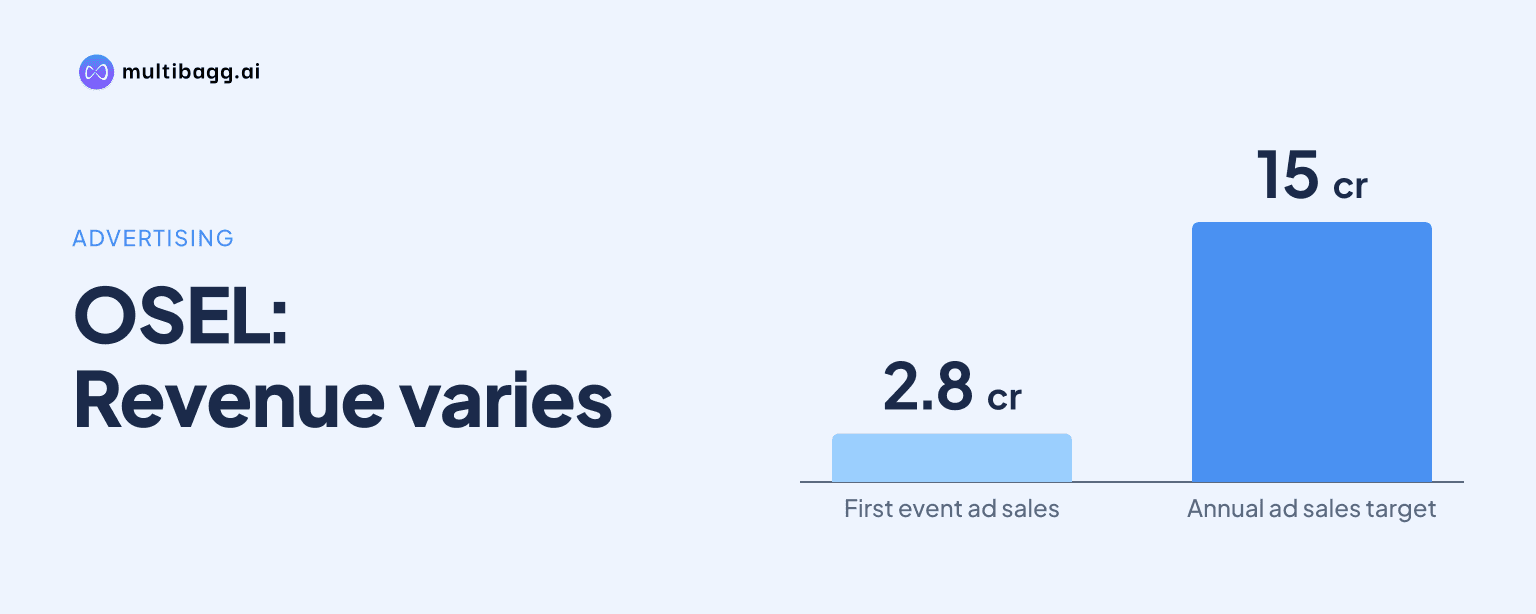
OSEL’s 10-year Bharat Mandapam advertising concession targets Rs 15 crore of annual revenue, but management said the figure depends on advertisements sold through agency partners rather than a fixed payment. OSEL said it had booked Rs 2.8 crore of revenue from the first India International Trade Fair after installing screens.
Know OSEL Devices inside out
Results, valuation, peers and who's buying, in one view.
How does OSEL’s Bharat Mandapam contract work?
OSEL said its 10-year contract with Bharat Mandapam gives it advertising rights within the premises, including the Trade Fair, exhibition halls and other areas. Management described the project as a partnership with the Government of India and Bharat Mandapam, under which OSEL installs screens for digital advertising and seeks to monetise the advertising inventory.
OSEL said any LED screen displayed at the ITPO premises would be supplied by OSEL, tying the project to its LED manufacturing operations. Unlike a one-time hardware order, the revenue mechanism is the sale of advertising space after screens are installed. OSEL is responsible for generating that advertising revenue, using advertising-agency partners for agency sales and media sales.
The arrangement therefore requires an upfront capital expenditure before advertising income is earned. Management said the project is part of OSEL’s move into digital out-of-home advertising, a model that combines its LED-screen manufacturing with media-inventory sales. The call did not disclose the number of screens, their installation cost, advertising rates or the payment terms under the 10-year concession.
Is OSEL’s Rs 15 crore annual revenue fixed?
No, OSEL’s Rs 15 crore annual Bharat Mandapam figure is management’s expectation from advertising sales, not a fixed annual payment. Management directly rejected the suggestion that the amount would be paid regardless of advertiser demand, saying OSEL’s revenue is based on advertising revenue that it is responsible for securing.
Management said it derived the Rs 15 crore expectation from discussions with agencies and the minimum guarantees those agencies were committing. Those commitments support OSEL’s forecast, but management did not disclose a contractual minimum revenue payable to OSEL by Bharat Mandapam, a guaranteed payment from the Government of India, or a numerical floor under the company’s annual receipts.
The distinction matters because the project’s sales outcome can change with advertiser volumes and media rates. An investor on the call noted that higher advertiser demand or different rates after four years could move revenue upward, and management confirmed that revenue is based on advertising income. OSEL did not provide a forecast range around the Rs 15 crore target.
What has OSEL booked from the first Trade Fair?
OSEL said it had booked Rs 2.8 crore of revenue from the first ITPO event after screens were installed. Management initially cited a range of Rs 2.4 crore to Rs 2.8 crore, then clarified that the booked revenue was Rs 2.8 crore, correcting an investor who had heard Rs 13 crore.
Management said the India International Trade Fair started on the 14th and that revenue had already begun to come in from the first event. The call does not state the month of the 14th, the duration of the fair, the advertising inventory sold, or whether the Rs 2.8 crore was collected in cash rather than booked as revenue.
The Rs 2.8 crore booking is different in scope from the annual Rs 15 crore expectation. The first figure relates to one Trade Fair event after installation, while the latter is management’s estimate for annual advertising business across the Bharat Mandapam opportunity. OSEL provided no comparable booking figure for an earlier Trade Fair or another advertising site.
Got a follow-up? Ask IRIS
When does OSEL expect Bharat Mandapam to break even?
OSEL expects to recover its screen-installation capital expenditure in 1.5 to 2 years, according to management. The company said it must first recover the investment in screens before the project produces the later revenue stream available during the remainder of the 10-year agreement.
That 1.5-to-2-year period is management’s expectation rather than a reported break-even result. It depends on ad sales secured through OSEL and its agency partners, because the Rs 15 crore annual estimate itself is variable. Management did not disclose the capital expenditure amount, so the call does not permit a calculation of the revenue required to reach break-even.
After capital recovery, OSEL said the advertising revenue would be shared with partners, including agency partners and ITPO. Management did not disclose the revenue-share percentages, the order in which each party is paid, operating costs after installation, or a margin target. As a result, the Rs 2.8 crore booking cannot be treated as a measure of project profit.
How does Bharat Mandapam change OSEL’s LED business?
Bharat Mandapam shifts OSEL from supplying LED screens alone to installing screens and participating in advertising revenue over a 10-year term. Management said LED manufacturing gives OSEL an advantage in digital out-of-home advertising because screens are the underlying infrastructure required for the advertising model.
Management described Bharat Mandapam as OSEL’s first step into digital advertising and said it sees the location as a major opportunity because of exhibitions held there. However, OSEL supplied no footfall figure, advertiser list, occupancy data or historical advertising-sales data to quantify that view. The disclosed evidence at the call was the Rs 2.8 crore booking from the first event.
The project also changes the timing of cash needs compared with a direct screen sale. Management said the business is capital-heavy because OSEL must fund and install screens before revenue arrives, while the expected 1.5-to-2-year recovery is intended to cover that initial investment. No funding plan or project-specific capital budget was disclosed.
Will OSEL add more advertising locations?
OSEL said it may assess more advertising centres after monitoring Bharat Mandapam, but it has not announced a site-expansion target. Management said more centres could become available and that it would watch the first partnership closely, evaluate its experience and then decide whether to pursue further locations.
Management said it intends to become more serious about the business once it has gained experience from the first site. That is a stated plan rather than a commitment to additional capex: the call did not identify another location, give a timetable, or set a target for the number of new concessions, screens, revenue or investment.
For now, the disclosed project remains the 10-year Bharat Mandapam concession, with Rs 15 crore as management’s annual advertising expectation. Its performance will depend on agency-led sales, the pace of events and exhibitions, and the time needed to recover screen-installation expenditure. The first Rs 2.8 crore booking provides an initial data point but not a full-year run rate.
Conclusion
OSEL’s Bharat Mandapam project replaces a purely hardware-led sale with a 10-year model in which OSEL funds LED screens and earns advertising revenue. Management’s Rs 15 crore annual expectation is supported by agency discussions and the Rs 2.8 crore booking from the first Trade Fair, but management clearly said revenue is variable because ad sales remain OSEL’s responsibility.
Next, investors can watch whether agency commitments convert into recurring advertising bookings and whether OSEL meets its stated 1.5-to-2-year capital-recovery expectation. Management also plans to evaluate additional centres only after monitoring Bharat Mandapam, while the call left the capex amount, revenue-share percentages and expansion timetable unresolved.