










Paisabazaar Core Disbursals Gain 22% in Retail Rebuild
Key highlights
- Core lending disbursals rose 22% year on year in Q2 FY27, led by 30% growth in unsecured credit.
- Total disbursals fell to ₹4,739 crore in Q2 FY27 from ₹8,570 crore a year earlier after PB scaled down wholesale sourcing.
- Credit-card issuance reached 99,000 in Q2 FY27, up 10% year on year and 8% quarter on quarter.
- PB’s retail acquisition base averaged 33 lakh monthly credit-product enquiries in the quarter ended September 2026.
powered by IRIS
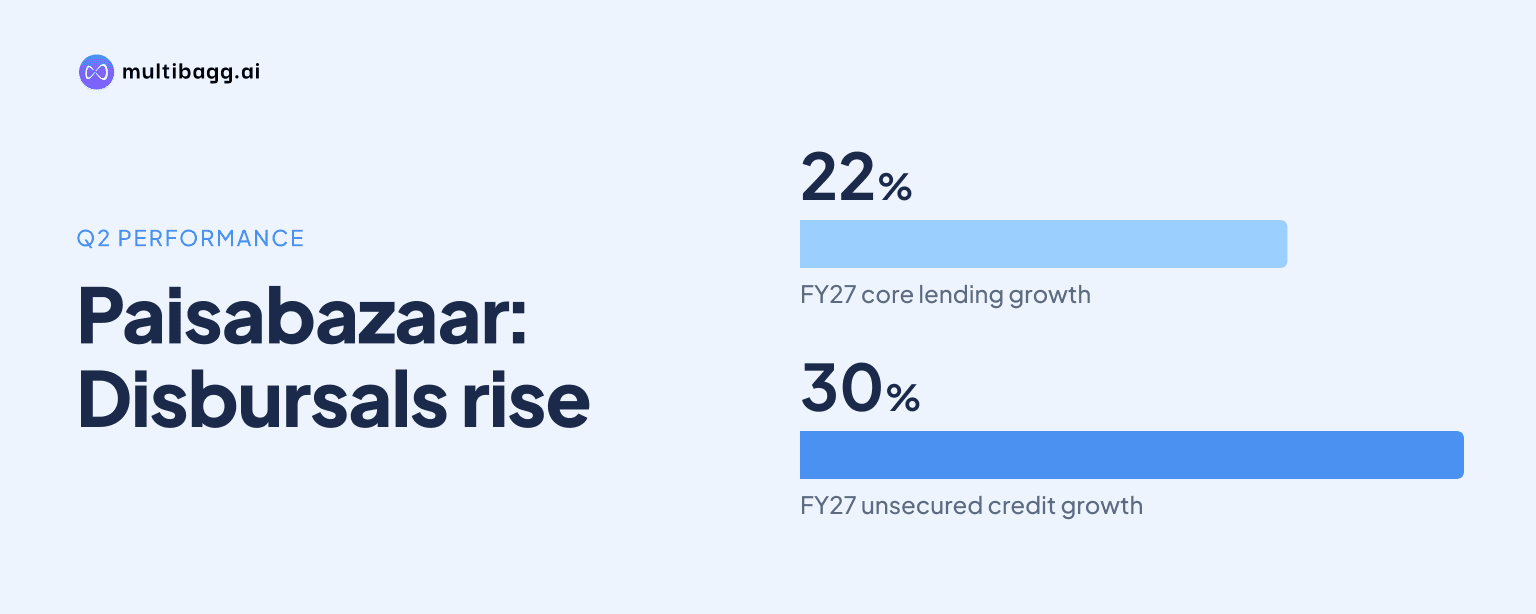
Paisabazaar said core lending disbursals rose 22% year on year in Q2 FY27, led by 30% unsecured-credit growth, even as total disbursals fell to ₹4,739 crore from ₹8,570 crore. The difference reflects its scale-down of wholesale sourcing in new initiatives and its stated rebuild around retail lending.
Know PB Fintech inside out
Results, valuation, peers and who's buying, in one view.
Why did PB's total disbursals fall despite core growth?
PB's total disbursals fell because it scaled down wholesale sourcing within new initiatives, while its core business grew 22% year on year in Q2 FY27. Management said new-initiative disbursals were recovering after the strategic reduction and retail pivot, but it did not disclose separate disbursal values for the core and new-initiative businesses.
Total quarterly disbursals declined by ₹3,831 crore, from ₹8,570 crore in Q2 FY26 to ₹4,739 crore in Q2 FY27. The total had reached ₹9,986 crore in Q3 FY26, then dropped to ₹5,182 crore in Q4 FY26 and ₹4,366 crore in Q1 FY27. The ₹373 crore sequential increase in Q2 FY27 shows reported disbursals rose from the immediately preceding quarter.
PB's reported total therefore combines two movements: growth in core lending and a reduction in wholesale-sourcing volumes. Its annualised loan-disbursal run rate was ₹19,000 crore based on the quarter ended September 2026, whereas the ₹4,739 crore figure is the reported Q2 FY27 total. The presentation attributes the gap between periods to the change in channel mix rather than providing a split by product or sourcing model.
How is PB rebuilding new initiatives around retail lending?
PB is rebuilding its new initiatives around retail lending through direct-to-consumer, or D2C, journeys and digitised execution via PB Connect. In secured credit, it says it is strengthening its D2C play, building fulfilment capabilities and using PB Connect for digitised onboarding and execution efficiency. These measures accompany the reduction in wholesale sourcing disclosed for Q2 FY27.
In unsecured credit, PB is using intelligent offer comparisons, artificial-intelligence-led card discovery and proprietary risk scores that augment partner underwriting. Instant personal loans are live with 18 lenders, including HDFC Bank, Axis Bank, Yes Bank, IndusInd Bank, Federal Bank and IDFC First Bank. The first-time customer journey includes personal details, offer selection, video know-your-customer, or KYC, verification and instant approval.
PB also cites an existing retail acquisition base of average monthly credit-product enquiries from 33 lakh consumers, based on the quarter ended September 2026. Its comparison platform offers products from more than 70 partners, while SmartMatch ranks offers by stated eligibility. The presentation describes the app-first model as spanning credit, savings and payments, rather than supplying a retail-disbursal target for the rebuilt initiatives.
Got a follow-up? Ask IRIS
What is driving PB's unsecured-credit growth?
PB said unsecured credit led the core-disbursal increase, growing 30% year on year in Q2 FY27 against 22% growth for core disbursals overall. Its quotes engine combines internal machine-learning models trained on historical approval data with partner black-box scorecards hosted on the platform. PB says this process is designed to display offers with the greatest approval certainty.
PB is live end to end with six banks, allowing customers to enter details, customise an offer, complete video KYC and receive instant approval. The six banks are HDFC Bank, Axis Bank, Yes Bank, Federal Bank, IDFC First Bank and IndusInd Bank. The presentation does not provide approval rates, conversion rates, ticket sizes or the rupee value of unsecured disbursals in Q2 FY27.
PB's risk score acts as a gate before lender decisioning. It said about 10% of lender-approved customers, representing about 11% of market business, were rejected on its platform because that rejected cohort had about three times higher early six-month delinquency. Management said first-payment defaults, or FPD, were measurably lower and portfolio quality was ahead of expectation, without disclosing an absolute FPD rate or target.
For lenders, PB says this pre-filtering can reduce acquisition leakage and improve portfolio quality. For PB, management links the process to higher monetisation per user, partner stickiness and a compounding data advantage. Those are management views on the operating model, not reported revenue or margin outcomes for Q2 FY27.
Can PB's card ecosystem support the retail rebuild?
PB's card ecosystem can support the retail rebuild by extending customer activity from card discovery through payment, reminders and rewards. Credit-card issuance reached 99,000 in Q2 FY27, up 10% year on year from 90,000 in Q2 FY26 and 8% quarter on quarter from 91,000 in Q1 FY27. PB described this as a third consecutive quarter of issuance growth.
PB's card marketplace covers six stages: discovery, comparison, application, activation, bill payment and rewards. It has three live co-brand propositions with RBL Bank, Yes Bank and Federal Bank, while an insurance-focused fourth co-brand is planned. The 99,000-card figure covers the overall operation, and the presentation does not split issuance between marketplace and co-brand cards.
PB also uses payments, recharges, PB Wallet and PB Pass as engagement features after card acquisition. PB Wallet allows cashback earned on product purchases to be redeemed against bills and recharges, while PB Pass offers lounge access across more than 1,800 lounges and 850 airports for new-card and selected bill-payment customers. The presentation positions these services as tools to increase repeat app activity beyond a single credit application.
Conclusion
PB's Q2 FY27 figures show that falling total disbursals and rising core lending can occur at the same time. Total disbursals were ₹4,739 crore, below ₹8,570 crore a year earlier after the wholesale-sourcing scale-down, while core disbursals grew 22% and unsecured credit grew 30%. The strategy combines retail acquisition, digital matching, risk screening and post-issuance engagement.
The next measures to watch are whether new-initiative disbursals continue the recovery management described after Q2 FY27 and whether PB Connect expands secured-credit execution. PB also plans an insurance-focused fourth co-brand card after its three live propositions with RBL Bank, Yes Bank and Federal Bank, but the presentation gives no launch date or quantified retail-rebuild target.