










Policybazaar says AI lifted conversion 20% and ticket size 10%
Key highlights
- Policybazaar says AI increased advisor conversion by 20% and average ticket size by 10%.
- Policybazaar reports that its fraud framework averted Rs 9,618 crore of life-insurance sum assured in FY26.
- Policybazaar says its AI systems handle about 10 crore customer interactions each month and process 600 gigabytes of data daily.
- Deaths within the first 12 months of savings-policy issuance were 1.8 per 10,000 policies in FY26, up from 1.16 in FY25 but below 14.4 in FY23.
powered by IRIS
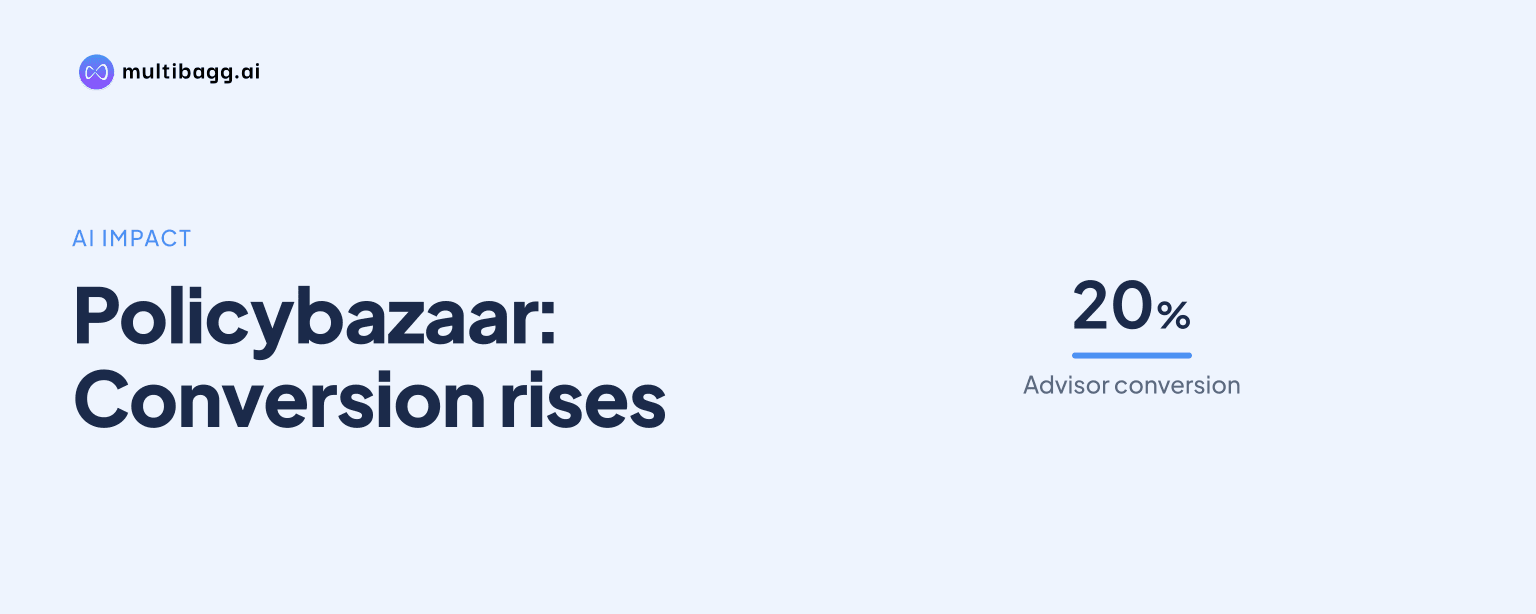
Policybazaar says its AI-enabled sales systems lifted advisor conversion by 20% and average ticket size by 10%, using insights from calls, chats and purchases. The company also reports that its fraud framework averted Rs 9,618 crore of sum assured in FY26, extending AI use beyond sales into pre-issuance risk controls.
Know PB Fintech inside out
Results, valuation, peers and who's buying, in one view.
How did Policybazaar’s AI tools change sales results?
Policybazaar says its customer relationship management systems increased advisor conversion by 20% and average ticket size by 10%. The systems combine intent analysis, lead matching and pitch-quality checks, with the company attributing the outcome to data-driven insights from calls, chats and purchases rather than identifying one tool or a measurement period.
The sales stack covers four stages: preparation, engagement, consultation and coaching. An AI-generated 360-degree profile gives advisors portfolio, renewal and opportunity information before a call; a lead summary identifies requirements and concerns during engagement; Ask with Genie answers underwriting, product and medical queries; and the AI Sales Coach produces call feedback and improvement plans.
Policybazaar estimates that, before AI, advisors spent 60% of their time managing data and 40% speaking to customers. Management aims to move meaningful conversation time to 90%, while the architecture disclosure says 30% of callbacks are auto-scheduled, linking follow-up activity to lead management.
What AI operating scale does Policybazaar report?
Policybazaar says its AI operating system handles about 10 crore customer interactions each month, including 21 lakh calls and 17 lakh conversation minutes daily. It says 100% of calls with more than 60 seconds of talk-time are AI-processed across seven Indian languages, including code-switching.
The company also reports 2.7 lakh emails a day, all AI-polished; 7 lakh documents a day, with 1,000 hours saved daily; and 19,000 chats a day, with AI providing the first reply in every case. Its operations disclosure further lists 20,000 tickets categorised daily through AI triage and 600 gigabytes of data processed each day in real time.
At the infrastructure level, Policybazaar lists a 3-terabyte data lake, 500 gigabytes of daily data ingestion and 2.53 crore documents with personally identifiable information masked. It says its system has more than 2,500 daily reporting pipelines and transcribes 100% of calls longer than 10 seconds through proprietary automatic speech recognition, or ASR.
The disclosure uses different thresholds and language counts for distinct processes. The scale page covers AI processing of calls above 60 seconds in seven languages, while the voice-and-ASR page says all calls are transcribed across nine Indian languages; Policybazaar describes this ASR capability as built in-house and hosted on-premises.
How does Policybazaar use AI in customer service?
Policybazaar says its service AI provides 24×7 availability and delivers 2× faster issue resolution across life, health and motor interactions. Its system creates case summaries across chat, email and calls, while sentiment-aware AI flags frustration and escalates relevant cases to human agents.
For claims, the Claim Processor classifies documents, checks bills and identifies discrepancies. Conversational AI handles health-insurance queries on claims, payments, status updates and policy features, while the Netra Service Coach uses automated call analysis, individual feedback and team-level benchmarking for service teams.
The consumer journey also uses optical character recognition, or OCR, and computer vision for documentation, along with real-time endorsements, one-click refunds, renewals and motor inspection. Policybazaar says its chatbot enhancement responds in under one minute and handles complex queries, but does not quantify the resulting increase in unassisted business.
The AI service model operates alongside physical claims assistance. In H1 FY27, Policybazaar supported more than 1.25 lakh health claims and more than 80,000 motor claims, with on-ground health-claims support in more than 300 cities and about 45,000 motor customers supported through its Assured Delivery Program since Q2 FY25.
Got a follow-up? Ask IRIS
How does Policybazaar apply AI to fraud and insurance risk?
Policybazaar says its risk engine profiles more than 30 parameters per customer and scores every applicant in real time before issuance. Applicants below a risk-score cutoff are sent to insurers for processing, while those above the cutoff are flagged for additional checks.
The model combines current website, mobile-site, telephone, video and meeting interactions with historical enquiries, transactions and claims history. Policybazaar also lists payment-graph data, document verification, biometric checks and identity verification, including deepfake detection, face matching, liveness checks and voice cross-referencing.
Policybazaar says its fraud-detection framework resulted in company-initiated life-insurance cancellations covering Rs 9,618 crore of sum assured in FY26. Those cancellations represented 3.2% of premium and 3.6% of policies across term and savings products, although the presentation does not state the premium value linked to the cancelled cases.
For savings policies, deaths within the first 12 months of issuance fell from 14.4 per 10,000 policies in FY23 to 1.16 in FY25, before increasing to 1.8 in FY26. The FY26 measure remained below FY23 and FY24 but was above FY25, so the reported series did not decline in every year.
What technology is included in Policybazaar’s AI stack?
Policybazaar says its stack includes agentic AI, generative AI, vision OCR, machine-learning pipelines, deeptech risk AI and voice AI. Its architecture has three layers: infrastructure for data, pipelines and security; communication channels including WhatsApp bots and voice AI; and intelligence models for intent, sentiment, classification and risk scoring.
In the intelligence layer, Policybazaar says it uses real-time next-best-action signals, automatically flags sentiment and escalation on every call, and classifies interactions into 250 categories with zero manual sorting. It also lists nine live WhatsApp conversational workflows, Ask Genie handling 100,000 queries a day and an AI coach for 20,000 advisors.
For insurer partners, Policybazaar describes a risk-intelligence engine that filters viable risks using explainable models. Its fraud framework also includes voice biometrics, anti-spoofing, document authentication, payment and booking anomaly detection, third-party checks and manual underwriting review, showing that human review remains part of the disclosed process.
Conclusion
Policybazaar presents AI as part of its sales, service and risk processes rather than as a standalone customer-chat feature. Its clearest commercial claims are a 20% increase in advisor conversion and a 10% increase in average ticket size, while the Rs 9,618 crore of FY26 sum assured risk averted illustrates the separate role of pre-issuance fraud controls.
The next disclosed measure to watch is management’s aim to raise advisor time in meaningful customer conversations from the pre-AI estimate of 40% to 90%. Future risk disclosures will also matter after the FY26 savings-policy death measure rose to 1.8 per 10,000 policies from 1.16 in FY25, alongside the continued rollout of sales, service and claims workflows.