










Paisabazaar held Q2 disbursals flat while expanding lenders
Key highlights
- Paisa said Q2 core credit disbursals were broadly flat sequentially after marketing was not increased aggressively from Q1 to Q2.
- Management said banks added to Paisa’s platform should begin contributing to disbursals in Q3.
- Paisa reported no change in partner underwriting from August to October, while new lending partners joined and expanded.
- PB Pay was a three-month-old operation, while Paisa’s wealth stack includes mutual funds, bonds and fixed deposits.
powered by IRIS
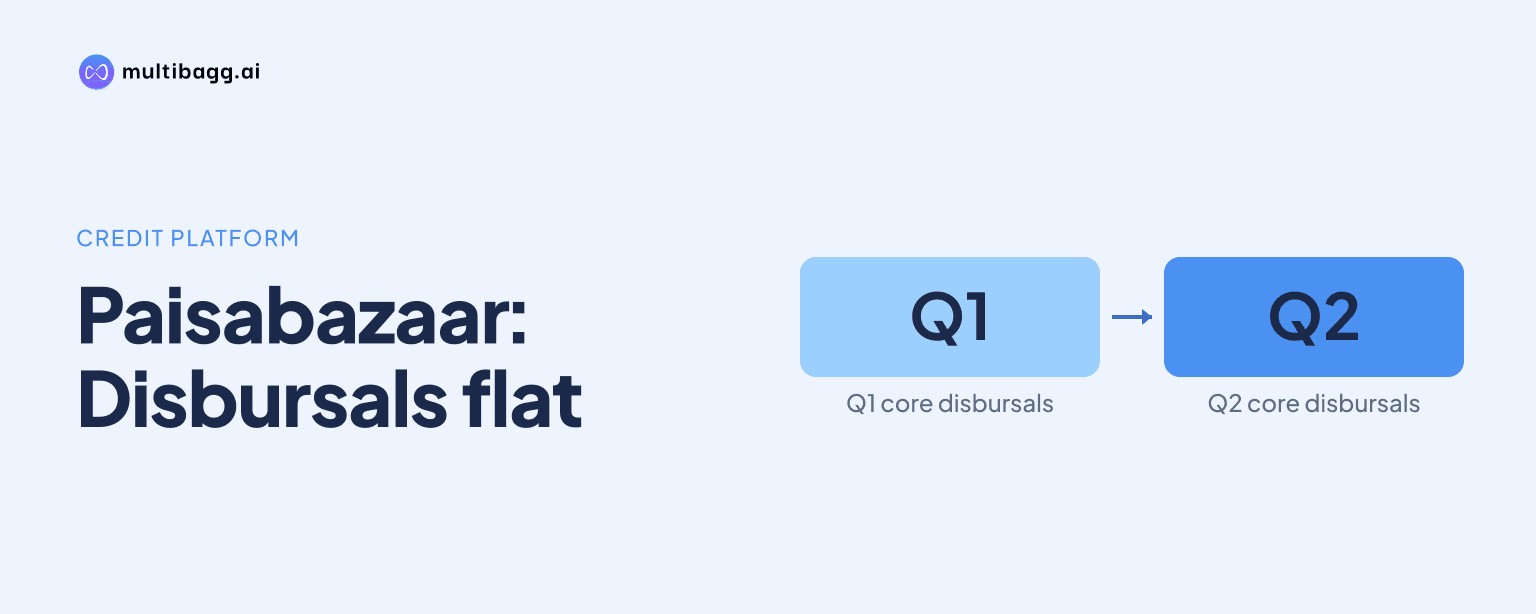
Paisabazaar kept core credit disbursals broadly flat sequentially in Q2 after deliberately limiting marketing growth from Q1 to Q2 while adding lending suppliers and strengthening distribution. Management said newly onboarded banks should begin contributing in Q3, while bill payments, bonds and fixed deposits broaden the platform beyond its historically credit-focused business.
Know PB Fintech inside out
Results, valuation, peers and who's buying, in one view.
Why were Paisa disbursals flat in Q2?
Paisa said its core credit disbursals were broadly flat sequentially in Q2 because it was not aggressive in increasing marketing-driven customer inquiries from Q1 to Q2. Management said it had identified an opportunity to add more partnerships and suppliers for its customer segment, and chose to build that capacity before pursuing faster disbursal growth.
The stated sequence was to add suppliers, strengthen distribution and then go after growth. Management said several banks had been onboarded, with those relationships expected to play out in Q3. This explanation attributes the muted Q2 outcome to a measured marketing approach, rather than to a disclosed fall in lender appetite, customer demand or partner approval rates.
Paisa did not provide a Q3 disbursal target, the number of banks added or the expected contribution from each new lender. It said the business would contribute to the wider group, but management cautioned that this did not make Paisa more important than it had been previously. The immediate objective remains building the platform while maintaining its role in the group.
What is Paisa doing before increasing marketing?
Paisa is adding lenders and applying greater portfolio-quality discipline before raising acquisition marketing. Management said the risk discipline used in the insurance business had become more embedded in Paisa, making it more cautious about the type of credit portfolio generated for lending partners. It said this caution was showing up in the book being built.
That emphasis matters because a larger inquiry funnel does not by itself establish the quality of loans originated through the platform. Management did not disclose credit losses, approval rates, loan categories, borrower segments or partner-level portfolio metrics for Q2. It did, however, say it was being “extremely careful” about book quality while expanding the supplier base.
The approach represents a change in near-term emphasis rather than a retreat from growth. Management said its confidence was not lower than it had been 35 days earlier, although it avoided giving a specific second-half target. Paisa’s strategy is therefore to prepare distribution and lender availability first, then use those additions to support future disbursals.
Have Paisa lenders tightened underwriting?
Paisa said it saw no change in lending-partner underwriting from September to October, or across the August-to-October period. Management added that new partners had joined the platform and expanded during that timeframe. The comment addressed an analyst’s question about whether a potentially more difficult lending environment could lead banks to tighten their criteria.
The disclosed position contrasts with a scenario in which lenders reduce credit availability across the marketplace. Yet the call did not quantify the new partner additions or specify whether expansion occurred in unsecured credit, secured credit or another lending category. Paisa also did not provide monthly disbursal data for August, September or October.
Management’s comments place the platform’s quality controls alongside partner underwriting, rather than presenting them as a replacement for lenders’ credit decisions. Paisa said it is careful about the portfolios supplied to partners, while reporting that partners had not changed their approach over the August-to-October period. The effect of this discipline on growth and loan performance was not quantified.
Got a follow-up? Ask IRIS
How is Paisa expanding beyond credit?
Paisa is moving from a largely credit-focused model into bill payments, consumer engagement and wealth products. Management said it had entered bill payments and was undertaking more work on consumer engagement. It also said the wealth journey was starting, with bonds and fixed deposits among the products taking shape.
Management said some of these offerings will take time to generate revenue. Its intended model is to build a broader financial overview of a customer and, where permitted, assess which product is suitable rather than treating credit, insurance and savings as separate customer journeys. Operational discussions have begun, but management said action depends on what the final regulations allow.
The wealth stack was also described as including mutual funds, alongside bonds and fixed deposits. Management did not say that savings would become a larger category because of regulatory discussions. Instead, it said no such discussion had occurred, while acknowledging that a broader product set could create opportunities to offer more than one financial product to a customer if regulations permit.
What could payments and wealth add to Paisa?
Paisa’s new lines are intended to create engagement and revenue formats beyond core lending. Management described PB Pay as a three-month-old operation that was scaling up, designed to address the insurance industry’s requirements across different payment formats. It did not disclose PB Pay transaction volume, revenue, profitability or a target date for commercial scale.
Management said group teams could be redeployed toward ecosystem businesses as insurance-distribution economics remain subject to final regulations. It said more management focus could shift from operational activity to business growth where other revenue formats are needed. This is a group-level rationale for building payments and other financial-product capabilities, rather than a disclosed forecast for Paisa revenue.
One related scale reference was PB Partners revenue of about Rs 700 crore for the quarter. That was not reported as Paisa revenue and does not measure Paisa’s lending, payments or wealth activity. For Paisa, the call disclosed a Q3 expectation for newly added banks and a product-building agenda, but no standalone revenue, profit or disbursal guidance.
Conclusion
Paisa’s flat sequential Q2 credit disbursals reflected a deliberate decision to hold back marketing while lender relationships and distribution were expanded. The business is also broadening from credit into bill payments, customer engagement, bonds, fixed deposits and mutual funds, although management said newer offerings will take time to contribute revenue.
The next indicator is whether the banks added before Q3 translate into higher disbursals while the platform maintains its stated portfolio-quality discipline. Investors should also watch final regulations, because management said they will determine how Paisa can combine insurance, savings and other financial products, and whether those new product lines can be commercially expanded.