










PB Fintech Says Insurance Industry Q4 Growth May Be Near Zero
Key highlights
- PB Fintech said an 18% GST reduction produced incremental insurance-industry growth of 18% over the first six months.
- Management said Q4-over-Q4 insurance-industry growth may be near 0% as the GST demand effect reverses.
- PB Fintech disclosed quarterly PB Partners revenue of about Rs 700 crore.
- Policybazaar's health fresh take rate was 24%, compared with 31% for motor third-party fresh business.
powered by IRIS
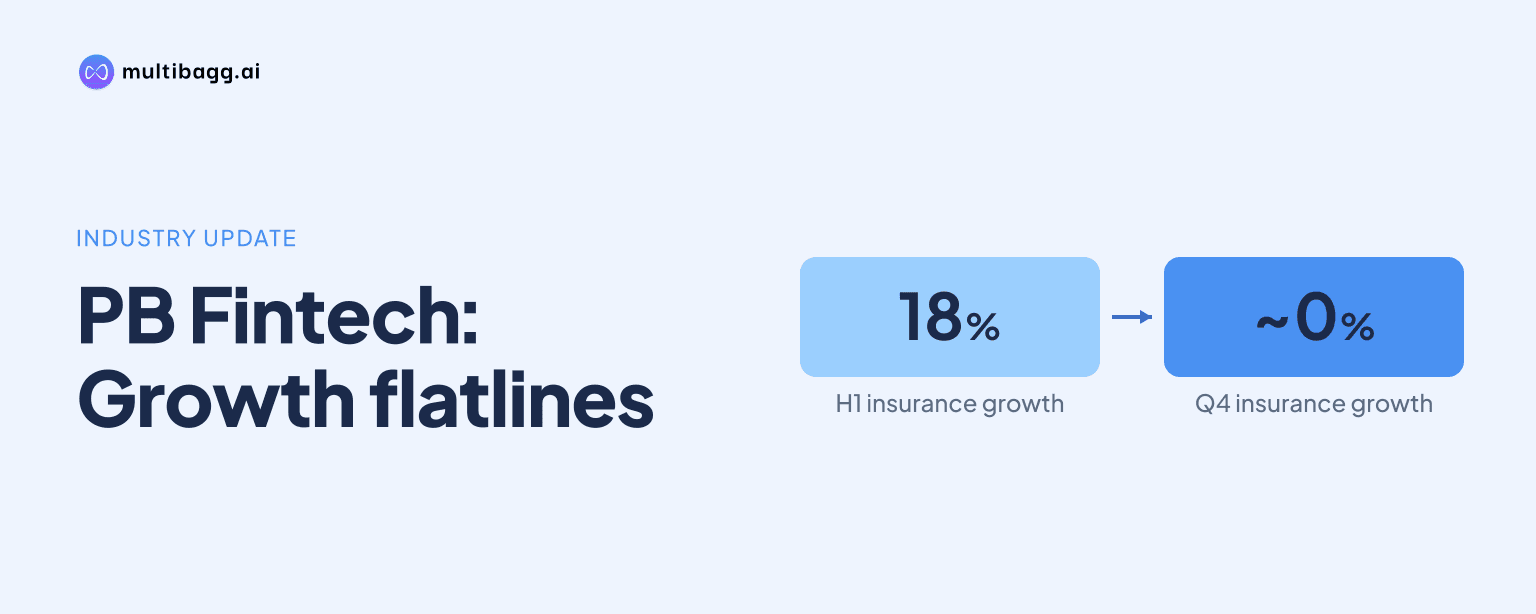
PB Fintech said insurance-industry growth in Q4 may be near zero year on year after an 18% Goods and Services Tax reduction lifted demand by an incremental 18% over the first six months. Management said the tax-driven benefit had largely faded by about March, creating a difficult comparison for new-customer acquisition.
Know PB Fintech inside out
Results, valuation, peers and who's buying, in one view.
Why does PB Fintech expect insurance-industry Q4 growth near zero?
PB Fintech expects Q4-over-Q4 industry growth may not be positive because the 18% GST reduction was passed on to customers and temporarily increased health-insurance demand. Management said the industry recorded incremental growth of 18% during the first six months after the price benefit, which it interpreted as consumer price elasticity of about one over that period.
Management said that demand effect has now ended and the comparison is reversing. It said the GST benefit had largely gone away by about March, so the industry is now comparing against a period of higher acquisition volumes caused by lower customer prices. The possibility of near-zero Q4 growth is management's assessment, rather than company guidance or a reported industry result.
What does the GST comparison mean for PB Fintech's growth?
PB Fintech said the immediate effect will be visible in reported new-customer growth at Policybazaar. Management said there was no way the post-GST demand response would not affect short-term visible growth numbers, particularly after an 18% customer-price reduction accelerated purchases in the first six months.
Management asked investors to consider the two-year growth rate through the next one or two quarters rather than rely solely on year-on-year comparisons. Its argument is that the temporary GST-driven increase and the subsequent reversal can distort annual growth rates, while the underlying customer base spans a longer period than a single Q4 comparison.
PB Fintech identified renewals as the offsetting factor. Customers who bought policies immediately after the GST change are continuing to renew, management said, even though the initial new-business demand surge has faded. That separates the pressure on fresh acquisition from the renewal stream from customers acquired during the lower-price period.
Which insurance products and operating indicators did PB Fintech disclose?
PB Fintech did not provide monthly October sales data for unit-linked insurance plans, or ULIPs. Instead, management said it has continued to promote waiver-of-premium products, under which an insurer pays future premiums if something happens to the customer, and described ULIPs as products for protecting long-term goals over 5, 10 or 15 years.
PB Fintech said its health fresh take rate was 24%, compared with 31% for motor third-party fresh business. Management said the motor figure reflected the Point of Sales Person, or POSP, business, and said discussions with the regulator had improved understanding of the core Policybazaar business and its role in customer decision-making and claims support.
The two take-rate figures do not measure expected Q4 industry growth. They instead describe the economics of particular fresh-business segments, with the 31% motor third-party rate exceeding the 24% health rate by 7 percentage points. Management also said it expects its regulatory conversations to continue.
Got a follow-up? Ask IRIS
How is PB Fintech adjusting costs and building other revenue streams?
PB Fintech said it will align marginal costs with the net present value, or NPV, available under the final regulatory framework, while retaining its focus on growth, customer proposition and quality. Management illustrated the approach by saying that if marginal NPV fell from X to 0.5X, marginal spending should also fall to 0.5X, but it did not disclose revised NPV or internal rate of return calculations.
Management said it would not withdraw customer propositions such as maternity cover, even though it earns zero commission on day one for that product. It also said it would preserve its ability to generate and convert inquiries, while more closely assessing marginal marketing spending, including whether sales credited to an influencer campaign would have occurred without it.
PB Fintech said its artificial-intelligence investment has run for multiple years, including experiments and projects over the past 18 months. Management said this work can sharpen cost-cutting analysis, while October hiring was a very small fraction of its previous level; capital expenditure had principally supported office expansion and staff capacity.
Can PB Fintech reduce its reliance on insurance-distribution revenue?
PB Fintech said it may redeploy management teams toward ecosystem businesses if insurance-distribution revenue declines. Management said those teams could shift from operating activities toward business growth, while the group currently performs between two-and-a-half and three-and-a-half of the activities undertaken by insurers.
PB Fintech said Paisa is building bill payments, consumer engagement and wealth products including bonds and fixed deposits. These businesses will take time to add revenue, management said, while PB Pay was only three months old and was scaling to support the insurance industry's different payment formats. PB Partners revenue was about Rs 700 crore for the quarter.
On Paisa lending, PB Fintech said it had seen no change in partner underwriting from September to October, or from August to October, and that some new partners had joined and expanded. Potential cross-selling of mutual funds, bonds, fixed deposits and insurance remains subject to final regulations, although management said operational conversations have begun.
Conclusion
PB Fintech's central message is that an 18% GST reduction created an 18% incremental industry-growth effect over six months, but now leaves a difficult Q4 comparison that could produce near-zero year-on-year industry growth. Management distinguishes that temporary pressure on fresh acquisition from continuing policy renewals from the customers acquired after the tax change.
The next issue to watch is the final regulatory framework and PB Fintech's response to it. Management said it will calibrate marginal costs to the available NPV, continue discussions with core partners and assess permitted product categories, while asking to be judged 1,000 days after the final regulation rather than over the next one or two quarters.