










PB Health targets Rs 500 crore annualised revenue by March
Key highlights
- PB Health targets a Rs 40-45 crore monthly revenue run rate around March, or about Rs 500 crore annually.
- Management said PB Health should be broadly break-even after corporate costs and one or two greenfield operations.
- Management will maintain its current stake in PB Health, with no plan to increase or reduce it.
- Management said insurance now settles about 40% of hospital bills, compared with 1% in 2008.
powered by IRIS
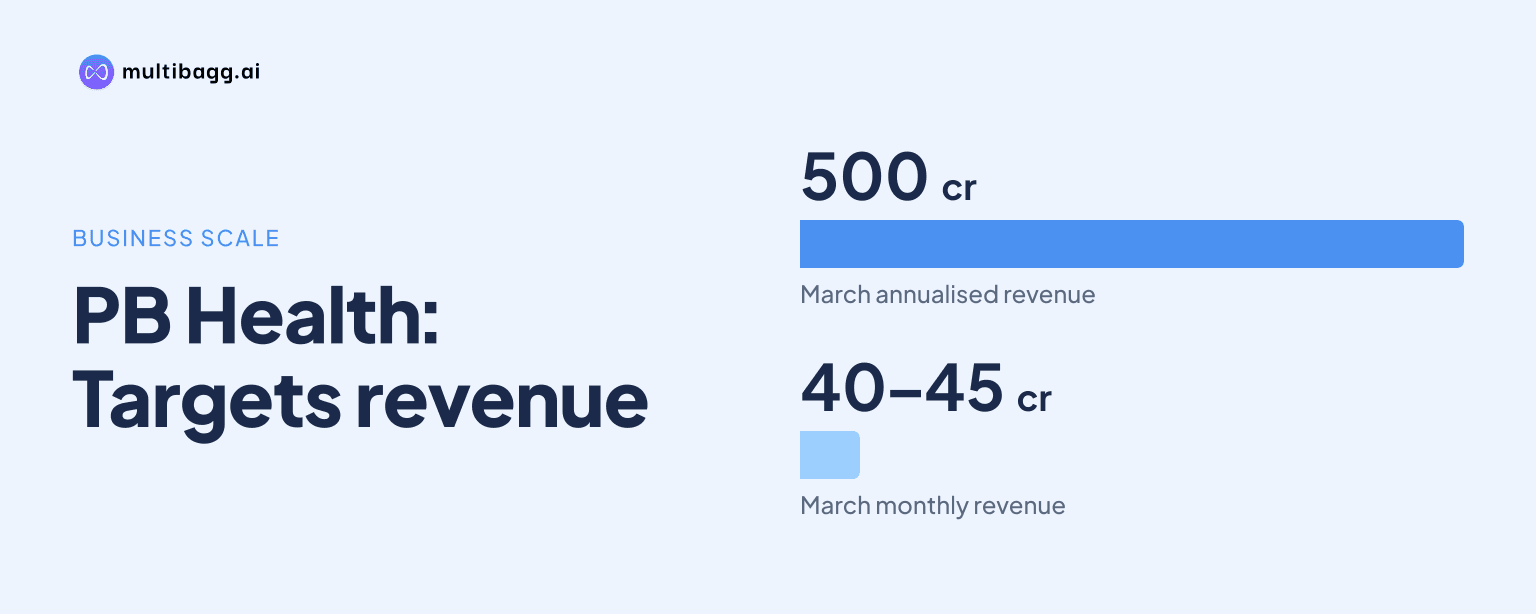
PB Health is targeting a Rs 40-45 crore monthly revenue run rate around March, equal to about Rs 500 crore on an annualised basis, while management expects the hospital business to be broadly break-even and said its existing stake will remain unchanged. The target depends on executing several new hospitals, including already operating properties.
Know PB Fintech inside out
Results, valuation, peers and who's buying, in one view.
What revenue is PB Health targeting by March?
PB Health is targeting a Rs 40-45 crore monthly revenue run rate around March, which management said equates to about Rs 500 crore for a year. Management linked that target to the execution of a few new hospitals and to running hospitals that already generate profit.
The Rs 40-45 crore monthly figure is a run-rate target, rather than a reported full-year revenue result. Management did not disclose PB Health's current revenue, the number of hospitals currently operating, or the date on which it expects to report a completed Rs 500 crore annual revenue figure.
Management said execution had not changed during the preceding quarter. Its explanation for the March target was that some properties are already running hospitals, meaning PB Health does not need to invest heavily in them before they contribute revenue and profit.
Is PB Health expected to break even as it expands?
PB Health is expected to be broadly break-even during the current execution phase because some running hospitals are profitable, while the main remaining costs are corporate operating expenditure and one or two greenfield operations. Management did not provide an operating-profit amount, margin or consolidated financial contribution for PB Health.
The near-term priority is to execute and stabilise the properties already in hand, rather than to pursue aggressive growth immediately. Management placed that stabilisation phase at the next six months to one year, after the targeted Rs 40-45 crore monthly revenue run rate around March.
That sequence makes the Rs 500 crore annualised level an operating-scale objective rather than a statement of a completed, mature hospital network. Management said it wants to gain confidence from executing the current pipeline before considering a more aggressive growth phase.
When could PB Health manage hospitals outside its balance sheet?
PB Health has not set a specific timetable for offering hospital-management services to properties outside its balance sheet. Management said it first wants experience from managing three to five properties, which it expects will create a steep learning curve for the team.
Management indicated that it could begin considering such options from about 18 months onwards, while describing that possibility as still some distance away. It did not commit to third-party hospital-management contracts, disclose expected revenue from them, or identify potential hospital partners.
For the next six months to one year, PB Health's stated task is executing and stabilising the hospitals already in its pipeline. The potential move from three to five managed properties into external hospital-management work would therefore follow, rather than replace, the current plan to build operational capability.
Got a follow-up? Ask IRIS
How does PB Health fit into claims and network management?
PB Health is intended to improve health-insurance claims outcomes and healthcare-network management, rather than maximise profit from each patient visit, management said. It identified non-disclosure of pre-existing diseases and treatment that may not be required as two major reasons claims are denied.
Management compared the current market with 2008, when insurance settled 1% of hospital bills. That share later rose to about 10% and now stands at about 40%, according to management, indicating that insurance has become a much larger source of hospital payments even as claims-related concerns persist.
PB Health is intended to provide a benchmark for consumer lifetime value in network management. Management said its objective is to treat customers without an intent to make the maximum from every visit, while related PB Care+ activities have become more important as the company addresses claims and network issues.
Policybazaar historically focused on better customer disclosures and has increasingly worked on network management, according to management. PB Health extends that approach into hospital operations, connecting the venture to claims experience and the management of healthcare networks rather than solely to hospital-level profit.
Will PB Health change its plan or ownership structure?
PB Health's business plan has not changed, and management said the project is neither speeding up nor slowing down. It reiterated that the venture remains important, while associated activities such as PB Care+ have become increasingly relevant to network management and claims support.
Management said it will maintain its stake at the current level, with no plan to increase or reduce it. The transcript did not disclose the size of that stake, PB Health's valuation, or a timetable for reviewing its ownership structure.
The next disclosed marker is operational: executing new hospitals to reach a Rs 40-45 crore monthly revenue run rate around March. The stated focus on stabilising existing properties before aggressive growth also means the source provides no estimate of longer-term capital requirements.
Conclusion
PB Health has set a near-term scale target of Rs 40-45 crore in monthly revenue around March, or about Rs 500 crore annually, while management expects the mix of profitable running hospitals, corporate costs and one or two greenfield sites to leave the business broadly break-even. Its stated purpose is to support better claims outcomes through disclosure and network management as insurance's share of hospital-bill settlements has risen from 1% in 2008 to about 40%.
The next development to watch is execution over the coming six months to one year, when PB Health plans to stabilise properties already in hand. Management also identified a possible decision point from about 18 months onwards, when experience managing three to five properties could lead it to assess hospital-management opportunities outside PB Health's balance sheet.